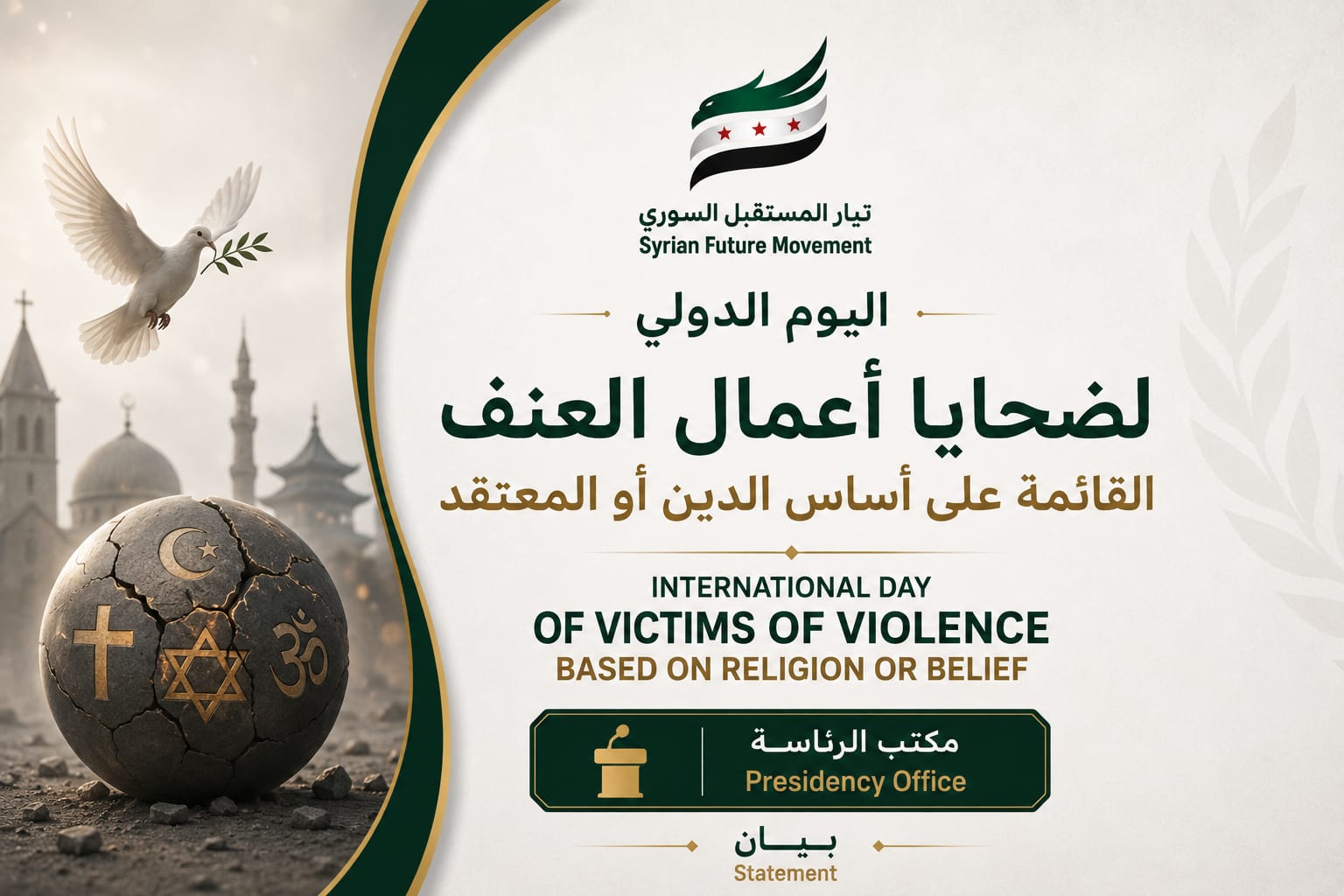
The Syrian Future Movement joins the international community, human rights organizations, and the United Nations in commemorating the International Day Commemorating the Victims of Acts of Violence Based on Religion or Belief, observed annually on August 22nd.
This is a major humanitarian and ethical milestone, awakening the global conscience to confront persecution, honoring the memory of innocent victims who paid with their lives for their spiritual identity, and protecting diversity as a fundamental element of human civilization.
We in the Syrian Future Movement see this occasion as a crucial opportunity to re-evaluate the current Syrian landscape. Our country has suffered throughout the years of war from the proliferation of transnational extremist rhetoric and the exploitation of exclusionary ideologies by various parties to ignite societal strife. This compels us, as a national movement, to navigate the transitional phase with a conscious awareness that blocks the path to hatred and establishes a social contract that respects beliefs and ensures that citizenship alone is the umbrella for all.
The intellectual discourse of the Syrian Future Movement regarding religious freedoms rests on firm ethical foundations:
- The value of absolute freedom of conscience: Faith and belief are a sublime, voluntary relationship between the individual and their Creator. Any use of coercion or violence in the name of religion is a distortion of divine messages and an assault on human dignity.
- Spiritual pluralism as a national heritage: The richness of diverse sects, schools of thought, and religions in our homeland is not a security concern, but rather a mosaic of depth that grants Syrian identity its distinctiveness and historical significance.
- Transitional justice and redress for victims: A commitment to uncovering the truth, holding perpetrators of sectarian crimes accountable, and compensating victims is a fundamental condition for healing psychological wounds and achieving national reconciliation.
The Syrian Future Current’s readers base their analysis on a database and statistics that reflect the immense price paid by the Syrian people as a result of hate speech and systematic exclusion:
- Targeted Religious Sites: Cumulative human rights reports have documented the total or partial destruction of at least 1,420 religious sites due to the conflict and the repression by the Assad regime and extremist groups. These include 1,285 mosques (among them historical landmarks such as the Umayyad Mosque in Aleppo) and approximately 135 churches, monasteries, and Christian sites (particularly in Homs, Aleppo, and eastern Syria).
- Victims of Direct Targeting: Field data indicates that sectarian or religiously motivated massacres perpetrated by extremist organizations or transnational sectarian militias have resulted in the deaths of more than 24,500 Syrian civilians based on their religious or sectarian identity since 2011.
- Forced Displacement and Demographic Change: Violence based on religion or belief has led to the depopulation of entire historic towns. The Christian population in Syria has declined from approximately 10% before the war to less than 3.5% in 2026 as a result of mass forced displacement. Nearly 1.2 million Syrian citizens have been internally and externally displaced due to their religious or ethnic affiliation (such as the Yazidis and other groups in the north and east of the country).
- Detainees and the Forcibly Disappeared: Approximately 12,000 Syrian citizens are being held in official and unofficial detention centers and prisons run by various parties to the conflict. They were targeted or detained directly because of their intellectual positions or their religious and spiritual backgrounds, without fair trials.
The Syrian Future Movement presents its strategy for building a state of law and citizenship through the following pillars:
- Separating Religion from Partisan Political Conflicts: We believe that protecting religion from distortion and protecting politics from monopolization requires building a state of institutions that stands at an equal distance from all religions and sects and prevents the use of religious platforms for incitement or negative political mobilization.
- Citizenship that Embraces Diversity: In the new Syria, rights and duties must be linked to belonging to the Syrian land and upheld by law, without any discrimination or favoritism based on ethnicity, gender, or religion.
- Confronting Extremism with Intellectual and Developmental Alternatives: Eradicating takfiri ideology cannot be achieved through purely security-based approaches, but rather by opening up spaces for democratic expression, or what we have termed “consultative democracy,” reforming the education system, and raising economic development rates in marginalized areas.
The Syrian Future Movement submits the following legislative and procedural recommendations to national and international bodies:
- Constitutionalizing the Prohibition of Discrimination and Hate Speech: We recommend that the upcoming Syrian constitution, once stability is achieved, include clear and codified provisions criminalizing incitement to violence and discrimination based on religion or belief.
- A National Program for Restoring and Maintaining Endowments and Historical Sites: Launching a participatory national initiative with community and international contributions to rebuild damaged historical mosques and churches as a symbol of the return of the spirit of Syrian fraternity.
- Establishing the “National Observatory for Civil Peace and Countering Extremism”: An independent body comprising legal and social experts and intellectual elites from all segments of society, to monitor and dismantle exclusionary rhetoric and provide awareness-raising consultations to public and private institutions.
- Launching the “Demographic Rescue and Trust-Building” project: We recommend immediate action with the United Nations High Commissioner for Refugees (UNHCR) to develop urgent protection programs that guarantee the safe return of communities subjected to systematic displacement, and to halt all measures of demographic change or illegal appropriation of real estate and endowments, in order to restore natural population ratios and preserve the Syrian mosaic from complete extinction.
- Reforming educational curricula: Purging school curricula of any concepts that promote intolerance, and incorporating the values of human rights and tolerance, while highlighting Syria’s diverse cultural heritage to strengthen shared human values.