Introduction:
Islam established for women full legal capacity and complete rights, unrestricted by any limitations except those prohibited by God and His Messenger. It made women partners with men in building society, a principle enshrined in Article 45 of the Constitution of the Syrian Arab Republic. This article guarantees women all opportunities that enable them to contribute effectively and fully to political, social, cultural, and economic life, and works to remove any obstacles that hinder their development and participation in building society.
In this context, and as Syria enters a new phase of state-building and institution development, the urgent need arises to review the legislative system, particularly the Personal Status Law, to ensure its alignment with the demands of the times and the achievement of justice between spouses.
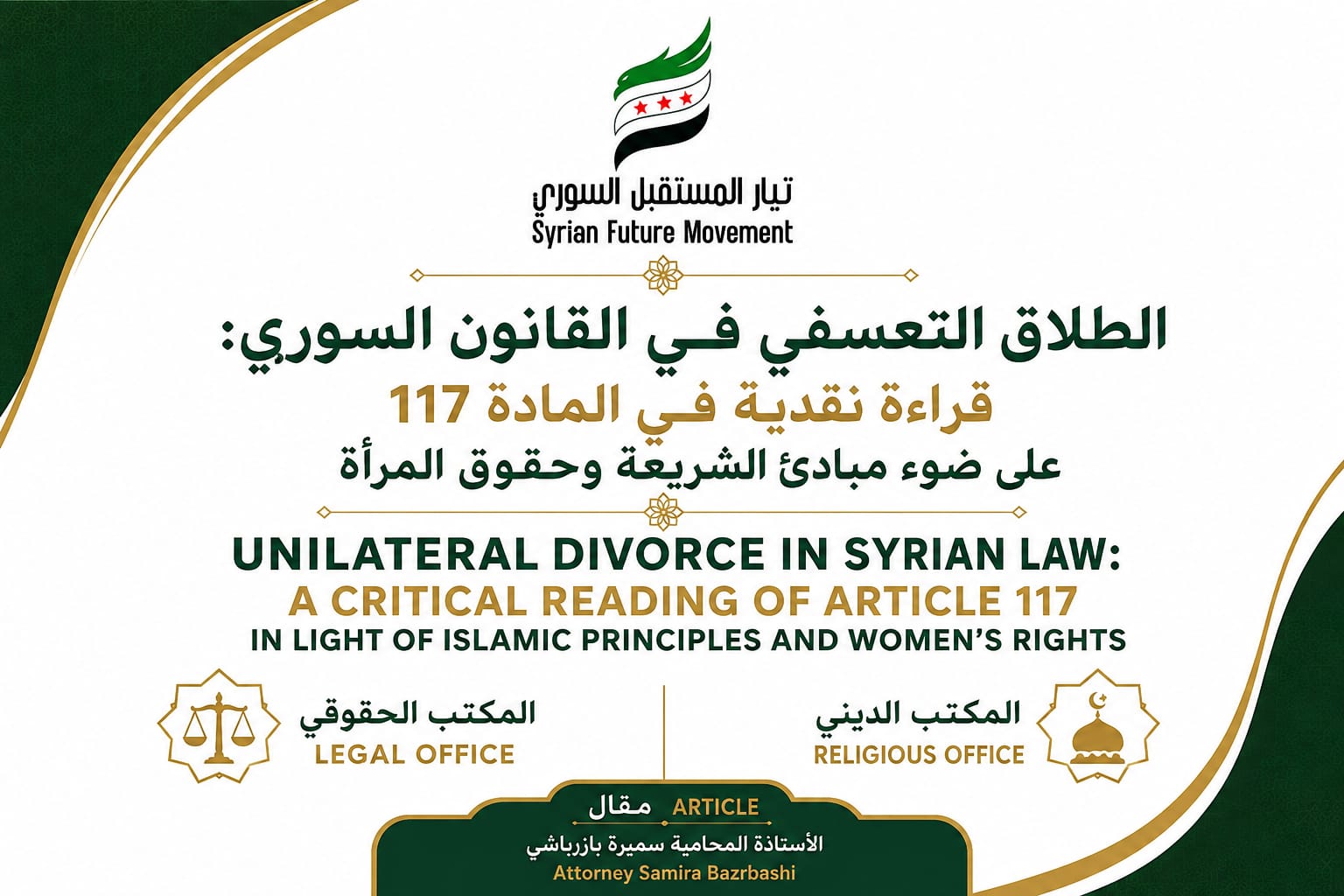
The Syrian Personal Status Law, issued by Legislative Decree No. 59 of 1953, despite subsequent amendments, still contains provisions that require reconsideration. Foremost among these is Article 117, which pertains to arbitrary divorce. This article exemplifies a legislative loophole that disrupts the balance between the rights of spouses and contradicts the spirit of Islamic Sharia, which has always surrounded women with care and dignity.
The Legislative Framework for Arbitrary Divorce in Syrian Law:
Divorce in Syrian law is of two types: revocable divorce (the first or second divorce, during which the husband has the right to take his wife back without a new marriage contract).
irrevocable divorce (occurs upon the expiration of the waiting period of a revocable divorce without reconciliation, or upon the pronouncement of the third divorce).
Within the framework of regulating the husband’s right to divorce, Article 117 of the Personal Status Law stipulates compensation for the wife if her husband divorces her arbitrarily.
However, the original text of the article—before the 2019 amendment—contained unfair conditions, namely:
First: the condition of hardship and destitution. The text required that the wife suffer “hardship and destitution” as a result of the arbitrary divorce, a condition that is difficult to prove and is negated as soon as the wife seeks refuge with her family or obtains employment. This deprives her of her legitimate right to compensation, even if she suffers significant moral and psychological harm.
Second: The three-year alimony limit. The legislator left the determination of alimony to the judge’s discretion, stipulating that it should not exceed three years’ worth of alimony, taking into account the husband’s financial circumstances. This amount is disproportionate to the realities of life and its ever-increasing demands.
Third: Lengthy legal proceedings. Divorced women face a series of protracted procedures, delays, and instances of coercion employed by husbands to evade compensation, exacerbating their psychological and financial suffering.
The 2019 legislative amendment and its challenges:
The issuance of Law No. 4 of 2019 marked a qualitative shift in the concept of compensation for arbitrary divorce, transforming it from a form of “social assistance” contingent on poverty into a “legally binding right.”
The amendment eliminated the unjust condition of “misery and destitution,” and compensation became based on the “theory of tort liability,” whereby the wife is entitled to compensation once arbitrary divorce is proven, regardless of her financial situation.
Article 117, as amended, stipulates that “If a man divorces his wife and the judge determines that the husband was abusive in divorcing her without reasonable cause… she is entitled to compensation not exceeding three years’ alimony for someone in her situation.”
Despite this legislative progress, several gaps remain that need addressing:
- The continued restriction to a three-year limit is an amount that does not reflect the extent of the moral and psychological harm inflicted on the divorced woman, nor does it reflect the rising cost of living.
- Leaving the judge’s discretionary power without clear criteria could lead to inconsistencies in rulings.
- The absence of provisions that deter husbands from delaying the implementation of compensation rulings. The reality of divorce in Syria in numbers:
- Statistics—most of which are based on the author’s field research—reveal a worsening social crisis that makes amending Article 117 an urgent necessity:
Syria ranked seventh in the Arab world in divorce rates for 2024.
Approximately 40% of marriages in Syria end in divorce.
Divorce rates in Syria have increased by as much as 35% over the past five years.
During the first half of 2026, 416 divorces and 1,358 annulments were registered, reflecting a growing number of families resorting to ending their marriages.
Statistics from the Central Bureau indicate that 24,710 out of 30,284 divorces involved men significantly older than their wives, representing 81.59%.
60% of young people are reluctant to marry due to difficult economic conditions and high dowries.
These figures reflect a worrying reality and underscore the need for legislation that protects families from disintegration and guarantees women’s rights in the event of divorce.
Arbitrary Divorce in Light of Islamic Law and Positive Law:
In Islamic Law:
Islamic law does not leave women vulnerable to abuse, but rather surrounds them with comprehensive protection in the event of divorce.
The Holy Quran commands kind treatment and mandates alimony for women upon divorce. God Almighty says: “And for divorced women is a provision according to what is acceptable—a duty upon the righteous” (Al-Baqarah: 241).
This provision is not a favor from the husband, but a legal right due to honor the divorced woman and console her.
Furthermore, Islamic law forbids tampering with the marriage contract, which God has made a “solemn covenant.” Divorce should not be a plaything in the hands of those who trifle with it, and the future of families and children should not be held hostage to the whims of a capricious man. Compensation for arbitrary divorce embodies the principle of “harm must be remedied” and “no harm shall be inflicted or reciprocated.” It is a legitimate right based on the act of divorce without cause, not on the state of poverty.
In positive law:
Compensation for arbitrary divorce in Syrian law is based on the theory of tort liability, which stipulates that whoever causes harm to another is obligated to compensate them.
A divorce initiated unilaterally without reasonable cause constitutes harm to the wife, necessitating material and moral compensation, regardless of her financial situation.
Furthermore, modern legal philosophy tends towards protecting “the right to family stability” as a fundamental human right that cannot be violated without legitimate justification.
Practical challenges in implementing Article 117:
Despite the 2019 legislative amendment, the implementation of Article 117 faces several challenges:
First: The difficulty in proving arbitrariness. “Reasonable cause” remains a flexible concept subject to the judge’s discretion, which may lead to inconsistencies in rulings. Second: The complexities of proving poverty and destitution in the old text. Although this condition was removed in the amendment, some judicial practices may still be affected by it.
Third: Lengthy judicial procedures. Divorced women suffer from the slow pace of litigation, which exacerbates their psychological and financial suffering and encourages ex-husbands to delay proceedings.
Fourth: Weak legal awareness. Many women lack knowledge of their legal rights, preventing them from claiming the compensation they are entitled to.
A future vision for amending Article 117:
Based on the necessity of protecting the Syrian family and ensuring its stability, and from our national duty to build a state of law and institutions, we propose the following amendments to Article 117:
First: Eliminating the three-year limit. Compensation should be proportionate to the actual extent of the harm, without being restricted by a rigid time limit, taking into account the duration of the marriage, the wife’s age, and her social and health circumstances. Second: Making compensation a mandatory right. Whenever arbitrary divorce is proven, the wife is automatically entitled to compensation without needing to prove additional harm, as stipulated in the amended article.
Third: Establishing clear criteria for assessing compensation and setting objective standards for judges, including the duration of the marriage, the number of children, the wife’s age, and the standard of living during the marriage.
Fourth: Expediting the review of alimony cases by enacting legislation that obligates courts to adjudicate alimony claims within a specific timeframe, thus preserving the dignity of women, which Islam has bestowed upon them.
Fifth: Increasing penalties for delays in compensation payments by imposing fines on husbands who delay implementing compensation rulings, in order to protect the rights of divorced women.
Sixth: Launching legal awareness campaigns to inform women of their rights to compensation for arbitrary divorce and the mechanisms for claiming it.
Conclusion:
Marriage is a contract that God has made a “solemn covenant.” It should not be a plaything in the hands of those who trifle with it, and the future of families and children should not be held hostage to the will of an arbitrary man.
A woman who spends her youth and money building her family, only to be divorced without just cause, does not deserve to be left prey to poverty or complex bureaucratic procedures.
The amendments to Article 117 in 2019 were a step in the right direction, but they are insufficient.
It is time to reconsider this text so that it truly redresses the harm done, protects the family from disintegration, and establishes a legal culture that respects women’s dignity and safeguards their rights, in accordance with the spirit of Islamic law and the aspirations of the Syrian people to build a state of law and institutions.
For harm can be remedied, justice is the foundation of governance, and protecting the family is protecting society as a whole.