
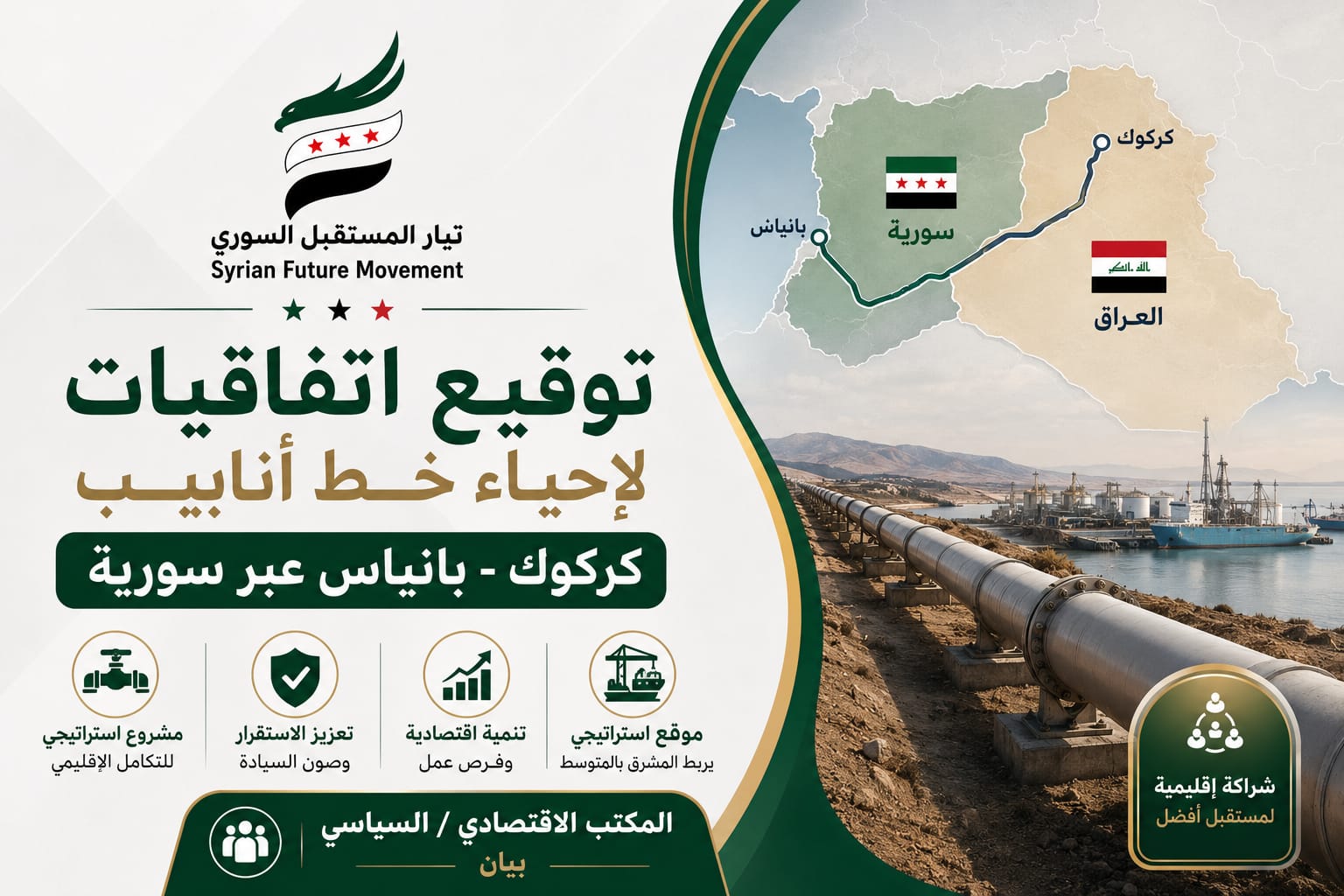
The Syrian Future Movement is following with interest the Republic of Iraq’s announcement of agreements with several Western companies to revive the Kirkuk-Banias pipeline project through Syrian territory. This project is considered strategic and can contribute to revitalizing regional economic cooperation and strengthening Syria’s position as a transit country linking the Levant and the Mediterranean.
The Syrian Future Movement believes that cross-border infrastructure projects should not be viewed solely from an economic perspective, but also as tools for enhancing stability, encouraging regional integration, and creating new opportunities for development and investment, provided they are managed based on principles of national sovereignty, transparency, and the public interest.
The Syrian Future Movement emphasizes that the success of this project requires a stable political, legal, and security environment, and competent national management that ensures the protection of strategic resources and maximizes benefits for the Syrian people, free from any sectarian considerations or narrow interests.
The Syrian Future Movement calls for investing in this project within a comprehensive national vision that includes developing the port of Banias, upgrading transportation and energy infrastructure, and enhancing Syria’s capacity to become a regional energy and logistics hub. This will positively impact the national economy, job creation, and reconstruction efforts. The Syrian Future Movement emphasizes that any agreements or strategic projects affecting Syria’s national resources or geopolitical position must be based on the principle of transparency, respect the interests and sovereignty of the Syrian state, and adhere to the legal and institutional frameworks that guarantee the preservation of the rights of future generations.
The Syrian Future Movement notes that this development aligns with the strategic vision previously presented by the Presidential Office in its article published on July 14, 2026, entitled: “The Kirkuk-Banias Pipeline and the New Geopolitical Game in the Levant.” This article addressed the geopolitical and economic dimensions of the project and the importance of transforming Syria from a mere transit country into an active regional partner in the energy and logistics sector, thereby strengthening its economic and strategic position and serving its long-term national interests.
Based on this, the Syrian Future Movement proposes the following:
First: The formation of a specialized Syrian national committee comprising representatives from governmental, economic, legal, and technical bodies to study the project and monitor its details and strategic implications.
Second: Transparently announcing the nature of the agreements related to the project, its financing mechanisms, implementing entities, and associated legal and sovereign guarantees.
Third: Preparing a comprehensive national feasibility study that identifies the expected economic returns for Syria and the project’s impact on the energy, transportation, employment, and local development sectors.
Fourth: Linking the pipeline’s reactivation to an integrated plan for developing the Banias port, upgrading refineries, and upgrading storage and transportation networks and related logistics services.
Fifth: Ensuring that Syrian expertise and national companies are key partners in the rehabilitation, implementation, operation, and maintenance phases.
Sixth: Establishing a joint security framework to protect the pipeline route and its facilities, and to prevent acts of sabotage, smuggling, and attacks, while fully respecting the sovereignty of each country.
Seventh: Developing a clear legal mechanism for resolving any potential disputes, in a way that preserves Syrian and Iraqi rights and prevents the project from being subjected to political pressure or external monopolies.
Eighth: Expanding regional dialogue on the project, particularly with countries involved in energy corridors, to transform competition into opportunities for economic integration.
Ninth: Allocating a portion of the anticipated revenues to the development of Syrian regions through which the pipeline passes, improving services and infrastructure, and creating sustainable job opportunities for their residents.
Tenth: Studying the future development of the project to become the nucleus of an integrated regional economic corridor, encompassing energy pipelines, railways, international roads, fiber optics, and industrial and logistics zones.
The Syrian Future Movement expresses its hope that this project, if completed and implemented, will constitute a significant step towards strengthening economic cooperation among the countries of the region and transforming shared interests into a pillar of stability and development, serving their peoples and enhancing opportunities for peace and prosperity.
The Syrian Future Movement affirms that the strategic visions previously published by the Presidential Office and the recommendations contained in this statement issued by the Economic/Political Bureau reflect a comprehensive institutional approach aimed at leveraging regional opportunities to serve the building of a modern Syrian state and strengthen its economic and geopolitical position within its Arab and regional environment.