
There are several controversial legal questions surrounding the trial of the accused, Atef Najib. To understand the most important of these points, we must review the following questions and answers:
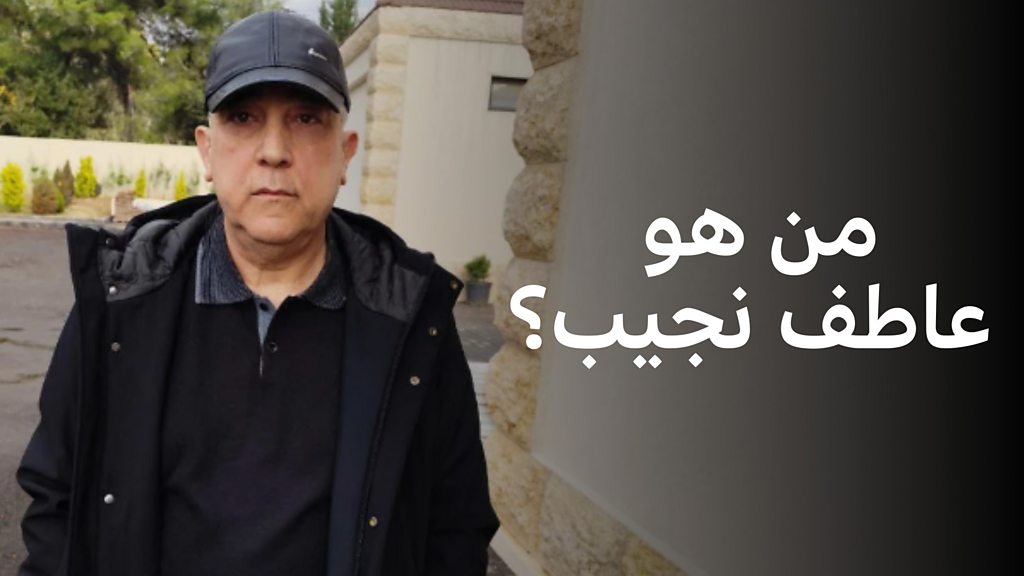
1- Who is Atef Najib?
Atef Najib is a retired brigadier general and the former head of the Political Security branch in Daraa Governorate in early 2011. He is a cousin of former President Bashar al-Assad. He was born in 1960 in the city of Jableh in Latakia Governorate. He joined the Military Academy in Homs and then the Political Security Directorate.
2- What was Atef Najib’s role in the Syrian Revolution?
In February 2011, fifteen children in Daraa wrote political slogans against the Assad regime on their school walls. The Political Security Directorate in Daraa, headed by the accused Atef Najib, intervened, arresting and torturing these children. Among them was Hamza al-Khatib, then thirteen years old, who died as a result of the torture.
These brutal and aggressive practices sparked a wave of popular protests in Daraa Governorate, leading to anti-regime demonstrations demanding the regime’s downfall and the trial of the criminal Atef Najib. These demonstrations were met with direct gunfire from security forces.
This popular uprising spread to several Syrian governorates, making Atef Najib the primary and direct instigator of the Syrian revolution.
3- What was the Syrian regime’s reaction to these legitimate protests?
The Syrian regime suppressed these protests with live fire, arrests, systematic torture, and the shelling of cities with lethal weapons, instead of containing the situation, implementing comprehensive reforms, and punishing Atef Najib, the primary and direct perpetrator of the violations and the torture of children and detainees.
The Fall of the Assad Regime and the Victory of the Syrian Revolution:
On December 8, 2024, after a swift eleven-day offensive led by Syrian opposition factions, the Assad regime fell. This followed President Bashar al-Assad’s flight to Moscow. Thus, the Syrian revolution triumphed after nearly fourteen years of political and armed struggle against one of the world’s most brutal regimes.
Atef Najib: From Power to Prison:
The criminal Atef Najib was arrested on January 31, 2025, in Latakia Governorate, following a meticulous intelligence operation that involved approximately two weeks of surveillance. The operation relied on precise information about his whereabouts and culminated in the encirclement of the area and his arrest without any clashes. This was part of the tireless efforts of the General Security Directorate of the Syrian Ministry of Interior.
The defendant, Atef Najib, was brought to trial on April 26, 2026, for the first hearing. This preliminary session was punctuated by revolutionary chants from the families of martyrs, detainees, and victims, demanding a fair trial and the imposition of the harshest penalties. The hearing took place in the Palace of Justice in Damascus before the Fourth Criminal Court.
On May 10, 2026, he was brought to his first interrogation session, during which the indictment was read and the interrogation began. Procedures included measures to protect witnesses, and live media coverage was suspended at a certain stage of the trial to safeguard their identities.
On May 17, 2026, he was brought to his second interrogation session, where he denied the charges and crimes attributed to him, including the involvement of the Political Security Branch in the storming of the Omari Mosque.
The defendant, Atef Najib, faced several primary charges, including:
- Murder.
- Torture.
- Kidnapping.
- Arbitrary arrest.
- Abuse of minors.
- Abuse of power.
- Issuing unlawful military orders.
In addition to committing several massacres, most notably the massacre at the Omari Mosque in Daraa.
The prosecution is the Public Prosecutor’s Office in Damascus, in addition to the private plaintiffs, who are the families of the martyrs and the victims’ relatives, numbering seventy-five plaintiffs.
The accused, Atef Najib, appointed lawyer Muhammad Firas Abdul Wahab to defend him.
Legal Analysis of the Trial of the Accused Atef Najib:
The following shortcomings can be noted in the trial proceedings of the accused Atef Najib:
First:
The Syrian Penal Code issued in 1949 lacks explicit and clear definitions of crimes against humanity and war crimes, and fails to stipulate appropriate penalties for these acts, which form the basis of the charges against the accused Atef Najib and the crimes attributed to him.
This contradicts the general principle in the penal code that states:
“There is no crime or punishment except by legal provision.”
Therefore, these acts and crimes fall under the category of ordinary crimes stipulated in the penal code, not crimes against humanity or war crimes, as the Syrian penal code lacks definitions of these crimes and provisions for their punishments.
Second:
The trial of Atef Najib at this time is premature, given the absence of a comprehensive legal framework for transitional justice and the lack of an elected parliament to assume legislative authority and enact a law specific to transitional justice and the prosecution of war criminals.
Third:
The trial of Bashar al-Assad and Maher al-Assad in absentia, along with the trial of Atef Najib in person, is problematic. Even if Bashar al-Assad and Maher al-Assad are sentenced to death, the countries to which they have fled may refuse to extradite them if their laws do not include the death penalty, in accordance with extradition treaties.
Fourth:
Atef Najib is the black box of the security apparatus and the repository of the Syrian regime’s secrets. Therefore, the investigation into him must be expanded to determine the fate of thousands of missing and forcibly disappeared persons.
The Syrian Future Movement’s Legal Office’s Perspective:
The Syrian Future Movement’s Legal Office believes that, despite the initiation of the transitional justice process in Syria, aimed at holding accountable all those who committed grave violations against the Syrian people, it is essential to consider the previous legal loopholes in the prosecution of war criminals, most notably the criminal Atef Najib.
We believe that closing these loopholes requires expediting the formation of a People’s Assembly that will enact a law specifically for transitional justice.
The law criminalizes all those who commit violations amounting to war crimes and crimes against humanity.
We emphasize the necessity of establishing a special court to try such criminals. This court should have a specific name, a special law, and special trial procedures to prevent them from escaping punishment or having their sentences reduced. It should be headed by the most impartial and competent judges and have its own independent headquarters.
The human rights office reiterates its confidence in the fairness of the Syrian judiciary, which is capable of advancing the path of transitional justice. It has previously stressed in numerous human rights statements the importance of transitional justice and the responsibility of the state, represented by the Ministry of Justice, to hold perpetrators of violations accountable. This is essential to achieve redress for the families of martyrs, detainees, and the forcibly disappeared, and to preserve civil peace.
We are closely monitoring the trial of the accused, Atef Najib, and are providing periodic recommendations to contribute to achieving transitional justice.