
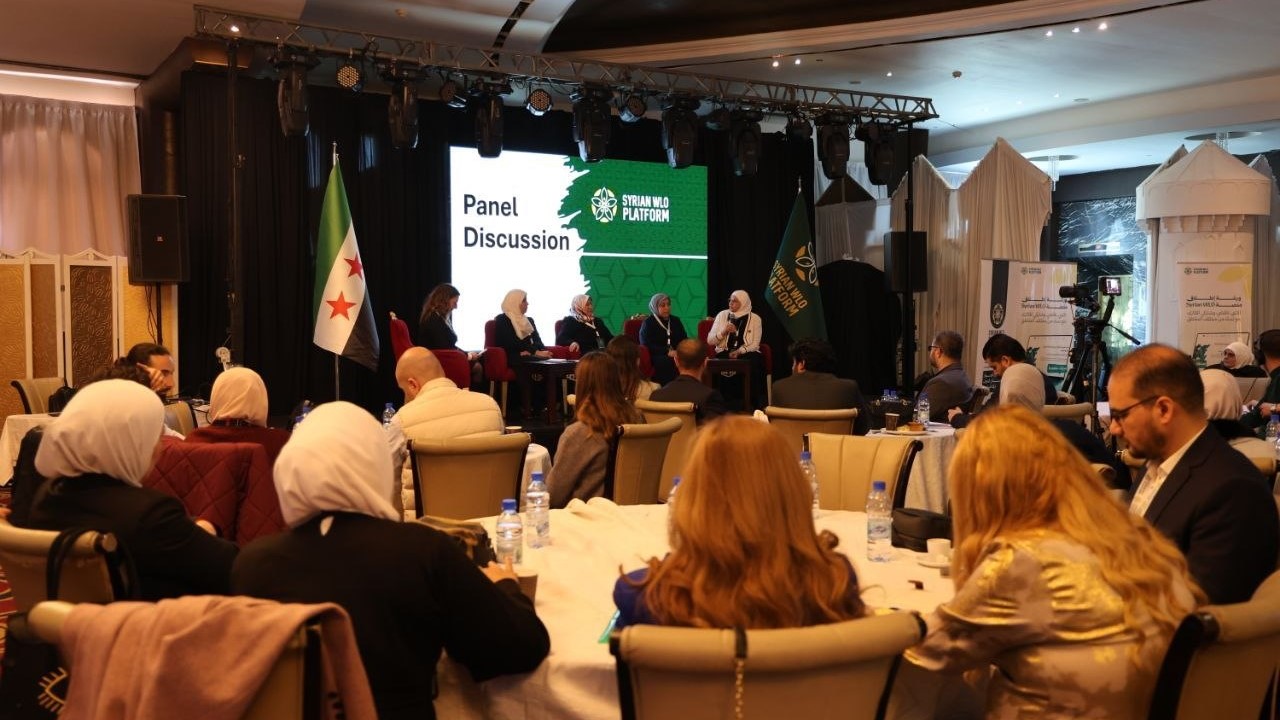
The Syrian Future Movement followed with great interest the launch of the “Women-Led Organizations Platform” in Damascus on Monday, April 13, 2026, during a conference held at the Caesar Palace Hotel. Representatives from government entities, UN agencies, and international and local organizations participated.
The platform was founded in 2023 outside Syria by ten women’s organizations before expanding its operations to within the country and growing its membership to include more than 100 women from various governorates.
It aims to enhance the participation of Syrian women in leadership and humanitarian fields, provide a space for exchanging experiences, and support economic and social empowerment, in line with the Ministry of Social Affairs and Labor’s strategy to protect women from gender-based violence and empower them.
The Syrian Future Movement sees this launch as more than just an organizational announcement; it carries profound political and social implications, which can be summarized as follows:
First, a shift from external to internal operations: The years of war have forced a significant portion of women’s civil society work to take shape outside or on the margins of Syria.
The relocation of this platform to Damascus places this effort in a different sphere, one characterized by direct partnership with governmental institutions, engagement in international coordination efforts, and a redefinition of the experiences Syrian women have accumulated in displacement, response, and survival as an asset that can be transformed into organized representation within the country itself.
Second, from symbolic participation to functional role: The platform’s formulation as a tool to enhance women’s presence in humanitarian and community work, as well as in planning, coordination, and decision-making, reveals a shift in the discussion from the question of “symbolic participation” to the question of “functional role” within the mechanisms of public administration. This shift explains the event’s significance more than its celebratory nature.
Third, the strategic link to transitional justice: Bahjat Hajjar, representative of the Ministry of Social Affairs and Labor, emphasized the platform’s importance in supporting women’s participation in leadership positions, particularly within the transitional justice process.
We believe this link carries significant strategic weight. Syrian women, especially survivors of violence, need justice mechanisms that respect the specific nature of their experiences, a point underscored in recent UN reports.
This development reinforces what the Syrian Future Movement has advocated on numerous occasions and confirms the validity of the vision we adopted from the outset. In this context, we recall what we published on our official website:
- “The Syrian Future Movement and Women” (April 2024): In this founding document, we affirmed that the Syrian Future Movement supports the participation of Syrian women in political and diplomatic life, their advancement to leadership positions, their involvement in shaping and making pivotal decisions, ensuring their voices are not ignored, and their effective participation in building a civil and democratic state.
We stressed the necessity of combating gender-based violence and providing the necessary support for women suffering from domestic, sexual, or political violence. - “International Women’s Day” (March 2026): We reaffirmed that women are full partners in decision-making within a democratic civil state, leaders in society, innovators in the economy, and protected from violence and discrimination.
We called for ensuring at least 30% representation for women in all transitional bodies and future institutions. - “Towards an Integrated Consultative Model” (April 2026): We presented our vision for the relationship between the state and society, emphasizing the importance of independent intermediary institutions (unions, federations, civil society organizations) that represent the public interest without guardianship.
The Syrian Future Movement, while welcoming this step, sees the need to raise realistic questions about the platform’s future and its ability to achieve its goals:
First, translating experience into influence: Syrian women possess immense experience accumulated through years of war, displacement, and forced migration. The fundamental question is: how can this experience be transformed from a “relief resource” into tangible “political and legislative influence”?
Second, decentralization: The platform includes more than 100 women, but how can we ensure it doesn’t become a “Damascene elite” detached from the concerns of women in Deir ez-Zor, Raqqa, or Idlib?
Third, sustainability and funding: Civil society organizations, especially women-led ones, are suffering from declining international support at a time when it is most needed.
A UN report issued on April 15, 2016, indicated that the UN-coordinated $1.25 billion humanitarian appeal was only 12.5% funded, warning that the risk is not just stagnation, but regression.
Fourth, the relationship with transitional justice mechanisms: How will the platform evolve from a mere professional coordination network into a source of expertise on legislation, reparations, and citizenship reform?
Based on our unwavering vision and commitment to the principles of partnership and integration between the state and society, the Syrian Future Movement recommends the following:
- Transforming the platform into a practical model of partnership: We see this platform as a genuine opportunity to embody the model of “partnership and integration” we aspire to, through its active participation in shaping policies and legislation related to women, not just in implementing programs.
- Linking the platform to the transitional justice process: We call for the platform’s formal inclusion in transitional justice mechanisms to ensure that these mechanisms consider the specific experiences of women survivors of violence and contribute to developing reparations and institutional reform programs.
- Ensuring fair representation: We demand that the platform’s membership reflect the diversity of Syrian governorates, with clear mechanisms to guarantee that the voices of women from remote and marginalized areas are heard.
- Supporting sustainability: We call on the international community and donors to allocate sufficient and sustainable funding to the platform and to women’s organizations in general, recognizing them as a backbone of transitional justice and social stability.
- Transparency and Accountability: We emphasize the need for the platform to adopt transparent mechanisms in its operations, accountable to its members and the community it serves.
The platform’s current The Syrian Future Movement views the launch of the “Women-Led Organizations” platform as a strategic step par excellence, reflecting a genuine shift in the relationship between the new Syrian state and women’s civil society, and a move from relief work to decision-making.
However, success is not guaranteed, and the platform will remain merely an organizational structure unless its promises are translated into concrete policies, and unless it moves from rhetoric to action.
We believe that the real challenge lies not in the number of members or the extent of media coverage, but rather in the platform’s ability to transform wartime experiences into political capital that influences legislation and policies, builds genuine bridges with transitional justice mechanisms, and overcomes the gap between Damascus and the provinces.
The Syrian Future Movement announces its full readiness to contribute all its intellectual and advisory resources to supporting this platform, based on our firm belief that there is no future for Syria without a genuine partnership between the state and society, and no genuine partnership without the full empowerment of Syrian women in decision-making positions.