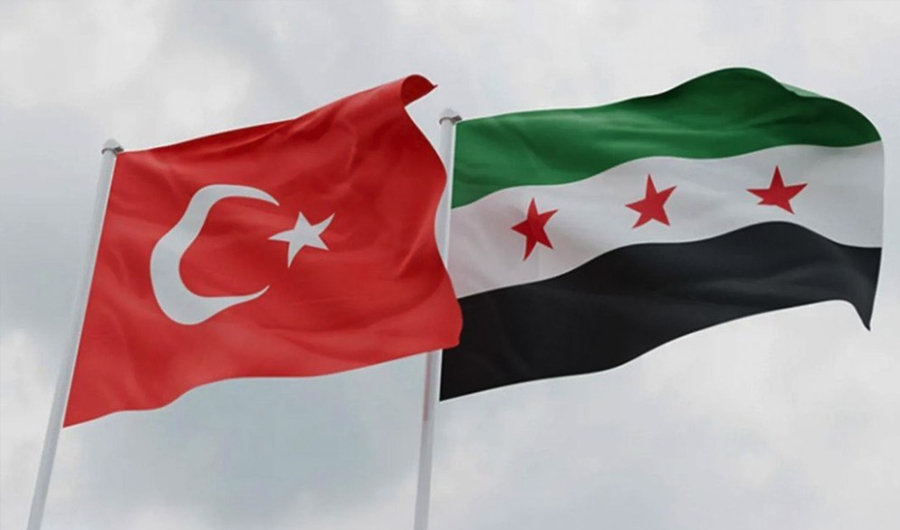
The Syrian Future Movement has been closely following the news from the Union of NGOs of the Islamic World (İDSB) and the Turkish Foundation for Voluntary Associations (TGTV), which announced their intention to strengthen their focus on stabilization and sustainable development projects in Syria, following a visit by a Union delegation to several Syrian governorates this month.
This coincided with the publication in the Turkish Official Gazette of a decision to establish a “Religious Services Attaché” affiliated with the Turkish Consulate in Aleppo and a “Religious Services Advisory” affiliated with the Turkish Embassy in Damascus, making religious and cultural affairs a central focus of the Turkish presence in Syria.
The Syrian Future Movement, while monitoring these developments from its independent national perspective, believes it is essential to address them with complete objectivity, through an analysis that combines an assessment of the actual need for development support with a warning against the repercussions of any external influence exerted under the guise of humanitarian work.
The Syrian Future Movement values any effort that contributes to transitioning Syria from the stage of emergency relief to sustainable development. International humanitarian organizations have made significant strides in supporting Syrians during the years of war, and their shift towards reconstruction, education, and infrastructure demonstrates their understanding that development is the most effective remedy for deep wounds.
We see this shift as a step in the right direction, especially if it is accompanied by transparent operational mechanisms focused on reconstruction and youth empowerment.
The Syrian Future Movement takes a critical stance, asserting that the international organizations’ focus on development does not, in any way, replace the Syrian state’s role in leading this process.
We emphasize that humanitarian and development aid, provided under the auspices of governmental and religious institutions with external affiliations, raises a legitimate question about these organizations’ priorities: Is it to help Syrians, or to build networks of political and religious influence and subservience? The Turkish Directorate of Religious Affairs (Diyanet) manages the religious sphere according to its national priorities, so what will be the situation of the Turkish religious attachés and consulates in Aleppo and Damascus?
Furthermore, we believe that the establishment of Turkish religious attachés and consulates within Syria cannot be viewed in isolation from the trajectory of relations between the two countries. While security and economic coordination is progressing positively, the establishment of a permanent administrative structure for the Diyanet (Turkish Directorate of Religious Affairs) within Syria signifies a long-term external presence. This places the Syrian government in a delicate position: how can it balance benefiting from Turkish support with preserving the identity of its religious and educational institutions?
The Syrian Future Movement calls for any future development projects to be subject to clear bilateral agreements that recognize full Syrian sovereignty and guarantee national oversight of educational curricula and cultural programs.
The Syrian Future Movement believes that coordination with international organizations is possible to benefit from their expertise, but without allowing Syria to become an arena for foreign cultural or religious influence.
The Syrian Future Movement urges the Syrian government to expedite the development of a legislative and oversight framework that ensures transparency in the work of foreign organizations, regulates relations with international religious institutions, and safeguards the right to determine national priorities for the reconstruction and education sectors.
We also believe that secrecy or isolation will lead to the strengthening of informal influence, while transparency and clear legislation will provide the state with effective tools to enforce its sovereignty.
The Syrian Future Movement believes that the coming period will witness a growing trend among international organizations to establish development projects in Syria.
Therefore, we call for the adoption of a national approach based on “utilization with caution,” meaning opening the door to partnership in development, but with clear safeguards that protect Syrian identity and preserve its independent decision-making.
We believe that the future we are working towards is a Syria governed by the rule of law, a Syria that will not relinquish its sovereignty in exchange for any support, and a Syria that remains free to determine the educational paths of its children and the features of its culture.
We believe that Syrian decision-makers today have a historic opportunity to put their own house in order before opening the doors wide, and the greatest hope rests on the ability of our national institutions to rise to this great responsibility.