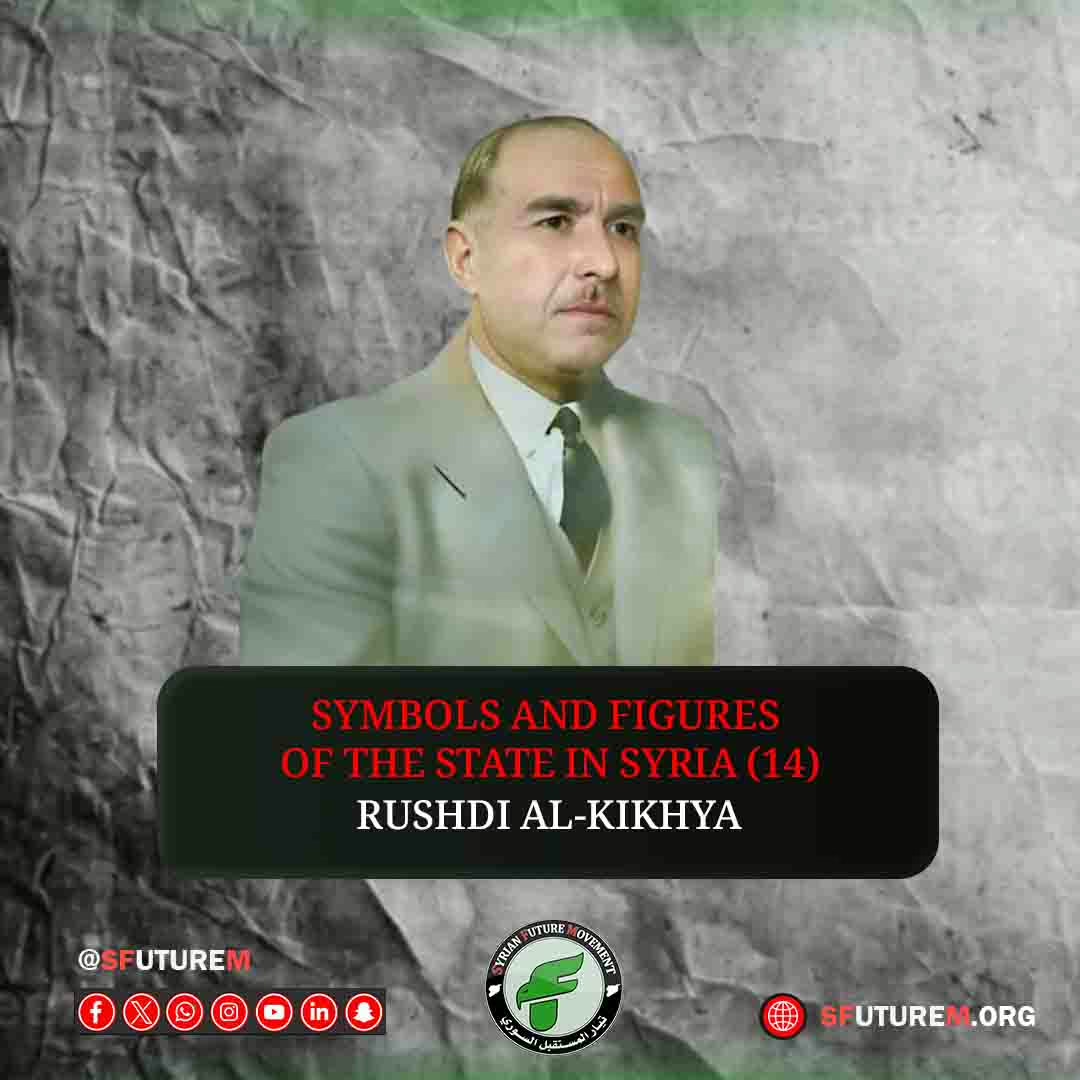
- He was born in the Syrian city of Aleppo in 1899, to an old Aleppo family, and received his education there.
- His father sent him in 1910 to pursue his studies in Beirut at the Islamic College.
- He inherited property and real estate in Turkey as a result of family connections.
- He studied law at the Sorbonne.
- He appeared on the political scene as a resistance fighter pursued by the French Mandate government during the Great Syrian Revolution of 1925.
- He worked in the ranks of the National Bloc since its formation in 1927.
- He was one of the signatories of the 1936 treaty with France.
- He announced his retreat from the treaty in 1938-1939 when negotiations with France faltered, it refused to ratify the treaty, and the bloc’s reputation was tarnished by the concessions it had made.
- He was one of the most prominent opponents of the annexation of Iskenderun to Turkey.
- In 1947, he headed the Constitutional Bloc in the House of Representatives.
- In August 1948, this bloc took the name of the People’s Party, and he remained its chairman until the dissolution of the parties after the Syrian-Egyptian unification.
- He left Syria to live between Turkey and Lebanon.
- He was elected as a deputy from Aleppo in the 1936, 1943, 1947 and 1949 sessions
- He held the Ministry of Interior in the Ministry of Hashim Atassi from August 14, 1949 until December 12, 1949, when he was elected Speaker of the Parliament.
- He presided over the Constituent Assembly that drafted the Constitution of Syria in 1950.
- He was a proponent of getting rid of Hosni al-Zaim and the effects of military rule.
- As soon as Brigadier General Sami al-Hinnawi’s coup took place, he welcomed cooperation with him in order to achieve freedom from Hosni al-Za’im’s coup.
- He was one of the most prominent opponents of Adib Shishakli’s regime and demanded his departure, which took place in 1954.
- He refused to serve as president after the secession (separation from the United Arab Republic formed as a result of the unification of Syria and Egypt) He said his famous phrase: The hand that signed the unity document with Egypt will not sign the separation document, even though the Nasserist media accused him of being an agent because of his enthusiasm for unity with Iraq.
- After the Baath Party seized power in 1963, he retired from politics after the arrest of Nazim al-Qudsi.
- Salah Jadid arrested him for his opposition to socialism and his liberal ideas, although he left politics and dissolved the People’s Party in 1966.
- His property was confiscated and he was transferred to Palmyra prison until he was released in 1967.
- The Baathist authorities asked him to leave Syria, so he went to Lebanon and then to Cyprus.
- Rushdi Al-Kakhia was destined to live far from his homeland until he died at the age of 87 in the Cypriot capital Nicosia in 1987 and was buried in one of its mosques.
We at Syrian Future Movement, as we recall the memory of the founding statesmen of Syria, we recall one of Syria’s influential men, and one of the symbols of the first Syrian state’s flags who contributed to influencing its structure, the liberal nationalist leader “Rushdi al-Kikhia” within a sequential file that we present to you to include symbols and flags of the Syrian state, in our desire to link our contemporary revolutionary present to a solid past and historical stations, with the hope of reviving in our people the need to build and manufacture statesmen par excellence, learn from their experiences, overcome their negatives, and build on their history to link our contemporary revolutionary present with a solid past and historical stations, hoping to revive in our people the need to build and create statesmen par excellence, learn from their experiences, overcome their negatives, build on their history, preserve the homeland, safeguard the gains, and restore the Syrian state to its glory after years of injustice, tyranny, and corruption.