
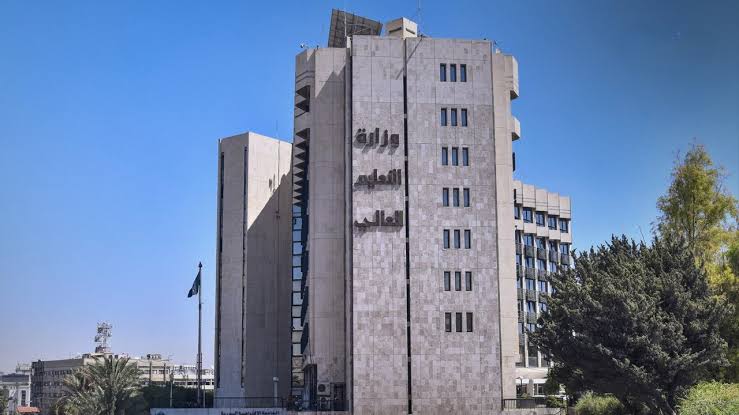
The Syrian Future Movement is following with great interest the announcement made by the Ministry of Higher Education and Scientific Research on Monday, November 23, 2026, regarding the formation of a specialized committee to regularize the status of Syrian students who graduated from external branches of Sudanese universities. The committee is tasked with facilitating the accreditation of their degrees, subject to specific academic criteria—including the fulfillment of graduation requirements, completion of an internship year, and passing the national examination. The status of students currently pursuing their studies will be addressed in the upcoming session of the Higher Education Council.
While acknowledging the importance of this announcement, the Syrian Future Movement notes that it comes months late, following persistent appeals from hundreds of Syrian doctors and students who found themselves at a dead end. After completing their studies at accredited external centers—following the outbreak of war in Sudan in 2023—they discovered that the path to degree accreditation in their home country was blocked by requirements they described as “prohibitively difficult”—most notably, the mandate to have resided in the country where the parent university is located, even though their degrees are recognized by various other nations.
The Syrian Future Movement welcomes the Ministry’s response, viewing it as a belated recognition of the significant hardships endured by these graduates.
Nevertheless, the Syrian Future Movement emphasizes that this response is not a favor granted by anyone; rather, it is a rightful entitlement for a group of individuals who completed their education under the duress of war. Having fulfilled their clinical training and final examinations under the supervision of the Sudanese Ministry of Higher Education, these students were subsequently confronted with demands from their own country to provide documentation for external centers—centers that may have since closed or become impossible to contact for the necessary paperwork. The Syrian Future Movement reaffirms that the formal recognition (equivalency) of academic degrees is both an academic and professional right, and a prerequisite for integrating Syrian talent into the nation’s reconstruction process.
While the Syrian Future Movement views the formation of this committee as a partial step toward realizing this principle, it remains incomplete without a binding timeline, clear operational mechanisms, and guarantees for those unable to return to Sudan.
The Syrian Future Movement believes that, despite its positive aspects, the announcement raises several fundamental questions that cannot be overlooked:
First: The absence of a timeline – The Syrian Future Movement notes that the official statement provides no deadline for the committee to complete its work, nor a schedule for processing individual cases. This is concerning, given that hundreds of graduates have been waiting for months, with many facing significant personal and professional hardships due to the stagnation of their academic or career paths.
The Syrian Future Movement asks: How much longer must these qualified individuals wait for their files to be processed? Will cases be handled individually—a slow and inefficient approach—or through a clear, collective mechanism?
Second: The “licensing” requirement as a barrier to recognition – The Syrian Future Movement points out that the committee has not explicitly waived the requirement to submit licenses from the external educational centers. Graduates have described this requirement as “impossible” to fulfill, as some of these centers have closed, or their licenses have become unobtainable following the war in Sudan.
The Syrian Future Movement calls for the process to rely solely on the authentication of degrees by the relevant official Sudanese authorities (the Ministry of Foreign Affairs and the Ministry of Higher Education). This would spare graduates the burden of chasing down documents that may no longer exist—a request echoed by the physicians themselves.
Third: The fate of students who have not… Regarding those who have not yet graduated, the Syrian Future Movement notes that the announcement was limited to “graduates,” while the status of students still pursuing their studies was deferred to the “next session of the Higher Education Council”—without specifying a date or the council’s intended approach.
The Syrian Future Movement believes that this postponement leaves hundreds of students in a state of uncertainty—particularly those who cannot return to Sudan or whose external study centers have closed. An urgent solution is required to allow these students to complete their studies at Syrian universities, as they have repeatedly requested.
Acting out of its national responsibility, the Syrian Future Movement recommends the following:
First: Establish a clear timeframe (not exceeding three months) to process all graduate files, and publish the names of those included, the communication channels, and progress updates, so that the public may follow the process.
Second: Accept documentation from the Sudanese Ministry of Higher Education and the Sudanese Ministry of Foreign Affairs in lieu of study center licenses. Syrian embassies should be tasked with verifying the authenticity of these documents, rather than placing burdens on graduates that they are unable to meet.
Third: Expedite the convening of the next Higher Education Council session and adopt clear decisions that allow students currently enrolled in their studies to continue their education at Syrian universities. This should be facilitated through flexible transfer mechanisms that recognize completed academic years and safeguard the students’ academic rights.
Fourth: Publish detailed criteria for the settlement process, including information on any potential financial fees, the expected processing duration, and the procedures for filing appeals, to ensure fairness and equal opportunity for all graduates.
Fifth: Link the file… The resolution process should be framed as a national plan for the integration of skilled professionals—moving beyond the mere “validation of academic credentials” to become part of a comprehensive national strategy. This strategy should aim to integrate Syrian doctors, engineers, and other qualified professionals into the labor market, especially given the country’s urgent need for medical and engineering personnel following years of war.
The Syrian Future Movement welcomes the formation of this committee, viewing it as a positive step toward securing justice for hundreds of graduates whose academic journeys were disrupted by war and displacement.
However, the Syrian Future Movement cautions that a delayed response is no substitute for a complete one. Establishing a committee without a clear timeline risks becoming yet another form of procrastination. These graduates—who hold internationally recognized degrees—deserve the same treatment as any other citizen who has fulfilled their academic requirements: the formal recognition of their credentials, the opportunity to practice their professions, and the ability to contribute to building a new Syria.
The Syrian Future Movement emphasizes that investing in Syrian talent is the most reliable investment in the nation’s future. Every doctor or engineer left out of the labor market due to bureaucratic hurdles represents an irreparable national loss.
For its part, the Syrian Future Movement will continue to support initiatives that promote academic justice and the integration of skilled professionals. It will remain vigilant, critiquing shortcomings and monitoring progress on the ground—all in pursuit of a new Syria where no graduate’s rights are lost, and no qualified individual’s potential goes to waste.