
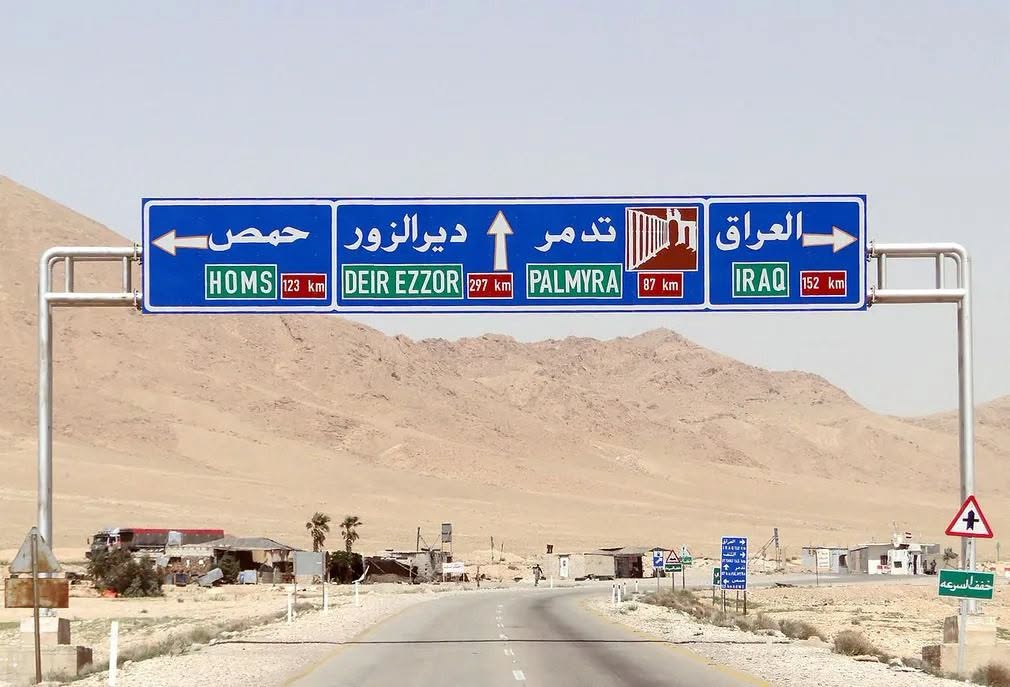
The Syrian Future Movement is closely monitoring the arrival of a second shipment of heavy machinery and equipment belonging to the Saudi contracting firm “Al-Rawaf” into Syrian territory. The equipment entered via the Nasib border crossing in Daraa on Saturday, November 21, 2026, and is intended for the rehabilitation of the Damascus–Palmyra and Palmyra–Deir ez-Zor roads, in preparation for the commencement of field operations in the coming days.
The Syrian Future Movement notes that this shipment consists of 48 pieces of heavy machinery, bringing the total number of units allocated for the project to approximately 177. According to the project’s executive director, Yasser Al-Ali, the remaining shipments are expected to arrive within 15 days, and the execution of the work will be subject to specialized engineering and technical oversight.
This development follows the signing of a supervision contract on November 17, 2026, between the Ministry of Transport and the Saudi engineering consultancy firm “SETS.” The project, valued at approximately $320 million, is scheduled for completion over 800 days. It covers a 426-kilometer route—stretching from Al-Dumayr in the Damascus countryside, through Palmyra, and reaching Deir ez-Zor—and includes the construction of a second branch of the road. The Syrian Future Movement welcomes this development, which marks the practical and tangible entry of Saudi investments into the Syrian infrastructure sector.
This follows a series of agreements and development loans—totaling over $403 million and signed on November 4, 2026—that encompass the health, housing, energy, civil defense, and debris-removal sectors.
The Syrian Future Movement views the Damascus–Palmyra–Deir ez-Zor road project as one of the most significant strategic initiatives for the coming period; it not only connects the capital to the eastern region but also reintegrates Syria into its natural geographical and economic sphere.
The Syrian Future Movement recalls that it had previously expressed its support for this plan in a statement published on its official website on June 29, 2026, titled “Launching the Comprehensive Plan for Rehabilitating Central Highways and Connecting Provinces.” In that statement, the Movement noted that “prioritizing the connection of the northeastern regions to the capital, Damascus—given their economic and geographical importance—sends a clear message: an end to the decades of marginalization and exclusion imposed by the ousted regime upon these resource-rich areas.”
With the arrival of machinery and the commencement of work, the Syrian Future Movement observes that this commitment is transitioning from rhetoric to action—a shift that deserves to be commended.
The Syrian Future Movement points out that this corridor serves as an economic and civilizational artery, stretching deep across the Syrian Desert and tracing the historical path of ancient trade routes that once linked Damascus to the Euphrates and Mesopotamia. The Syrian Future Movement believes that rehabilitating the road and converting it into a dual carriageway—with separate lanes for opposing traffic—would represent a qualitative leap for transport and commercial exchange. It would connect agricultural, oil, and mineral production areas in Deir ez-Zor, Raqqa, and the Badia (desert region) to major consumption and export hubs in Damascus and along the coastal ports.
The Syrian Future Movement points out that the existing road is no longer capable of accommodating increasing traffic volumes or meeting road safety standards, making the construction of a second carriageway an urgent necessity.
Furthermore, the Syrian Future Movement asserts that linking the eastern regions to the capital would end the isolation imposed on these areas for decades by the ousted regime, while strengthening national cohesion by integrating the geography with its population and economy.
However, the Syrian Future Movement notes that this project, despite its importance, faces fundamental challenges that cannot be overlooked:
First: The long implementation period—the movement observes that the announced timeline (791 to 800 days) means the road will not be ready until early 2029.
The Syrian Future Movement raises the following questions: Will the work be completed on schedule, or will this major project in Syria suffer the same delays seen in previous instances? Are there strict oversight mechanisms in place to ensure adherence to the timeline, or will the matter be left to mere promises?
Second: The Need for Transparency in Contracts and Implementation – The Syrian Future Movement emphasizes that any project of this scale ($320 million) requires complete transparency regarding contract details, the criteria for selecting companies, disbursement mechanisms, and quality control.
The Syrian Future Movement recalls that it has consistently called—in previous statements—for the necessity of “translating declarations into tangible projects and fostering transparent competition among Syrian companies,” a principle that applies to this project as well as others.
Third: The Necessity of Integration with Other Projects – The Syrian Future Movement notes that the Damascus–Deir ez-Zor road project should not be implemented in isolation from other infrastructure initiatives, such as railway lines, energy projects, and the industrial and logistical zones located along the route.
The Syrian Future Movement maintains that a road alone cannot generate development; rather, it requires an integrated ecosystem of services, facilities, and investments that can leverage its existence.
Guided by its national responsibility, the Syrian Future Movement recommends the following:
First: The publication of a clear implementation plan that specifies completion timelines for each segment of the road, monitoring mechanisms, responsible entities, and performance indicators, thereby enabling the public to track progress and hold relevant parties accountable for any shortcomings.
Second: The disclosure of the supervision contract details with the firm “SETS,” the criteria used for selecting contractors, and periodic progress reports. Furthermore, it is essential to ensure that the implementation process is subject to independent engineering oversight, allowing for the early detection of any defects or delays.
Third: This route should be part of a broader strategy that encompasses railways (such as the revival of the Hejaz Railway or freight lines), logistics zones along the Iraqi and Jordanian borders, and energy projects (like the Arab Gas Pipeline), in order to achieve genuine integration between transport modes and productive sectors.
Fourth: Syrian companies should be involved in the project’s implementation, and local labor from the areas along the route—such as Palmyra, Deir ez-Zor, and the Badia (desert region)—should be employed. This would help create job opportunities and stimulate the local economy, rather than relying entirely on imported labor and equipment.
Fifth: Leveraging the project to enhance security. …and stability in the Badia (Syrian Desert). Rehabilitating the road and revitalizing traffic along it will contribute to strengthening the civil and economic presence in the Syrian Badia, reducing the security vacuums often exploited by terrorist cells, and supporting stabilization efforts in the eastern region.
The Syrian Future Movement welcomes the arrival of this new shipment of machinery, viewing it as a practical step toward rebuilding Syria’s infrastructure and a tangible manifestation of an economic partnership with the Kingdom of Saudi Arabia.
However, the Syrian Future Movement notes that the arrival of this equipment marks the beginning of a true test—one that will gauge the ability of the transitional authority and the executing firms to transform this momentum into a completed, secure, and sustainable road that serves both the citizens and the national economy.
The Syrian Future Movement emphasizes that the road connecting Damascus to Deir ez-Zor serves as a bridge, reconnecting areas that have long suffered from marginalization and isolation. It sends a clear message: a “new Syria” leaves no region behind.
For its part, the Syrian Future Movement will continue to support all initiatives that foster reconstruction and development. It will remain a critical voice regarding any shortcomings and a vigilant observer of progress on the ground—all in pursuit of a “new Syria,” where roads connect cities, just as the hearts of its people are connected to one another.