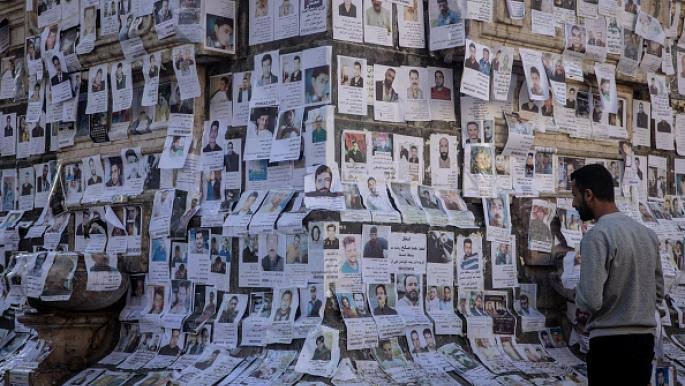
The Syrian Future Movement is following with great interest the announcement by the National Commission for Transitional Justice on Saturday, November 14, 2026, of the launch of the pilot phase for collecting data on victims and their families, as a prelude to building a national register of victims. This phase will focus on the most vulnerable groups residing within Syria.
The Syrian Future Movement commends this step, which constitutes a fundamental pillar for all transitional justice processes. It sees this as a practical implementation of its repeated calls for the establishment of a unified and secure national database that preserves the rights and dignity of victims and prevents the loss of rights in the absence of documentation.
However, the Syrian Future Movement believes that this register, despite its foundational importance, presents a number of fundamental challenges that cannot be ignored. These challenges relate to the comprehensiveness of the registration process, the transparency of verification mechanisms, linking the register to actual reparations programs, and ensuring that it does not become a selective or merely symbolic tool.
The Syrian Future Movement notes that the commission, as it announced, adopted a verification methodology based on “administrative and legal verification through cross-referencing various sources, interpreting doubt in favor of the victim, and not requiring complete documentation to prove the case.” Cases are classified into progressive levels (strong, moderate, preliminary, under investigation), based on testimonies, human rights documentation, and digital and community evidence.
The commission also indicated its adoption of the “do no harm” principle, based on more than 300 field visits in 11 governorates, with the aim of avoiding further harm to victims.
The Syrian Future Movement believes that these methodological foundations, if applied honestly and transparently, constitute an important guarantee for building a reliable record that not only counts victims but also documents what they have endured, understands the extent of the damage inflicted on individuals, families, and communities, and enables those affected to access justice and reparations.
The Syrian Future Movement believes that the current pilot phase, while necessary as a first step, has fundamental limitations that require urgent attention:
First: Limiting registration to residents inside Syria – The Syrian Future Movement notes that focusing on “residents within the Syrian Arab Republic” excludes, at this stage, millions of displaced Syrians outside the country, refugees, and internally displaced persons, who constitute a large percentage of victims of violations.
The Syrian Future Movement asks: How can a “comprehensive” national registry be built while excluding a large segment of victims who are no less affected than residents? When will registration channels be opened for them, especially given the absence of clear mechanisms for remote representation?
Second: Lack of reference to a mechanism for funding reparations – The Syrian Future Movement points out that the registry, despite being described as “a first step towards justice and official recognition of victims,” does not specify how this recognition will be translated into actual compensation.
The Syrian Future Movement believes that a registry without a national reparations fund and clear compensation mechanisms risks becoming merely a database that changes nothing in the lives of victims and perpetuates the years-long wait endured by families.
Third: The need for guarantees of transparency and independence – The Syrian Future Movement demands the public publication of verification criteria and standards, allowing independent human rights organizations to monitor the registration process, and ensuring that the registry is not subject to any political pressure or selectivity.
The Syrian Future Movement reiterates that any national registry that lacks the trust of victims and civil society will lose its legal and moral value, regardless of how rigorous its methodology may be.
In this context, the Syrian Future Movement reiterates its consistent positions, published on its official website, which have consistently called for the establishment of a comprehensive transitional justice process:
In its statement entitled “Managing the Files of Victims and Missing Persons,” dated December 6, 2025, the Syrian Future Movement called for “activating a high-level national committee comprising the Ministry of Justice, the National Committee for the Missing, the Independent Foundation for the Missing, representatives of victims’ families’ associations, and independent legal experts,” tasked with “verifying and professionally investigating the victims’ files.”
In its statement entitled “Adopting a Comprehensive Roadmap for Achieving Transitional Justice,” dated November 18, 2025, the Syrian Future Movement emphasized the necessity of “building a comprehensive justice process that includes truth-seeking, reparations, accountability for perpetrators, and reform of institutions guaranteeing justice,” and of “linking any amnesty or reconciliation measures to the full disclosure of the truth, reparations, and ensuring that there is no impunity.”
In its statement entitled “The Missing Persons File in Syria and the Families’ Right to Know the Truth,” dated July 24, 2026, the Syrian Future Movement emphasized the need to “expedite the protection of all documents, records, and evidence related to detainees and missing persons,” considering them to be of “legal, historical, and humanitarian value.”
The Syrian Future Movement believes that launching the National Register of Victims, while important, remains incomplete unless it is accompanied by the protection of archives, linking the register to the accountability process, and guarantees of actual reparations.
Based on its national responsibility, the Syrian Future Movement recommends the following:
First: Expanding the scope of registration to include Syrians outside the country as soon as possible by providing secure electronic platforms that allow refugees, internally displaced persons, and those forced to flee their homes to register their information and appoint representatives on their behalf, ensuring they are not deprived of their right to recognition and redress due to their forced disappearance.
Second: Linking the registry to a national reparations fund and clear compensation mechanisms by announcing a timeline for establishing the fund, defining criteria for material and moral compensation, and ensuring that registration in the registry is a first step towards actual compensation, not merely a formality.
Third: Ensuring transparency and independent oversight of verification mechanisms by publishing verification standards and levels, allowing human rights organizations to monitor the registration process, and guaranteeing the registry’s independence from any political or administrative pressure.
Fourth: Linking the registry to the accountability and truth-seeking process by integrating its data with the files of missing and detained persons, and linking it to national and international accountability mechanisms. To ensure that the registry is not isolated from the criminal justice system.
Fifth: Strengthening the protection of victims’ data and privacy by adopting the highest cybersecurity standards, ensuring that data is not used for purposes other than the victims’ best interests, and providing strict legal safeguards against any leaks or misuse.
The Syrian Future Movement commends the launch of the pilot phase of the National Victims Registry, viewing it as a foundational step towards the official recognition and redress of victims of violations.
However, the Syrian Future Movement emphasizes that the registry is not an end in itself, but rather a means to achieve justice and redress. Its true value depends on its comprehensiveness, transparency, connection to effective compensation mechanisms, and safeguards against selectivity and negligence.
The Syrian Future Movement affirms that building a new Syria will not be complete without ensuring justice for every victim, acknowledging every violation, and guaranteeing that such events will not be repeated.
The movement will remain supportive of everything that promotes transitional justice and the rights of victims, critical of every shortcoming, monitoring everything that is accomplished on the ground, striving for a new Syria in which the dignity of every citizen is preserved, and his wounds and rights are recognized.