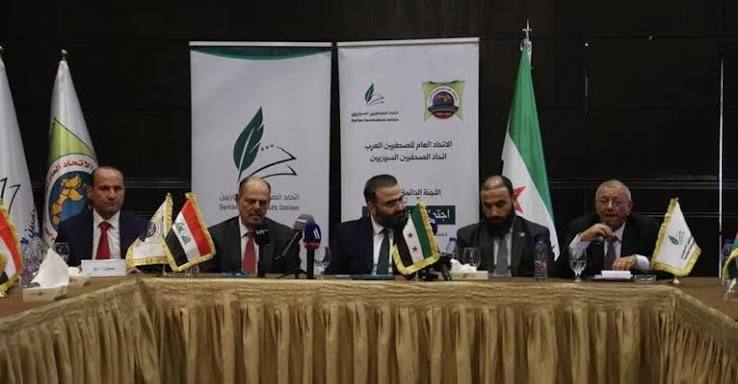
The Syrian Future Movement follows with interest and appreciation the launch of the “Damascus Declaration” for Press Freedom and Media Solidarity by the General Union of Arab Journalists. The declaration was announced on Sunday, October 18, 2026, under the auspices of the Syrian Ministry of Information, at the conclusion of meetings held by the Permanent Committee on Freedoms—which took place at the Damarose Hotel in Damascus from October 15 to 18—with the participation of delegations representing 18 Arab journalists’ unions and organizations.
The Syrian Future Movement views Damascus’s hosting of these meetings—for the first time since the liberation—and its selection as a platform for launching a comprehensive Arab declaration to protect journalists, as an acknowledgment by the Arab world of Syria’s active role in the media landscape. It further reflects the confidence of Arab unions that Damascus is capable of serving as a cradle for press freedoms, rather than a graveyard for them, as was the case under the ousted regime.
The Syrian Future Movement also notes that the Damascus Declaration encompasses essential pillars that serve as a roadmap for the protection of journalists. These include: safeguarding journalists and their independence; upholding freedom of expression; rejecting threats and assaults; condemning the crimes committed by the Zionist occupation against journalists in Palestine, Lebanon, and Syria; denouncing violations in Sudan and Yemen; and calling for the provision of a safe working environment. The Syrian Future Movement welcomes the declaration’s call for solidarity with Syria during its recovery phase, as well as the proposal to provide technical and professional support to its media institutions. It also supports the encouragement of Arab professional unions to partner with the Syrian Journalists Union on initiatives such as digital training and development, the preservation of media archives, and the creation of joint mechanisms for digital protection, professional safety, and countering disinformation.
The Syrian Future Movement notes that this declaration marks the culmination of a process that has seen a tangible improvement in press freedom indicators. Syria has climbed 36 places in the 2026 Reporters Without Borders index—rising from 177th to 141st out of 180 countries—the most significant advancement in its history. Furthermore, no journalists have been killed in the country since the beginning of this year.
While acknowledging the importance of this progress, the Syrian Future Movement views it as merely “a first step on a long journey.” Syria remains classified within the “very dangerous” category on the index, indicating that the path toward full media freedom is far from complete. The Syrian Future Movement reaffirms its consistent positions—as published on its official website—which have long advocated for the establishment of a free and independent media sector. These include: the statement on “Syria’s Historic Achievement in the 2026 World Press Freedom Index” (dated May 2, 2026); the statement on “World Press Freedom Day” (dated May 3, 2026), in which the Movement emphasized that “the objectives of this international day—namely, assessing the state of press freedom and protecting journalists from attacks—are core components of the Movement’s national agenda”; the statement on an “Urgent Resolution to Support Media Freedom in Syria” (dated May 11, 2026); and the statement regarding the “Syrian Journalists Association’s Rejection of the Code of Professional and Ethical Conduct Issued by the Ministry of Information” (dated February 8, 2026).
The Syrian Future Movement maintains that the “Damascus Declaration,” while possessing moral significance, remains merely a set of principles in need of legislative and executive implementation.
Furthermore, the Syrian Future Movement notes that the new draft media law—which the Ministry of Information has announced is in its “final stages” and will soon be submitted to the People’s Assembly—is expected to grant journalists unprecedented legal immunity, comparable to that enjoyed by lawyers. This would prohibit the arrest or searching of a journalist, except in cases of in flagrante delicto (caught in the act) and following formal notification to the Journalists’ Union. The Syrian Future Movement believes that this promise, if fulfilled, would represent a genuine, qualitative shift. However, it remains merely a “promise” until the law is formally enacted, published in the Official Gazette, supplemented by its executive regulations, and tested in practice.
Accordingly, the Syrian Future Movement calls for the swift adoption of this law, urging that it not be delayed or amended in a way that strips it of its substance.
The Syrian Future Movement reaffirms its vision for the future: to transform Syria into a “regional hub for media freedoms”—an “oasis of free press” for the entire Arab world—making Damascus a destination where Arab journalists can work in an environment that respects their independence and dignity, protects their right to access information, and ensures that no word is suppressed and no pen is broken.
The Syrian Future Movement maintains that this goal is not a distant, unattainable dream, but rather a feasible national project, provided that three pillars are established: a political will that translates rhetoric into legislation; an independent union capable of protecting its members; and a professional press that regains the public’s trust.
Furthermore, the Syrian Future Movement emphasizes that building this “oasis” requires—alongside the enactment of the law—the creation of a national fund to support independent and emerging media institutions. Such a fund would ensure their sustainability, free from the influence of conditional political funding; provide young journalists with training and professional development opportunities; and foster a culture of investigative journalism—serving as the “essential scalpel” needed to excise pockets of corruption within the nation’s emerging state institutions. Acting out of a sense of national responsibility, the Syrian Future Movement makes the following recommendations:
First: Expedite the adoption and immediate promulgation of the new media law. This law must guarantee genuine legal immunity for journalists, the right to access information, the protection of sources, the abolition of prison sentences for journalistic offenses, and the inclusion of civil society and independent unions in monitoring the law’s implementation.
Second: Translate the “Damascus Declaration” into a joint Arab operational framework by establishing a permanent follow-up committee—comprising the Arab Journalists Union, the Syrian Journalists Union, and other member unions—tasked with implementing the Declaration’s provisions, issuing periodic reports on the state of press freedom in Syria and the Arab world, documenting violations, and providing support to journalists at risk.
Third: Launch Arab-led training and professional development programs for Syrian journalists, in line with the Declaration’s call for partnerships in training, digital development, and the preservation of media archives. These programs should focus on professional safety, digital security, combating disinformation, data journalism, and investigative reporting.
Fourth: Strengthen the independence of the union and… Recognizing trade union pluralism and ensuring that a union serves as a genuine representative of journalists—rather than a tool in the hands of the executive branch—is essential. As the Movement has emphasized in previous statements, “the recognition of pluralism and the independence of trade unions” is a key indicator of the development of a media environment.
Fifth: Establishing a national fund to support independent journalism, finance emerging media organizations, provide grants to young journalists, and bolster investigative reporting. This would ensure true pluralism within the Syrian media landscape and prevent any single entity from monopolizing the public discourse.
The Syrian Future Movement welcomes the Damascus Declaration, viewing it as an important Arab initiative toward protecting journalists and promoting media freedom.
However, the Syrian Future Movement underscores that declarations alone do not create a free media. The true test lies in the laws that are enacted, the institutions that are built, the protections that are enforced, and the extent to which journalists are genuinely—not just rhetorically—safeguarded.
We affirm that the Syria its people deserve is one that stands as an oasis and a destination for free journalism throughout the Arab world—a nation where no one is detained for their opinions, no honest pen is broken, and which serves as a regional hub for free, professional, and responsible media.
For its part, the Syrian Future Movement will continue to support all efforts that strengthen press freedom and independence. It will remain critical of any regression or attempts to circumvent these rights, while closely monitoring developments on the ground—all in pursuit of a new Syria, where free expression acts as a constructive force rather than a crime punishable by law.