

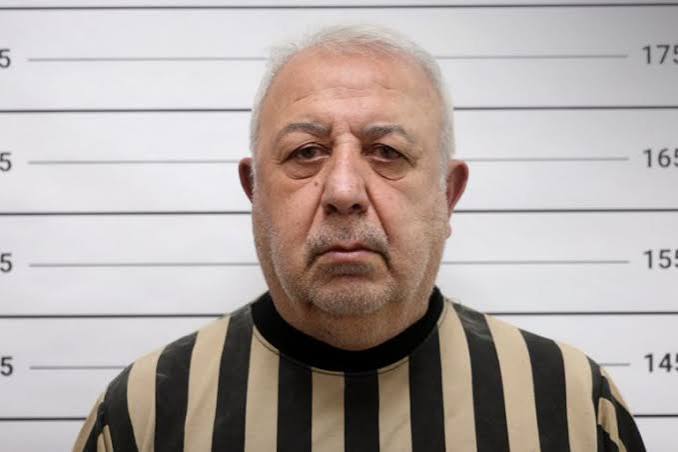
The Syrian Future Movement follows with great interest and relief the news of the arrest of Ali Kayali—also known as the “Butcher of Baniyas” or “Meraj Ural”—in connection with the atrocities and crimes committed in the city of Baniyas and its countryside during the Syrian Revolution. This development was followed by a celebratory gathering in the Al-Midan neighborhood of Damascus, where the families of the victims and other citizens expressed their joy at this long-awaited arrest.
The Syrian Future Movement views this step as a tangible realization of its repeated calls for holding the criminals of the ousted regime accountable, securing justice for the victims of grave violations, and ensuring that no perpetrator escapes punishment, regardless of how much time has passed.
Although this arrest comes more than 13 years late, the Syrian Future Movement considers it a true test of the seriousness of the transitional justice process in Syria, as well as a benchmark for the new authority’s commitment to the principles of accountability, justice, and the restoration of rights to the victims of these abuses. The Syrian Future Movement emphasizes that the blood of the martyrs in Al-Bayda and Ras al-Naba’ is not merely a statistic in a report; it represents the lives of innocent people slaughtered in cold blood, families torn apart, cities destroyed, and a collective memory scarred forever. The Syrian Future Movement records the precise details of the documented crimes in which Ali Kayali is alleged to have been involved, drawing upon reports by the Syrian Network for Human Rights (SNHR). The SNHR documented both massacres at the time they occurred and explicitly named Kayali in its report dated May 10, 2013—a finding based on testimonies from local residents who identified him as one of the individuals who led the massacres.
First: The Bayda Massacre (May 2, 2013) – 264 civilians were killed, including 36 children and 28 women, after forces of the defunct regime and its affiliated militias stormed the village. They carried out summary executions, slaughtered entire families, burned bodies and homes, and looted property.
Second: The Ras al-Naba’ Massacre (May 3, 2013) – 195 civilians were killed, including 56 children and 43 women, under similar circumstances involving mass killing and summary executions.
Third: Total Documented Victims – The Syrian Network for Human Rights documented the killing of 459 civilians—including 92 children and 71 women—across both massacres, in addition to dozens of individuals who went missing or were detained. The violations included summary executions, the killing of entire families, the burning of bodies and homes, and the looting of property—all perpetrated by forces of the defunct regime and its affiliated militias. The Syrian Future Movement asserts that these crimes—documented by the Syrian Network for Human Rights—constitute crimes against humanity and war crimes.
Such offenses are not subject to a statute of limitations and necessitate the immediate, public accountability of everyone involved in them.
The Syrian Future Movement notes that Kayali has been explicitly named in the Network’s reports since 2013, confirming that the allegations against him are not new but are, in fact, based on documentation from the time the crimes were committed.
In this context, the Syrian Future Movement reaffirms its consistent positions—as published on its official website—which have long called for holding the criminals of the ousted regime accountable and securing justice for the victims:
In a statement titled “Death Sentence Against Bashar al-Assad and Figures of His Regime,” dated August 12, 2026, the Syrian Future Movement welcomed the historic verdict, describing it as “a turning point in the process of transitional justice.” However, it emphasized that “while significant, this ruling does not obviate the need to continue the pursuit of justice, nor does it exempt anyone involved in crimes against the Syrian people—regardless of their position—from prosecution.”
In another statement, titled “International Day of the Victims of Enforced Disappearances” and dated August 30, 2026, the Syrian Future Movement stressed that “revealing the fate of hundreds of thousands of forcibly disappeared persons is the true test and the fundamental pillar for building a new Syria.” It further called for “providing both material and moral redress to the families of the victims of enforced disappearance.” The Syrian Future Movement considers the arrest of the “Butcher of Baniyas” a step in the right direction; however, it remains insufficient unless followed by the pursuit of all those involved, ensuring they face fair and transparent accountability, and providing justice for the victims and their families.
While acknowledging the significance of this arrest, the Syrian Future Movement notes that it raises fundamental questions regarding the circumstances under which it took place. The movement points to conflicting accounts concerning the location of the arrest: whereas the Syrian Arab News Agency (SANA) reported that Kayali was apprehended “while attempting to flee across the border,” Lebanese media outlets revealed that he was “abducted from his home in the town of Mansourieh, in the Metn District of Lebanon.” According to these reports, unidentified individuals broke into the property, restrained his wife and son, and took him to an unknown destination.
The Syrian Future Movement believes that these contradictory accounts undermine confidence in the seriousness of the legal process and necessitate an urgent, transparent, and official clarification.
The Syrian Future Movement further asks: How many other criminals continue to lead normal lives, while the families of their victims have been awaiting justice for over a decade? The movement emphasizes that the case of the “Butcher of Baniyas” is not an isolated incident; rather, it is representative of hundreds of other perpetrators who participated in similar massacres and violations across various Syrian provinces and who remain at large. The Syrian Future Movement believes that the continuation of this situation undermines citizens’ trust in the new state and creates the impression that justice is selective—implying that certain criminals are above the law—a matter that must be addressed with extreme caution and seriousness.
Furthermore, the Syrian Future Movement emphasizes that selective arrests, regardless of how they might be justified, cannot serve as a substitute for a comprehensive national strategy for transitional justice. Such a strategy must encompass all those involved—without exception or selectivity—and ensure accountability for everyone, from the highest echelons of power down to the lowest-level perpetrator.
Acting upon its national responsibility, the Syrian Future Movement recommends the following:
First: Ensuring a fair and transparent trial for the “Butcher of Baniyas,” with proceedings to commence no later than six months from now. The trial must uphold all guarantees of due process, provide victims and their families the opportunity to participate, allow them to present their testimonies, and enable them to pursue their civil claims. The Syrian Future Movement stresses that the trial sessions must be public and accessible to the media to ensure transparency and provide redress for the victims—all while acknowledging the gravity of a case of such magnitude… The case of Baniyas—involving hundreds of victims and thousands of documents—requires sufficient time to ensure the quality of justice.
Second: Expedite the prosecution of all those involved in the massacres in al-Bayda and Ras al-Naba’a. This includes forming an independent national investigative team—in coordination with international human rights organizations—to identify all perpetrators, issue arrest warrants for them, and pursue them both domestically and internationally.
Third: Strengthen cooperation with the International, Impartial and Independent Mechanism (IIIM)—established by a 2016 UN General Assembly resolution—to assist in collecting and analyzing evidence of the most serious international crimes committed in Syria since 2011, and to facilitate the work of the relevant judicial authorities.
The Syrian Future Movement notes that on February 10, 2026, the Syrian Minister of Justice, Dr. Mazhar al-Wais, received a high-level delegation from the IIIM, led by Robert Petit, to discuss ways to enhance cooperation, improve methods for collecting and documenting evidence, and support the transitional justice process.
The Syrian Future Movement calls for the expansion of this cooperation to encompass all files related to these massacres, and for these cases to be referred to the appropriate international judicial bodies to ensure that all perpetrators—including those who have fled the country—are held accountable.
Fourth: Provide fair compensation to the families of the martyrs and the wounded; ensure access to healthcare and psychological support for the injured; provide assistance to the families of the missing and the displaced; and launch social and economic rehabilitation programs for the region. The Syrian Future Movement proposes the establishment of a national fund to compensate victims of human rights violations. This fund would be financed through the general state budget and the recovery of assets looted by criminals associated with the ousted regime.
Fifth: The establishment of a national museum to document the crimes committed by the ousted regime in Baniyas and other Syrian cities, the launch of a digital platform to record such violations, and the preservation of these archives as part of the national memory. The Syrian Future Movement commends the efforts of the Syrian Network for Human Rights in documenting the two massacres since they occurred, and emphasizes the importance of transforming these records into admissible judicial evidence, in cooperation with the International, Impartial and Independent Mechanism (IIIM).
Sixth: The initiation of community reconciliation efforts in Baniyas, the inclusion of victims’ families in local decision-making processes, the reactivation of state institutions within the city, and the facilitation of the return of displaced persons, along with providing them with compensation for their years of hardship.
The Syrian Future Movement welcomes the arrest of the “Butcher of Baniyas,” viewing it as a belated yet positive step toward justice. It stresses that this is not the end of the journey, but rather the beginning; true justice is not achieved by the arrest of a single criminal, but through the prosecution of all those involved, the provision of redress to all victims, and the implementation of guarantees to ensure that such violations never recur.
The Syrian Future Movement affirms that the blood of the martyrs of Al-Bayda and Ras al-Naba’ will not have been shed in vain. Every drop of blood spilled on Syrian soil shall remain a testament to the crimes of the ousted regime—a constant impetus for continued steadfastness and the pursuit of justice. For its part, the Syrian Future Movement will continue to support all efforts that strengthen transitional justice, critique any shortcomings, and monitor developments on the ground—all in pursuit of a new Syria governed by the rule of law, where the rights of victims to truth and redress are upheld.