

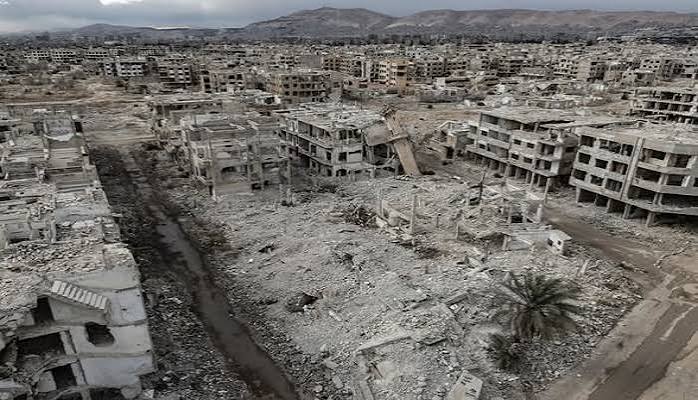
The Syrian Future Movement follows with great interest the responsible national stance announced by the Boards of Trustees for the Jobar and Qaboun neighborhoods in Damascus. In a statement issued on Tuesday, October 13, 2026 (drafted on Monday), they rejected the current proposal for the reconstruction of these neighborhoods, calling for its suspension and the submission of a revised plan that addresses the residents’ demands and ensures their meaningful participation in its formulation.
The Syrian Future Movement commends this civilized, civic stance, which reflects a profound public awareness of rights and a categorical rejection of any project that determines the future of these neighborhoods without the involvement of the original rights-holders.
The Syrian Future Movement clarifies that this rejection is not an objection to the principle of reconstruction itself, but rather to a framework that lacks even a minimum level of transparency and clarity—one that imposes financial burdens upon the residents for which they bear no responsibility.
The Syrian Future Movement notes with deep concern the specific details of the proposed plan, as documented in studies conducted by the two local councils:
First: The estimated value of the project—Current estimates suggest that the investment proposal for the reconstruction of Jobar and Qaboun amounts to approximately 21 billion dollars—a staggering figure that demands the highest standards of transparency and rigorous scrutiny.
Second: The imposition of additional financial burdens on residents—Studies by the councils reveal that the proposal shifts the costs of public facilities and infrastructure onto the project, while also expanding its overall scope—thereby increasing its complexity and financial requirements. Estimates suggest that these additional burdens—stemming from developer loans—could reach approximately $9 billion, meaning that, ultimately, it is the residents who will bear the cost.
Third: The absence of written agreements and detailed plans—The Syrian Future Movement notes with grave concern that, from the very beginning of discussions, there has been a complete lack of written documentation and detailed plans. This has fueled the spread of rumors and created divisions among the residents themselves regarding the future of the two neighborhoods and the mechanisms for their reconstruction. The Syrian Future Movement asserts that the absence of these fundamental documents constitutes a breach of the principle of transparency, deepens uncertainty, and puts the rights of the residents at risk of being lost.
Fourth: The demand to decouple the project—The Qaboun Secretariat Council has explicitly called for the reconstruction project for Qaboun to be separated from that of Jobar, given that each neighborhood faces different circumstances and they cannot be treated as a single, unified project. The Syrian Future Movement considers this demand entirely legitimate, as it is rooted in the principle of respecting the unique local context of each area.
In this context, the Syrian Future Movement reaffirms its consistent position—as stated on its official website on February 4, 2026, in a piece titled “Launch of a Center for Documenting Citizens’ Property Rights in the Qaboun and Jobar Neighborhoods”—where it welcomed the government’s initiative to document property ownership, describing it as “an essential step toward regulating real estate rights and ensuring a safe and organized return for the residents.” In that statement, we emphasized that “reconstruction is a comprehensive process that begins with the protection of human rights and private property.” We called for the next phase to be one of “reconstruction for all of Syria”—a phase in which every citizen can reclaim their property rights without fear of conflict or unlawful seizure.
The Syrian Future Movement also reiterates its position—published on August 29, 2026, under the title “A Stand Against Expropriation and Old-Lease Laws”—in which it affirmed that “the protesters’ demands—centered on rejecting the expropriation and old-lease laws dating back to the era of the defunct regime—are just and legitimate, reflecting the genuine suffering endured by thousands of Syrians for decades.” The Syrian Future Movement views the current events in Jobar and Qaboun as a continuation of this suffering and a true test of the state’s commitment to the principles of justice, transparency, and popular participation.
The Syrian Future Movement points out that the residents’ rejection of the current framework is based on clear legal grounds, most notably:
First: Law No. 10 of 2018, enacted during the era of the ousted regime, which has been used as a tool for the seizure of property and the engineering of demographic change. The Syrian Future Movement maintains that no reconstruction project in Jobar and Qaboun should be built upon this law; rather, it must be repealed or radically amended—consistent with the demands the Movement has made in previous statements.
Second: The principle of public participation in urban planning decisions, which constitutes a fundamental right for citizens, guaranteed by both the constitution and international law. The Syrian Future Movement points out that international experience has demonstrated that reconstruction projects only succeed when they are built upon a genuine partnership with local communities.
Third: The German experience in the reconstruction of Berlin following the country’s reunification relied on a broad, participatory model. Residents were involved in the design of reconstruction projects, and transparent compensation mechanisms were established; this transformed the reconstruction into an inclusive national process rather than a source of conflict.
Fourth: The Lebanese experience in the reconstruction of Beirut—despite its complexities—shows that a lack of transparency and community participation led to long-standing property disputes and the marginalization of the most vulnerable groups. The Syrian Future Movement believes that Syria can avoid these pitfalls by adopting a transparent, participatory approach from the outset.
Guided by its national responsibility, the Syrian Future Movement makes the following recommendations:
First: An immediate response to the residents’ demand to halt the current proposal and begin, without delay, the development of alternative models. These models must safeguard the rights of the residents and preserve the existing demographic composition and social fabric. Furthermore, the demand to separate the Qaboun project from the Jobar project should be taken into account, given the distinct circumstances of each neighborhood.
Second: The full disclosure of all plans and studies related to the project, with a clear, written, and public articulation of the rights and obligations of all parties involved. This information should be made accessible to the general public and specialists alike, in order to dispel rumors and put an end to speculation. The Syrian Future Movement emphasizes that transparency is not merely an option, but a fundamental prerequisite for building trust between the state and its citizens. Third: Effectively and directly involving representatives of the local community in all decision-making processes by establishing a joint committee that includes representatives of the residents, as well as experts in urban planning, law, and… …a body responsible for reviewing the current proposal, developing alternatives, and overseeing implementation. The Syrian Future Movement asserts that the decisions of this committee must be binding, not merely advisory.
Fourth: The announcement of clear and fair criteria for compensation and investment ratios, ensuring that the rights of property owners remain uncompromised, while taking into account the socio-economic circumstances of the most vulnerable groups. The Syrian Future Movement proposes that compensation should be no less than 70% of a property’s market value, with owners offered multiple options (such as cash compensation, an alternative housing unit, or a partnership stake in the project).
Fifth: The repeal or amendment of Law No. 10 of 2018, and the adoption of new legislation that protects property rights, prevents the seizure of assets under any pretext, and guarantees the right to appeal or file a grievance for any citizen who believes their rights have been infringed upon.
Sixth: The adoption of a principle of full transparency throughout all stages of the project, facilitated by independent oversight mechanisms, the regular provision of information, and the publication of periodic financial and technical reports concerning costs, funding, and implementation.
The Syrian Future Movement commends the stance taken by the Boards of Trustees for Jobar and Al-Qaboun, viewing it as a national model—worthy of emulation—for advocating for one’s rights through peaceful and legal means.
The Syrian Future Movement emphasizes that the reconstruction of Jobar and Al-Qaboun is not merely an urban development project; rather, it serves as a genuine test of the new state’s commitment to the principles of justice, transparency, and popular participation. It is worth noting that the construction of a new Syria cannot be achieved at the expense of the rights of its own people; any reconstruction project that lacks social consensus is inherently flawed, regardless of the developmental justifications offered for it.
The Syrian Future Movement reiterates its call to the transitional government and the Damascus Governorate to address the residents’ demands and to engage with them as partners in shaping the future of their neighborhood—rather than treating them merely as beneficiaries of a project that determines their fate without their participation.