
Introduction:
Since the fall of the Assad regime on December 8, 2024, Syria has entered the most critical transitional phase in its modern history. Following more than five decades of single-party rule—and decades of “systematic political desertification” that stripped public life of any genuine partisan substance—the country faces a dual challenge: building new state institutions and forging a new political legitimacy rooted in representation and citizenship.
Central to this challenge is the political parties law—a measure promised by the transitional authority since the People’s Assembly convened on July 12, 2026, yet one that remains absent to this day.
This absence now appears as a strategic void, threatening to hollow out the transitional period of its democratic content and potentially reviving the logic of single-party monopoly that entrenched one party’s dominance over state and society for decades.
This article examines the pivotal roles political parties play during transitional periods and analyzes the consequences of delaying the political parties law within the Syrian context. Drawing on theories of democratic transition and comparative international experiences, it outlines future scenarios and offers practical recommendations.
First:Theoretical Framework
Literature on democratic transition emphasizes that political parties are not merely an “institutional sideline” that can be deferred until state-building is complete; rather, they constitute the essential infrastructure for peaceful political competition. Comparative theory suggests that political parties perform functions that no other institution can carry out as efficiently: structuring electoral competition, providing citizens with a symbolic identity, forming governments, and aggregating voter interests to convey them to decision-making centers.
Linz and Stepan note that democracy is consolidated only through a tripartite interaction between the state, the market, and civil society; none of these components can become an effective political actor without institutionalized party mediation.
The International Political Science Association (IPSA) poses a fundamental question:
How can parties build democracy during a transitional phase when they are themselves still under construction?
The answer is that, despite their fragility, parties remain the primary actors in managing political competition. Successful experiences in Spain, Portugal, Eastern Europe, and Tunisia were grounded in political reconciliations centered largely on parties, in cooperation with civil society.
Schmitter further points out that, in post-authoritarian contexts, parties undertake the task of legitimizing the new regime in the public consciousness, as they serve as the primary channel for translating popular demands into public policy.
The importance of these functions is magnified in divided societies or those emerging from conflict. Here, cross-cutting parties act as “mobilization agents,” helping to integrate local groups into the broader national fabric, rather than allowing primordial loyalties—such as sectarian, tribal, or regional affiliations—to fill the void. Thus, the absence of political parties does not signify an “absence of political conflict”; rather, it leaves the conflict in the hands of non-institutional networks that are subject to neither accountability nor legal rules.
Another crucial theoretical framework for analyzing the Syrian context is the concept of the “public service bargain.” This concept explains the dual dilemma facing new revolutionary regimes: on one hand, they require loyalists to ensure the stability of the new order; on the other, they need competent professionals to manage the bureaucracy and political partners to confer representative legitimacy upon the regime.
In the absence of political parties, this partnership fails to materialize, and the “public service bargain” devolves into a narrow pact of loyalty between the authorities and a limited circle of supporters—a shift that undermines the regime’s legitimacy in the long run.
Secondly, the legislative vacuum and its impact on representative legitimacy:
The Syrian landscape today is characterized by a fundamental contradiction. On one hand, there is official acknowledgment of the need for a political parties law; Interim President Ahmed al-Sharaa affirmed on March 5, 2026, that “Syria will have a political parties law, and legal experts will establish its regulations and foundations,” noting that he would not draft it alone but would entrust the task to experts and specialists.
On the other hand, subsequent statements have seen this commitment retreat into a more cautious stance, with the political parties law being framed as a measure to be deferred until the constitution is finalized. In practical terms, this means that party-based political life will remain in limbo until the end of the transitional period. MP Nawar Najma—a member of the committee that oversaw the formation of the parliament—clearly articulated this reservation, stating that political parties “should not be established until Syria achieves stability, develops a new social contract, and reaches a sufficient level of political maturity.”
He further noted that “this experiment is taking place during a transitional phase characterized by limited public trust in party-based activity, deep societal divisions, and constrained capacity for organized political action.”
This legislative vacuum leaves political actors outside a clear regulatory framework, thereby undermining the representative legitimacy of the transitional period—particularly given the absence of a legislative body capable of enacting a definitive law.
Fadel Abdul Ghany, a legal expert and director of the Syrian Network for Human Rights, warns that “replicating a similar legal model—even under a different name—could effectively mean reproducing the same system, where actual power remains centralized despite the apparent multiplicity of party structures.”
He adds that Syria requires a temporary, transitional law on political parties rather than a permanent one; a permanent law presupposes a stable constitutional consensus regarding the nature of the political system and national identity—conditions that have not yet been met.
This analysis aligns with the views of researcher Samir al-Abdullah from the Arab Center for Contemporary Syrian Studies. He argues that the absence of political parties in the current People’s Assembly cannot be taken as an indicator of a lack of political pluralism, given the exceptional nature of the current phase—which follows more than five decades of single-party rule and fourteen years of war. However, this justification does not excuse the continued absence; rather, it merely explains the circumstances of the initial formation and places a greater responsibility on the Council to remedy this shortcoming by enacting a law that restores confidence in organized political activity.
Thirdly, arguments for delay and a critique thereof:
The transitional authority—and certain voices aligned with it—advances a set of arguments to justify delaying the political parties law. These arguments essentially posit that Syria has not yet achieved “sufficient stability” and that hastily formed parties could become instruments for entrenching sectarian, ethnic, tribal, and regional divisions, rather than serving as vehicles for national competition based on political platforms.
However, this line of reasoning rests on a dangerous fallacy. As an analysis by Majalla magazine points out, the assumption that stability, political maturity, national unity, and a new social contract can all be achieved prior to allowing organized political life to develop is flawed. These are inherently political objectives that cannot be resolved in isolation from the active participation of political forces.
Transitional justice, for instance, entails difficult choices regarding accountability, punishment, reconciliation, and reparations. Such choices cannot be left solely to the transitional authority; rather, they require genuine negotiation among groups possessing deep-rooted legitimacy.
More alarmingly, early indications from the current council’s experience suggest that the absence of political parties does not yield an “independent parliament.” Instead, it produces a body that is largely subservient to the executive branch. The People’s Assembly—following its inaugural session—appeared more like an extension of the presidency, thereby limiting its capacity to perform the traditional functions of a parliament, most notably the oversight and accountability of the executive authority. Researcher Samir Al-Abdullah asserts that “the presence of active political parties within the council would have infused its work with greater vitality by enriching debates on public policy, enhancing oversight of government performance, and transforming political differences into institutional, platform-based competition rather than clashes of personalities.”
Fourth: The risks associated with continued delay:
The ongoing absence of a political parties law in Syria entails a range of risks, which can be summarized across three levels:
Regarding legitimacy: This absence undermines the representative legitimacy of the transitional phase, as citizens lack institutional channels to express their interests and aspirations.
The Tunisian experience—considered the most successful within the context of the Arab Spring—demonstrates that democratic transition was achieved through an independent high-level body comprising representatives from political parties and civil society; this body advised the transitional government and drafted the electoral laws that paved the way for elections.
Regarding stability: An analysis by Al-Majalla newspaper warns that “stability cannot rely on suppressing every institution capable of organizing the opposition.”
Instead of fostering genuine stability, the delay risks stripping peaceful protests of institutional outlets, pushing them toward informal—and difficult-to-control—trajectories.
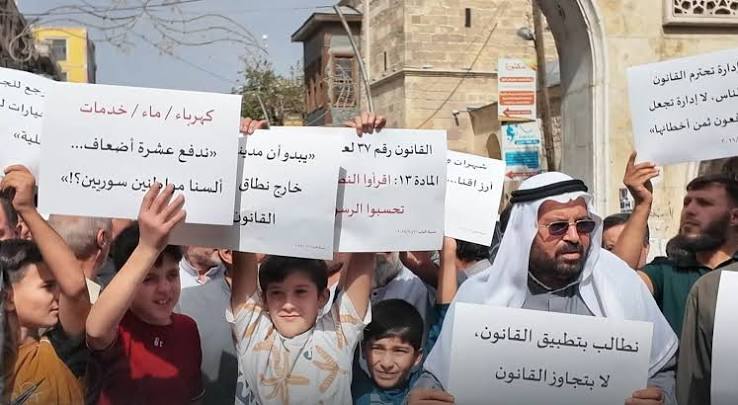
Syria’s experience during months of recurring protests has shown that public anger inevitably seeks channels for expression; the absence of political parties does not eliminate this anger but rather deprives the authorities of the ability to contain and channel it. Regarding state-building: The absence of political parties poses an obstacle to constructing a modern state, as the political vacuum left by their absence is filled by traditional communal ties—such as family, tribe, region, and sect. These ties are unsuitable as a foundation for a modern state, as they marginalize individual identity and curtail intellectual and political choices.
An analysis by Al-Thawra newspaper asserts that any parliament lacking organized political blocs remains limited in its effectiveness; ultimately, a parliament is a sovereign political institution expected to generate legitimacy and ensure a balance of power among state authorities.
Fifth: Lessons from successful transitions:
Comparative experiences offer vital lessons for the Syrian context.
In South Africa, the first post-apartheid elections were held within the framework of a consensual constituent assembly comprising representatives from all political and social groups; political parties played the primary role in drafting the new constitution.
In Rwanda, the transitional phase relied on an inclusive national dialogue involving multiple parties and social groups, despite the country’s tragic legacy of genocide.
In Tunisia—despite the unique nature of its situation—political parties (notably Ennahda and Nidaa Tounes) played a pivotal role in the national dialogue that saved the transition process from collapse.
Conversely, experiences where the launch of party politics was postponed until state-building was completed yielded less successful results. In some Eastern European countries, delays led to the concentration of power in the hands of an executive elite and the reproduction of patterns of patronage-based rule under the guise of a “transitional phase.”
IPSA analysis indicates that countries that successfully managed their transitions were those that recognized that “political parties are instruments of democracy, but during the transition phase, they can also build democracy.”
Sixth: Future Scenarios
Scenario One: Adoption of a transitional law on political parties (the most likely scenario):
In this scenario, the authorities enact a temporary transitional law allowing national parties to register and declare their existence, subject to safeguards preventing formation along sectarian or regional lines.
The law is designed to be flexible and time-bound, linked to the constitutional and electoral processes.
This leads to the gradual revitalization of party life, the creation of institutional channels for peaceful opposition, and the strengthening of the legitimacy of the legislative council and the government.
This scenario requires political will from the authorities, alongside societal pressure from political forces and civil society.
Scenario Two: Continued delay (the pessimistic scenario):
If the delay persists and the “no parties until stability” mindset becomes entrenched, the political vacuum will be filled by informal networks (familial, tribal, and regional), and opposition will devolve into haphazard, non-institutional protests.
This could deepen the crisis of legitimacy, weaken the state’s ability to contain public anger, and increase the risk of a return to violence as a means of political expression. The third scenario, a restrictive political parties law (the worst-case scenario):
In this scenario, The authority may enact a law on political parties, yet it is often encumbered by strict constraints that render the formation of parties nearly impossible, or it grants the authority the power of “prior licensing” based on vague criteria.
This effectively reproduces the logic of a one-party system under the guise of nominal pluralism, causing citizens to lose faith in party-based activity as a vehicle for change.
Seventh: Recommendations
Based on the theoretical framework, the Syrian reality, and comparative experiences, the Syrian Future Movement recommends the following:
First: Expedite the adoption of a transitional law on political parties. There is no need to wait for a permanent constitution to enact a temporary law regulating party activity; such a law should be flexible, time-bound, linked to the constitutional and electoral processes, and automatically expire upon the adoption of the new constitution.
Second: Adopt a “notification” system rather than “prior licensing.” A party should be considered established simply by announcing its formation and registering with an independent body, with its full legitimacy subsequently established based on its actual performance in political life.
This prevents the use of vague legal provisions as tools for political exclusion and guarantees freedom of organization without compromising state stability.
Third: Establish clear, unambiguous regulations prohibiting the formation of parties based on sectarian or ethnic grounds. These regulations must prevent the emergence of any extremist political entity based on religion, ethnicity, sect, or tribe, without allowing such measures to become tools for excluding national political forces.
Fourth: Involving political forces and civil society in drafting the law. The law should not be drafted behind closed doors but rather through a comprehensive national dialogue that includes licensed and emerging parties, trade unions, civil society organizations, and legal experts.
This ensures that the law is the product of national consensus rather than a tool for imposing the vision of a single elite.
Fifth: Linking the political parties law to upcoming elections; the parties law should serve as a precursor to the electoral law, not a substitute for it.
Parliamentary and presidential elections cannot hold true democratic significance in the absence of organized parties capable of presenting alternative political platforms to citizens.
Conclusion:
Syria stands today at a critical crossroads.
It can either choose to accelerate the construction of a national party framework—shifting political competition from the streets and digital platforms into institutions, and restoring citizens’ confidence that their voices and agendas have a place in the new state—
Or it can choose delay, allowing the political vacuum to be filled by those who operate outside the law, thereby repeating the mistakes of past decades in a new guise.
The political parties law serves as a true test of the transition period’s seriousness.
Political parties are not rewards granted only after stability is achieved; they are the very institutions through which stability is built.
The transitional authority must realize that every day passing without a political parties law represents a squandered historic opportunity to rebuild trust between the citizen and the state.
References:
- الشبكة السورية لحقوق الإنسان. (2025، 19 تموز). دعوة لتصحيح مسار الانتقال السياسي في سورية عبر تعزيز الجبهة الداخلية. https://snhr.org
- عبد الغني، ف. (2026، 24 أيار). مأزق التعددية الحزبية في سورية!. https://fadelabdulghany.net
- Beaud, G. (2022). Negotiating public service bargains in postrevolutionary times: The case of Iran’s diplomatic corps. Governance, 35(4), 1-20. https://doi.org/10.1111/gove.12712
- International Crisis Group. (2026، 27 تموز). Syria’s new parliament can build institutions and trust. https://www.crisisgroup.org
- Al-Modon. (2026، 11 آذار). الشرع: مستقبل سورية سيتضمن قانوناً للأحزاب السياسية. https://www.almodon.com
- Al-Majalla. (2026، 11 آب). Syria cannot build lasting stability in a political vacuum. https://en.majalla.com
- Rosa Luxemburg Stiftung. (2026، 22 كانون الثاني). Rebuilding Political Pluralism in Post-Assad Syria: The Crisis of Opposition Parties. https://rosalux-lb.org
- UK Government. (2026، 14 نيسان). Country policy and information note: criticism of the government, Syria. https://www.gov.uk
- Linz, J. J., & Stepan, A. (1996). Problems of Democratic Transition and Consolidation: Southern Europe, South America, and Post-Communist Europe. Johns Hopkins University Press.
- Yalla Syria News. (2026، 5 نيسان). نوار نجمة يكشف تفاصيل حصرية من إذاعة دمشق حول تشكيل مجلس الشعب الجديد ومستقبل الدستور والأحزاب. https://yallasyrianews.com