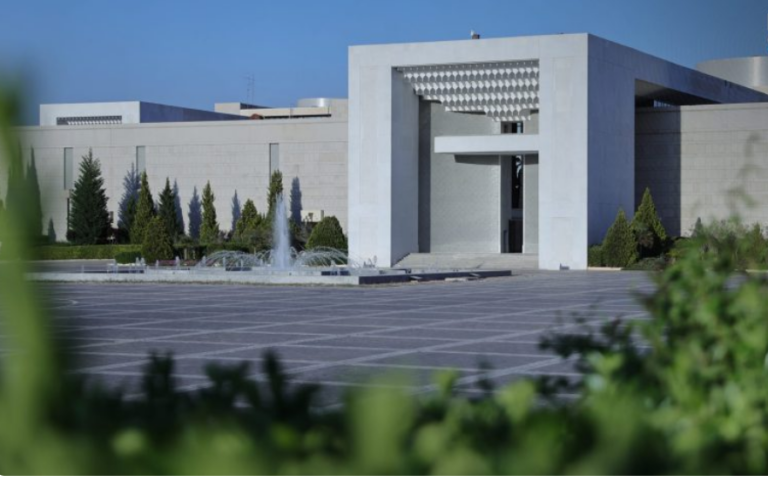

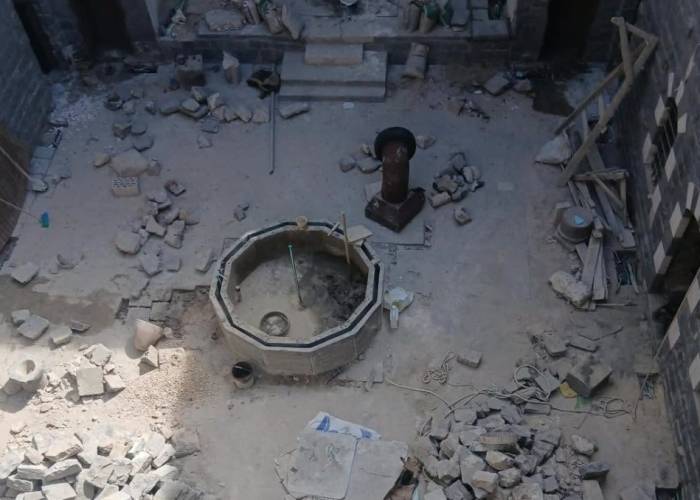
The Syrian Future Movement welcomes the decision issued by the Directorate-General of Antiquities and Museums on Wednesday, October 7, 2026. This decision mandates the suspension of ongoing restoration work at the historic Al-Zahrawi Palace in Homs, calls for an urgent field inspection of the site, orders the impounding of key elements of the investment contract, and refers the file to the Central Authority for Oversight and Inspection.
The Syrian Future Movement views this decision as a responsible response—one that heeds the voice of reason and upholds the preservation of identity—following repeated warnings regarding the dangers of treating cultural heritage through a purely commercial lens.
The Syrian Future Movement recalls an article it published on its official website on October 6, 2026, titled “Cultural Heritage: Between the Rhetoric of Protection and the Reality of Destruction.” In that piece, the Movement warned that “utilizing the property for commercial investment purposes strips the expropriation of the legal legitimacy originally intended for the public good.” It further noted that the contract signed on April 9, 2026, between the Ministry of Culture and “Al-Taer Commercial Company”—valued at 6.3 billion Syrian pounds (approximately $456,000)—raised fundamental questions regarding the fate of this heritage.
The Syrian Future Movement considers the decision to halt the work and impound the contract a practical realization of its own calls for action, and a reaffirmation that the protection of heritage is both a national and moral responsibility. The Syrian Future Movement considers the admission by Ayman Nabo—Deputy Director-General of Antiquities and Museums—regarding “legal and procedural errors and violations” that marred the investment process to be a significant acknowledgment; one that must be built upon to advance the path of accountability.
The Syrian Future Movement notes the specific details of the case as documented by sources:
First: Background of the contract and the executing company – On April 9, 2026, the Ministry of Culture signed a contract worth 6.3 billion Syrian pounds with “Al-Taer Commercial Company” to restore Al-Zahrawi Palace and Dar Mufid al-Amin in Homs.
According to official documents, the company “possesses no history or expertise in the restoration of historical landmarks.”
The Syrian Future Movement views this stark contradiction between the nature of the task (restoring an archaeological site) and the nature of the executor (a commercial company lacking experience) as the core of the problem.
Second: Legal issues from the outset – Nabo indicated that Al-Zahrawi Palace had been the subject of legal complications since it was first proposed for investment, due to a prior decree mandating its conversion into a museum of folk traditions.
The Syrian Future Movement points out that the property was expropriated in 1977 for the General Directorate of Antiquities and Museums “with the aim of converting it into a museum,” raising a legitimate question: How was it transformed into a commercial project (a restaurant and hotel) without revisiting that decree? Third: Exceeding legal authority – Audits revealed that the contract value (6.3 billion Lira) “exceeds the limits of administrative and legal authority granted to the Minister of Culture,” as such sums “invariably require the approval of the State Council—a step that was missing from the contracting file.”
The Syrian Future Movement considers this overreach not merely a minor administrative error, but a violation of the law that warrants accountability.
Fourth: Procedural irregularity in the signing sequence – Evidence indicates that the Minister “signed the ‘notice to proceed’ first, only for the document to be sent subsequently to the Director of the Directorate of Antiquities and Museums for signature”—a reversed sequence that violates established protocols.
The Syrian Future Movement views this irregularity as reflecting a “mentality of haste” that fundamentally conflicts with the principles of heritage preservation, which require time, specialized expertise, and consultation.
The Syrian Future Movement commends the response of the Directorate General of Antiquities and Museums and the referral of the file to the Central Authority for Oversight and Inspection.
It considers this step—albeit belated—a positive turning point in the handling of cultural heritage matters, confirming that calls to preserve national identity have not gone unheeded.
However, the Syrian Future Movement maintains that halting the work is insufficient on its own; a genuine response requires seeing the accountability process through to the end and ensuring that no one responsible for negligence escapes punishment, regardless of their position. We also call for extending this approach to all archaeological sites vulnerable to ill-conceived investment projects, similar to what occurred at Al-Zahrawi Palace.
Acting upon its national responsibility, the Syrian Future Movement recommends the following:
First: We call upon the Central Authority for Oversight and Inspection to expedite its investigations, determine individual accountability for legal and administrative violations, refer those found responsible to the judiciary, and announce the findings to the public.
Second: Conduct a comprehensive review of all contracts regarding the investment of archaeological sites in Syria to ensure compliance with governing laws and the nature of these historical sites, and to guarantee that their cultural value remains uncompromised.
Third: Re-examine the outdated laws governing the investment of archaeological sites and work toward enacting new legislation. This legislation must ensure that any investment in heritage takes place within a framework that protects the sites’ cultural value, mandates specialized expertise in archaeological restoration, and is subject to rigorous oversight.
Fourth: Involve universities, research centers, and heritage-focused civil society organizations in any project concerning archaeological sites. This aligns with the Movement’s statement regarding the “Syrian-Jordanian agreement to renew and develop cultural cooperation agreements” (dated July 23, 2026), which emphasized that “protecting cultural heritage is not the sole responsibility of government institutions, but rather a shared national and societal responsibility.” The Syrian Future Movement supports the decision to halt the restoration of Al-Zahrawi Palace and suspend its contract, viewing this as a victory for the voice of reason and a response to calls for preserving national identity.
It reiterates that Al-Zahrawi Palace is a living memory of the city of Homs and part of the human heritage deserving of protection.
We also affirm that protecting cultural heritage is a national and moral responsibility, and that any negligence regarding this matter constitutes a failure toward future generations.
For its part, the Syrian Future Movement will continue to support all efforts that strengthen the protection of heritage and identity, while criticizing any shortcomings and monitoring work on the ground, in pursuit of a new Syria. It preserves its past and builds its future.