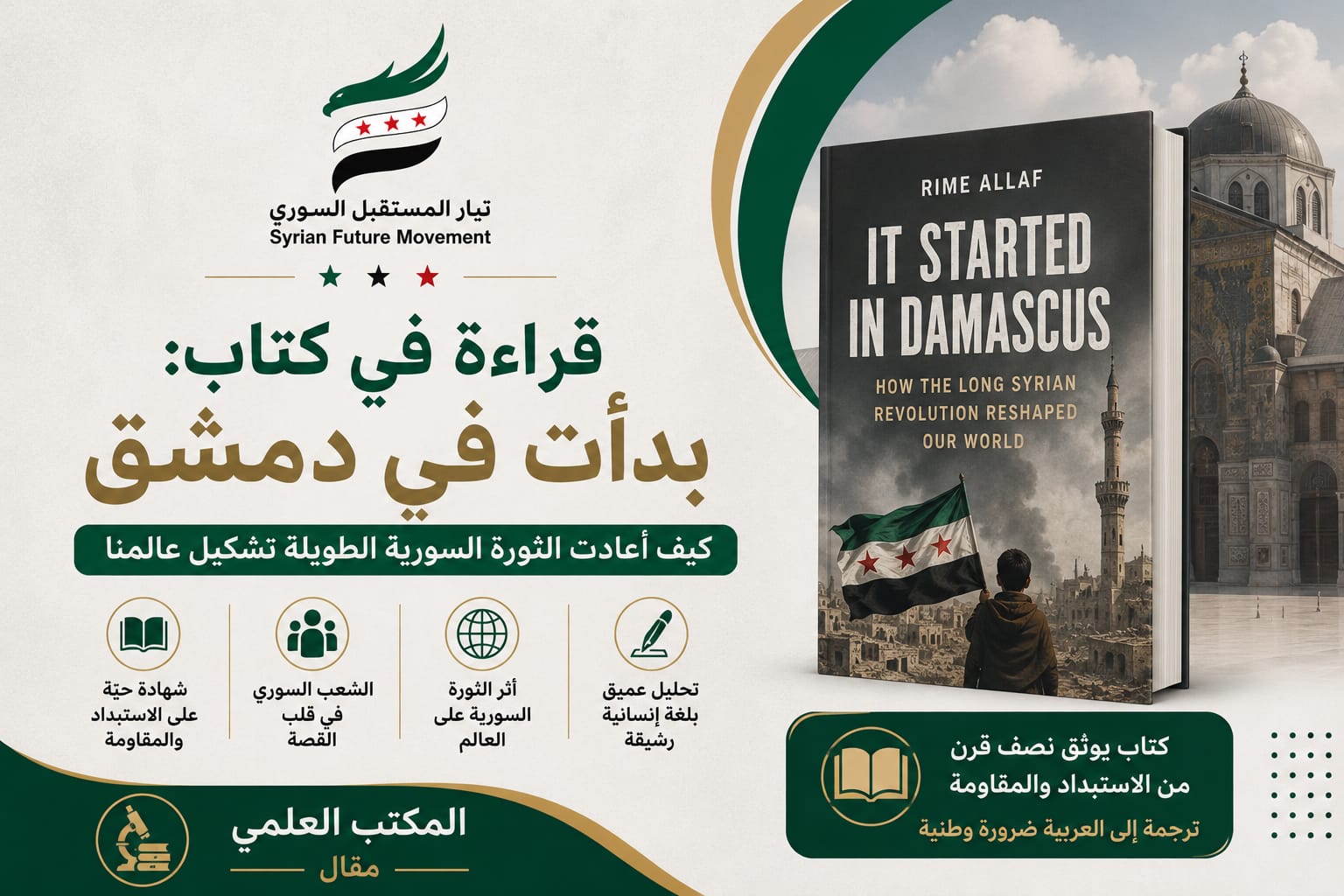
A few months after the fall of the Assad regime in December 2024, at a pivotal historical moment, a book with an ambitious title was published: It Began in Damascus: How the Long Syrian Revolution Reshaped Our World.
The book, published by Hurst Publishers in November 2025, is authored by Reem Allaf, a Syrian-born writer and political analyst, and a former fellow at the prestigious Chatham House think tank in London.
The 352-page book arrives at an exceptional time: a moment when Syrians have shifted from celebrating the fall of the dictatorship to confronting the legacy of fifty years of Assadism.
The book poses a central question: How did Syrians, after decades of oppression and marginalization, achieve what seemed impossible, despite betrayal and abandonment from all sides?
The answer, as Allaf presents it, lies not in a cold analysis of the major powers, but in the lived experience of the Syrian people, in the details of their daily lives under the yoke of tyranny.
Book Basic Information:
- Title: It Started in Damascus: How the Long Syrian Revolution Reshaped Our World
- Suggested Arabic Title: It Started in Damascus: How the Long Syrian Revolution Reshaped Our World
- Author: Rime Allaf – Writer and consultant on politics and diplomacy, former Chatham House Fellow
- Publisher: Hurst Publishers (London)
- Publication Date: November 6, 2025
- Number of Pages: 352
- Language: English
- ISBN: 9781805264118
- EBID: 9781805264842
Book Structure and Chapter Content:
The book consists of three main parts, preceded by an author’s note, followed by acknowledgments and an index. The narrative spans approximately 55 years of Assad rule (1970–2024), offering a unique blend of political analysis, personal narrative, and historical documentation.
Part One: The Patrimonial Legacy:
This part examines the establishment of the Assad regime as a machine of repression and classism, and how it transformed Syria into the private fiefdom of the Assad family.
It focuses on:
- The Rise of Hafez al-Assad (1970): How an Alawite officer from the minority became an autocratic dictator, establishing a system based on nepotism and absolute loyalty.
- The Legacy of Repression: The book documents how the regime subjected Syrians to fifty years of Assadism, tracing the mechanisms of repression, which included espionage, arbitrary arrest, and the suppression of any dissenting voice.
- The Elite Society: Allaf describes how Hafez al-Assad’s regime created a loyal “elite class,” characterized above all by its “immunity from accountability.” This class of loyal businessmen and close officers amassed enormous wealth, while the majority of Syrians suffered from abject poverty.
- Syria’s Isolation: The book recounts how the regime’s policies cut Syrians off from the world. Under Hafez al-Assad, even basic necessities like bananas and tissues were expensive luxuries, only appearing in the markets when a crony chose to stock them.
- The regime also imposed travel bans on approximately five million Syrians (nearly a quarter of the population) as punishment for their perceived disloyalty.
- The 1982 Repression: This section examines the bloodiest event of Hafez al-Assad’s rule—the Hama massacre—as a turning point in the trajectory of Syrian repression.
Key themes in this section include:
- Transforming the state into a private fiefdom for the ruling family.
- Establishing a culture of fear and silence as a mechanism of control.
- The principle of “survival of the quietest” as the norm for daily life.
Part Two: An Erratic Decade
- This part focuses on the first decade of Bashar al-Assad’s rule (2000–2011) and analyzes how the hopes of the Arab Spring turned into bitter disappointment:
- The illusion of a Damascus Spring: When Hafez al-Assad’s brutal rule ended in 2000, many believed his son would bring change.
- But Bashar’s hubris quickly betrayed him, “and he spent his first decade in power interfering regionally and breaking his promises of domestic reform.”
- Bashar’s personality: Allaf describes Bashar as “arrogant yet indecisive, a clumsy politician and a narrow-minded, incompetent ruler.”
- This combination of hubris and indecisiveness was disastrous for the country.
- Nepotism and corruption: Under Bashar, “the crony elite and their entourage flaunted their vast wealth, in stark contrast to the impoverishment of the majority of Syrians.”
- The Kingdom of Silence: The book explains how “most people followed the ‘survival of the quietest’ rule” in what became known as the “Kingdom of Silence.”
- It was “the elite who made all the noise.”
- The Uprising and the Brutal Response: When Syrians finally rose up in the 2011 revolution, they were “brutally crushed by the regime—with extensive Iranian and Russian support—and abandoned by the Western powers that had claimed to support them.”
Key ideas in this section:
- The shattering of hopes for reform and the transformation of the dream into a nightmare.
- The exposure of the regime’s true nature when faced with a popular challenge.
- The stark gap between the elite’s wealth and the people’s poverty.
Part Three: The Revolution for Dignity
This part examines the Syrian revolution (2011–2024) and the fall of the regime, highlighting:
- The Resilience of the People: It recounts how Syrians persevered despite brutal repression, international intervention, and Western abandonment, and how, despite betrayal and abandonment on multiple fronts, the long Syrian revolution finally broke through.
- Western Misrepresentation: The book devotes space to revealing how “Western scholars, journalists, politicians, diplomats, and even ‘anti-imperialist’ activists consistently ignored the circumstances and aspirations of ordinary Syrians.” Allaf accuses these commentators of “failing to see Syrian society beyond Orientalist assumptions and geopolitical headlines that often proved to be false.” Their reporting was “superficial… laden with clichés.”
- The Global Impact: The book discusses how the consequences of the Syrian revolution continue to “resonate internationally, in the largest refugee crisis since World War II and in a new world order that has weakened democracy and favored authoritarian regimes.” Authoritarianism.
- After the fall: With the regime’s collapse in December 2024, Syrians face a new challenge: “With a new authority “A hand in Damascus: Can the people shape the Syria they’ve dreamed of for a quarter of a century?” The book poses an open question about transitional justice and the legacy of a struggle that began many years ago.
Key ideas in this section:
- The Syrian revolution was a decades-long struggle.
- Western disinformation as part of the Syrians’ suffering.
- The enormous challenges facing post-Assad Syria.
Key insights and conclusions:
- “Assadism” as a lived experience: The book captures the ironic, absurd, and brutal nature of the Assad era better than any other reviewer has encountered.
- It traces how Assadism seeped into language, memory, and conscience, rooted in social customs shaped by fear and scarcity.
- The Central Bank and Tabbouleh Story: The most powerful story in the book is her visit to a relative at the Central Bank. There, she found employees talking about their families, then pulling out chopping boards and starting to prepare tabbouleh in the middle of the workday. When the manager entered, he joined in the fun. Al-Allaf reflects on this “brutal, self-serving sectoral machine that dragged productivity and efficiency to the ground, and frustrated and exhausted citizens who had to contend with the hell of Ba’athist bureaucracy.”
- Western Misrepresentation as Part of the Tragedy: The book accuses Western commentators of “failing to see Syrian society beyond Orientalist assumptions and geopolitical headlines.” This critical perspective on the West is what makes the book unique.
- The Long Revolution: The book views the Syrian revolution as a decades-long struggle, not merely the 2011 uprising.
- A Warning to the World: The book is not limited to Syria; it sees it as a mirror to the Middle East and the world.
- As Janine di Giovanni writes, “To understand the future of the Middle East—with all its risks and possibilities—one must first understand Syria.”
Critical Reading
A. Strengths:
- A Human Voice Above Ideological Noise: As Dima Wannous observes, the book’s human voice “rises above the din of military analyses, grand political issues, ideology, and stereotyping, placing the Syrian people at the heart of the story: their dreams and disappointments, their astonishing resilience, and their determination to live, despite all the death that has surrounded them for decades.”
- Blending the Inside and the Outside: Allaf’s unique position—Syria from within (as a Damascene by origin) and an analyst from a Western background (English being her first language)—gives her the ability to see what others do not and translate it for a Western audience in a language they understand.
- Lived-Out Details: Small stories—like the tale of the tabbouleh at the Central Bank—convey the essence of tyranny in a way that statistics and reports cannot. This is what makes the book “disturbing, compelling, and sometimes breathtaking.”
- A Critique of Western Misinformation: The book offers a scathing critique of the Western stance on Syria, which gives it a rare analytical dimension in Western literature on Syria.
- Timing: The book was published at a pivotal moment in history, making it a vital document for understanding what has happened and what is to come.
B. Points of Criticism and Questions:
- Western Sensitivities: One critic noted that “despite being Syrian and intimately familiar with the country, the author’s sentiments are those of a Western liberal (English is her first language).”
- This might lead some Syrians to feel that the book is read more from an outsider’s perspective than from within.
- Exaggerated Title: Some considered the subtitle, “How the Long Syrian Revolution Reshaped Our World,” to be exaggerated, arguing that the book’s true strength lies not in its grand claims, but in its portrayal of life under Assad’s rule.
- Lack of In-Depth Economic Analysis: The book focuses heavily on the political, social, and psychological dimensions, but it may neglect a macroeconomic analysis of the regime’s dynamics, or the role of capital and corruption as mechanisms of governance.
- Absence of an Answer to the Question of the Future: The subtitle promises “How the Revolution Reshaped Our World,” but the book—given its timing—cannot provide a definitive answer about Syria’s future, leaving the reader with an open question.
Conclusion:
“It Began in Damascus” is more than just a book about Syria; it is a living testament to the devastation wrought by tyranny and a narrative of a people’s resistance and refusal to be broken.
As Lise de Sette described it, it is “a history in motion,” and as Dima Wannous called it, “one of the most important books on Syria and its revolution.”
However, a major obstacle to the wider public benefit of this valuable work remains: language.
The fact that the book is only available in English deprives the vast majority of Syrians—including activists, writers, historians, and local researchers—of direct access to its profound narrative.
Therefore, we recommend that this book be translated into Arabic as soon as possible, whether by the publisher itself or through the initiative of research centers or funding bodies.
This book places the Syrian people at the heart of the story—their dreams and disappointments, their astonishing resilience, and their determination to live despite the death that has surrounded them for decades.
This voice needs to be heard by Syrians in their own language.