
The recent security appointments in Syria are not merely a change of names, nor simply a redistribution of responsibilities within the state hierarchy. They represent a political and institutional moment that warrants careful consideration, as they touch upon the very nature of the emerging system and the relationship being forged between power and the state, between trust and competence, between security and politics, and between the center of power and the rest of the nation.
The recent decisions included assigning Interior Minister Anas Khattab to head the National Security Bureau in addition to his existing duties, and appointing new leaders in the General Intelligence Directorate, the Ministry of Interior, and the National Security Bureau. Regardless of one’s personal assessment of any of those appointed, the concentration of highly sensitive security positions, or their association with a limited number of individuals belonging to narrow circles of trust, raises a question that transcends individuals and reaches the very structure of governance itself. Is Syria today moving towards building a national security apparatus governed by institutions, laws, and diverse centers of expertise, or towards a concentrated system of loyalty based on personal trust and proximity to the center of power?
It is natural for any president, especially during a turbulent transitional period, to need trusted individuals in sensitive positions.
A state emerging from a protracted war, threatened by security breaches, dismantling projects, and armed chaos, cannot afford to be naive in its handling of security matters. This is something we understand and acknowledge.
However, there is a profound difference between trust being a prerequisite for appointment and personal trust becoming the “ruling condition” for every appointment, the criterion that supersedes competence, experience, national representation, and institutional accountability.
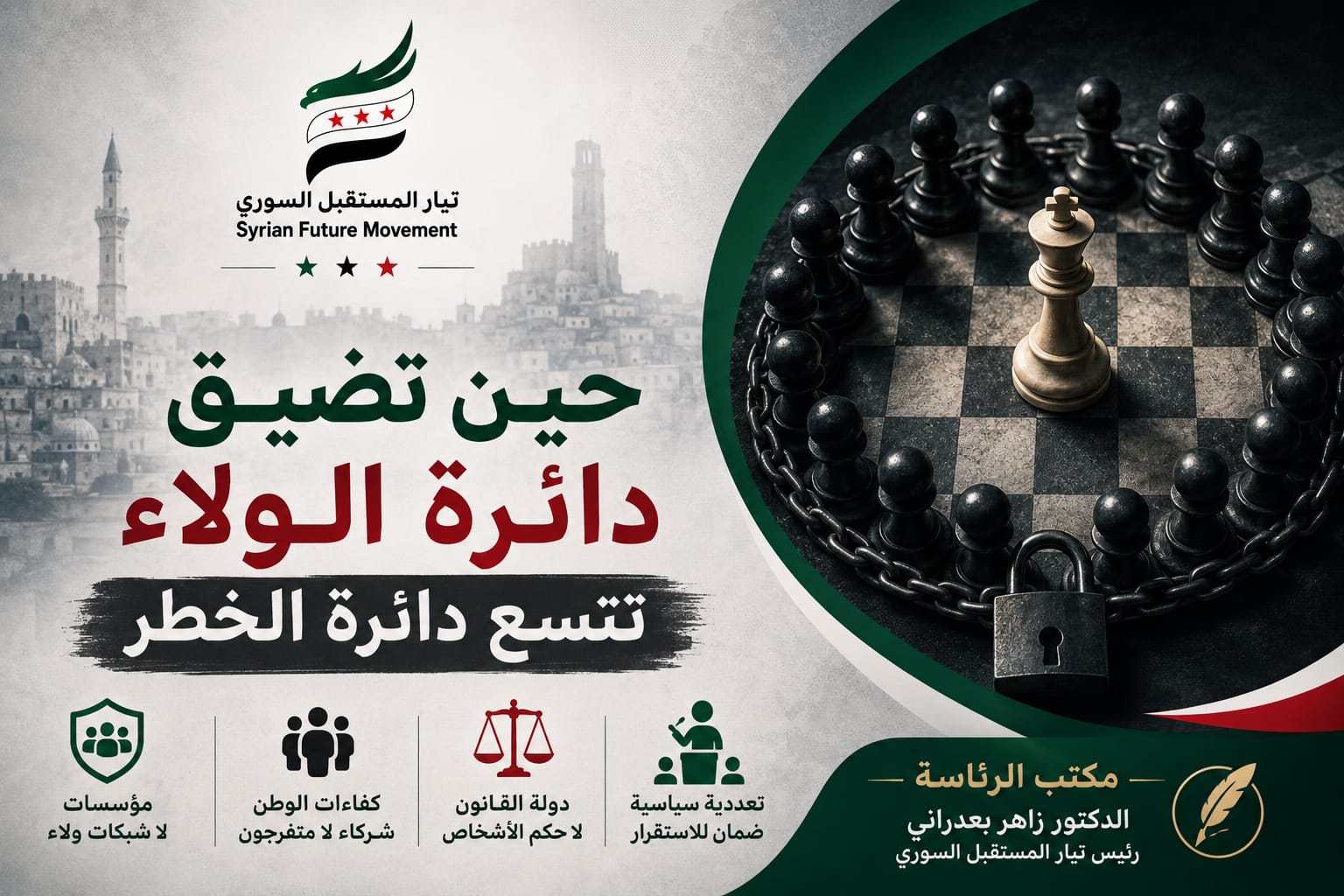
Trust is essential, but a state built solely on trust is not a stable state; rather, it is a closed human network whose well-being depends on the integrity of its internal relationships.
A circle whose members are chosen based on absolute loyalty may appear more cohesive and less risky to the president, but it harbors inherent dangers that are not immediately apparent.
The first of these dangers is that narrowing the circle of loyalty does not protect the center of power; instead, it isolates it.
The fewer people allowed close to the president, and the higher the criteria for personal trust, the more susceptible the information reaching the head of state becomes to selection and filtering. Here, the president no longer sees reality as it is, but rather as his inner circle allows him to see it. The problem then lies not necessarily in the ill intentions of this circle, but in the inherent nature of any closed group: to protect its position, affirm the correctness of its choices, and downplay the importance of voices from outside.
Over time, the circle of trust transforms into a closed circle of perception, then into a closed circle of decision-making, and finally into a circle of mutual interests.
Criticizing a decision becomes a threat to the circle, objecting to one of its members becomes an objection to the president, and demanding broader participation becomes a questioning of the state’s stability.
This is where the real danger begins! The ruler is no longer protected by institutions but surrounded by individuals, and these individuals, however loyal, are prone to change, make mistakes, compete, conceal information, and fear admitting failure.
Institutions, on the other hand, are built precisely to prevent an individual’s error from becoming a state error.
The most loyal circles may be the most capable of reassuring the president, but they are not necessarily the most capable of warning him. In politics and security, decision-makers need not only reassurance but also the courage to tell them that their assessments might be wrong, that some of their policies are creating unnecessary enemies, and that those they sideline today might be needed tomorrow (if they can find them).
A circle built on absolute loyalty is, by its very nature, less willing to deliver bad news.
Every official within it knows that their position rests not only on their professional success but also on their image in the eyes of those who appointed them. Therefore, they tend to conceal shortcomings, embellish results, blame others for failures, and eliminate anyone who might expose poor performance.
Thus, the loyalty intended to guarantee governance becomes a source of its own deception.
The second danger is that the balance of competence and loyalty itself becomes monopolized by a narrow circle.
Who determines who is a patriot? Who decides who is loyal? Who distinguishes between a sincere opponent and a dangerous competitor? Who decides which expert deserves to be in the government and which should remain outside? When there are no declared standards, no independent committees, no legislative oversight, and no clear institutional pathways for appointment and promotion, the de facto answer becomes “the circle itself.”
Here, loyalty is no longer a general national value, but rather a certificate issued by a limited group.
A person may be loyal to Syria, with a history of involvement in the revolution, public service, or expertise, yet be excluded because they don’t know anyone within the circle, or because they hold an independent opinion, or because they refuse to allow their experience to be used to justify decisions.
Thus, the concept of loyalty is transformed from loyalty to the state to loyalty to whoever defines the state.
This is one of the most dangerous transformations that can occur during transitional phases. The new state is supposed to broaden the meaning of belonging, not narrow it.
It is supposed to give Syrians a sense of partnership in building their nation, not make them wait for a small group to recognize their patriotism.
The third danger is that these circles of loyalty not only exclude their opponents, but also those who are truly loyal but don’t belong to them. In Syria today, there are thousands of officers, experts, academics, lawyers, economists, administrators, and politicians who possess the knowledge, experience, and ability to contribute to nation-building, yet they find no natural path to decision-making.
Some lived through the years of the revolution, some confronted the former regime, some remained in the country and preserved its institutions, and some returned from abroad bringing expertise the nation needs.
But when the doors of the state become governed by personal relationships of trust, these individuals understand that experience alone is not enough, patriotism is not enough, a vision is not enough, and what is required is entry into the network of loyalty or remaining on the margins.
This not only leads to the loss of talent but also to its psychological and political transformation.
From a constructive energy to a mass of frustration.
An individual excluded due to a lack of competence may accept self-improvement, but one who feels excluded, regardless of their competence, simply because they are not part of the inner circle, loses faith in the fairness of the entire system.
As this feeling accumulates, the tension is no longer confined to the power structure and its opponents, but extends to the vast space encompassing the loyal, the independent, the hesitant, and those with national projects.
This space is what determines the stability or fragility of nations, for it is not inherently hostile, but it may be driven to alienation from the state if it feels ignored.
One of the most dangerous things any new authority can do is transform national neutrality into hostility, independence into suspicion, criticism into a security threat, and political organization into a threat to the state.
Here, the security threat intersects with the political threat.
As the circle of decision-making and appointment narrows, calls increase for postponing the formation of political parties, curtailing political movements, or deeming party activity premature. Syrians are told that the priority now is state-building, and that politics can come later.
But this separation between state-building and political life is misleading! A state cannot be built in a vacuum, and the transitional phase cannot continue without organized channels for participation, expression, deliberation, and accountability.
When the doors of appointment are closed to those outside the circles of trust, and then the doors of party activity are shut down under the pretext of timing, where do those with visions, projects, and expertise go? How do they participate? Through what institution do they express their ideas? And how do the demands of society reach the decision-making center?
Preventing politics does not eliminate it; rather, it pushes it into the shadows.
Postponing political parties does not postpone disagreements; rather, it prevents their peaceful organization.
Weakening national movements does not strengthen the state; rather, it leaves society without frameworks capable of absorbing tension, representing interests, and producing elites.
A country that does not allow for organized political opposition will produce disorganized dissent. Countries that fail to open peaceful avenues for participation will inevitably open paths to silent anger, isolation, emigration, regional and sectarian divisions, and perhaps even rebellion in later stages.
Political parties are not a luxury to be postponed until after the state has been established! They are one of the means that prevent the state from becoming an authority without society.
Pluralism is not inherently dangerous to the transitional phase, but the danger lies in pluralism without the rule of law, weapons outside the control of the state, foreign funding, or projects of division.
As for national parties that operate within the framework of the law, sovereignty, and national unity, their existence broadens the state’s base and provides it with partners instead of leaving it surrounded by bystanders and resentful individuals.
The combination of security monopolies and political repression creates an extremely dangerous environment, because security becomes devoid of political balance, politics lacks institutional protection, and society is deprived of genuine channels for expression. When a single official combines the Ministry of Interior and the National Security Bureau, stricter institutional and oversight safeguards are required, not because the individual is under suspicion, but because concentrating power in one person increases the level of risk.
The Minister of Interior is responsible for a broad executive apparatus, while the National Security Bureau is supposed to play a coordinating and strategic role among the various agencies.
Combining the two functions may increase efficiency and speed of coordination in some circumstances, but it can also lead to a concentration of security responsibilities within a single center unless the boundaries of jurisdiction and accountability are clear and transparent.
In a modern state, security is not built solely on the assumption of the official’s integrity, but on the institutional design, ensuring that an individual’s mistakes, deviations, or misjudgments do not lead to the collapse of the entire system.
Sound systems do not say, “We trust this person, therefore we grant them broad powers.” Rather, they say, “We may trust them, but we build our institutions on the possibility of error, and we establish a separation of powers, oversight, accountability, and multiple sources of information, because the security of the state is too important to be tied to any one person, no matter how loyal they may be.”
The fourth danger is that the circle of loyalty itself does not remain unified forever.
Every close circle harbors within it a hidden struggle for proximity, influence, and the interpretation of the president’s will.
When positions and authority are based more on personal relationships than on institutional principles, each individual within the circle becomes preoccupied with protecting their position from the others.
This leads to the emergence of sub-loyalties within the larger circle, factions within the group, competing information centers, attempts to eliminate rivals, and a race to gain access to the president. National security may gradually transform into the security of positions within the power structure.
In the early stages, this conflict may be concealed behind a facade of harmony, but it surfaces at the first major crisis, security failure, succession dispute, decline in the regime’s popularity, or external pressure.
At that point, the regime discovers that the circle it considered a solid wall was, in reality, a network of relationships held together by the power of the center, not by the strength of institutions.
If the center falters, the circle falters with it.
This is what makes narrowing the circle of loyalty a danger to the circle itself before it is a danger to others.
Whenever a small group monopolizes responsibility, it also monopolizes the consequences of failure.
Whenever it excludes partners, it loses those who could defend the experiment when it is threatened.
Whenever it marginalizes national forces, fewer people will see the success of the new era as a personal success.
Herein lies the great paradox! A regime that narrows the circle of participation, believing this will protect it, may find itself alone at the first crisis, because most of society was not a partner in the decision-making, nor in the responsibility, nor in the fruits of the labor.
Indeed, a broad state protects the ruler, while a narrow circle makes him responsible for everything.
In Syria, where society is exhausted, fragmented, and burdened by a heavy memory of tyranny and security apparatuses, rebuilding the security system requires extra sensitivity.
Syrians do not view the security apparatus as ordinary administrative institutions; rather, they harbor a deep-seated historical fear of it.
Therefore, any ambiguity in its structure or concentration of its powers
Whether it’s the absence of oversight, or the closed nature of its formation, this will be interpreted through the lens of past memory, even if the intentions are different.
It’s not enough to simply say that today’s leaders are not the same as yesterday’s.
What’s required is that today’s institutions be different in their structure, laws, ideology, and accountability mechanisms, not just in the names of their leaders.
The Syrian revolution wasn’t just a revolution against specific individuals, but against an entire philosophy of governance, where loyalty to the individual took precedence over loyalty to the constitution, where the security apparatus protected the regime more than the state, and where competence remained subject to political and security vetting.
Therefore, the most dangerous thing that could happen is for the individuals to change while the philosophy remains the same! For the slogans to change while the closed system persists! For it to be said that the new phase is different from the previous one while the doors to decision-making remain governed more by proximity and loyalty than by law and competence!
I’m not saying that Syria has definitively entered this path, nor that every new appointment is conclusive proof of the establishment of a closed system. But the indicators necessitate early warning, because the function of national policy is not to wait for a danger to fully materialize and then describe it, but rather to sense it as it takes shape.
What is required is not to weaken the president, nor to dismantle the authority at a moment when the country needs stability, but quite the opposite. What is required is to protect the president and the new era from the dangers of isolation, from filtered information, from the inflated influence of those around him, and from trust becoming a substitute for institutions.
Protecting the leadership is not achieved by reducing the number of partners, but by broadening the base of the state.
Protecting security is not achieved by concentrating it within a closed circle, but by subjecting it to the law, oversight, and multiple centers of authority.
Protecting the transitional phase is not achieved by postponing politics, but by regulating it and preventing it from descending into violence or division.
Today, Syria needs an institutionalized National Security Council, not a network of patronage networks; institutions with a clear national ideology, not one based on protecting individuals; transparent criteria for appointment and promotion; legislative and judicial oversight; a clear separation between political security and partisan activity; and opportunities for qualified Syrians from all backgrounds, provided they are committed to the country’s unity, sovereignty, and laws.
It also needs a political parties law that allows for organized national political activity while simultaneously prohibiting weapons, suspicious funding, foreign ties, and sectarian rhetoric.
The equation is not between security and political parties, nor between the state and pluralism, but rather between a strong state that embraces politics and an anxious, fearful regime.
Loyalty to Syria should not require certification from a narrow circle.
National competence should not wait for personal connections to access the state.
Responsible criticism should not be interpreted as a lack of loyalty, but rather as a means of protecting the government from its mistakes.
True loyalty, however, is not about agreeing with every decision, but rather about ensuring that mistakes in decision-making do not become dangers to the nation.
The new Syria does not need to replace one department with another, nor to transfer the center of loyalty from one person to another.
It needs to fundamentally move from a state based on loyalty to a state based on the rule of law (and any delay in this transition will only increase the cost).
Because the competent individuals excluded today may emigrate tomorrow, the elites marginalized today may withdraw from public life, a society prevented from organizing may seek alternative organizations, and institutions not subject to institutional oversight may, over time, transform into centers of power. The department that appears fiercely loyal today may tomorrow become a source of competition, deception, or conflict within the regime itself.
The danger does not begin when a department turns against its leader, nor when people take to the streets, nor when the state fails to recover the lost talent. But the danger begins long before that. It begins when the ruling elite becomes convinced that a narrow circle is the source of security, when competent individuals believe they have no place in their homeland except on the condition of personal loyalty, and when politics is reduced to obedience, security to trust, and the state to those surrounding the president.
At that point, the question is no longer: Are these appointees loyal?
The more dangerous question becomes: Can Syria be built in such a way that it remains safe and strong even when the loyal ones err?