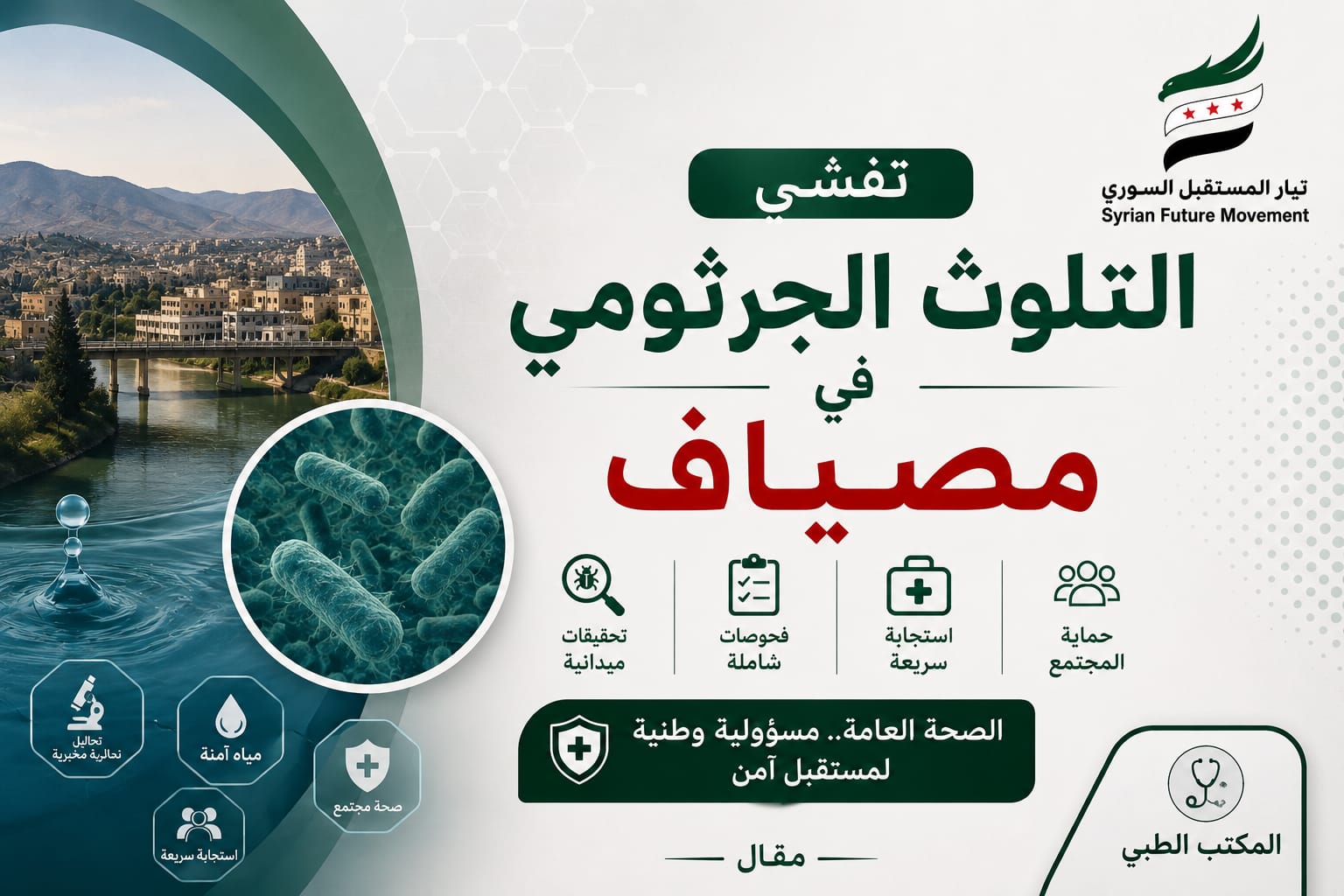
Executive Summary:
From July 11 to 16, 2026, the city of Masyaf in the western Hama countryside experienced a severe outbreak of acute diarrhea, with 769 cases reported. Of these, 38 required admission to the National Hospital and 20 to private hospitals.
Laboratory analyses of drinking water and food samples revealed bacterial contamination in most of the tested samples, while cholera was definitively ruled out.
This analytical paper aims to provide a scientific and epidemiological overview of the crisis, assess the official response, and draw lessons for strengthening the public health system in Syria.
First, the epidemiological dimensions of the incident:
The timing of the outbreak and the simultaneous appearance of cases indicate the presence of one or more sources of contamination. This is confirmed by laboratory analysis results showing that drinking water samples were “bacteriologically unfit for consumption.” The recorded figures raise several points that warrant attention:
First, the scale of the outbreak: 769 cases were recorded in just 5 days (an average of 154 cases per day) indicating that the source of contamination was widespread and affected a large segment of the population, especially given that some sources reported the number of cases reaching 500 in a short period.
Second, the severity of the infections: Although the cases were described as being in “good health,” the fact that 58 cases required hospitalization suggests that the outbreak was not limited in its severity and that some cases necessitated intensive medical intervention.
Third, the pattern of spread: The distribution of cases between the national hospital and private hospitals reflects the widespread nature of the contamination throughout the city, not just in a limited area. This necessitates expanding the scope of investigations to include all water and food sources in the city.
Second, the causes of contamination:
Based on the available data, the following hypotheses can be drawn regarding the potential sources of contamination:
- Contamination of the public water network: Tests showed that most of the water samples tested were contaminated with bacteria, suggesting a malfunction in the public distribution network or in the primary water sources (wells and reservoirs).
The poor quality of water and sanitation infrastructure in many Syrian cities, resulting from years of neglect and systematic destruction, makes this the most likely hypothesis. - Contamination of food sources: Bacterial culture results of food samples (vegetables and melons) showed that they were bacteriologically unfit.
This raises questions about the safety of food products sold in markets, the irrigation sources used in agriculture, and the extent of compliance with transportation and storage standards. - Interrelation of Sources: The contamination likely resulted from an interaction between two or more sources, as water contamination alone may not explain the diversity of contaminated food samples.
Third, Evaluation of the Official Response:
A. Strengths:
- Swiftness of Action: The Ministry of Health activated its epidemiological response immediately upon reporting the increase in cases. Investigation teams conducted field visits to hospitals and health centers, reflecting a relative preparedness of the health system.
- Comprehensiveness of Investigations: Field operations included testing public water and wells in city neighborhoods and patients’ homes, in addition to collecting food, vegetable, and melon samples for laboratory testing.
- Institutional Coordination: Coordination meetings were held with relevant authorities, including water, municipalities, supply departments, and private hospitals, to define roles. This demonstrates an understanding of the importance of collaborative efforts in addressing health crises.
- Transparency in Announcing: Announcing the test results (negative for cholera, presence of bacterial contamination) is a positive step in building trust between citizens and the health institution.
B. Weaknesses and Challenges:
- Delayed Detection of Contamination: Although the crisis began on July 11, the official announcement came days later, which may have prolonged the period of exposure to the contamination.
- Lack of Early Warning Mechanism: There was no indication of an early warning and monitoring system capable of detecting such contamination before it developed into an epidemic.
- Limited Community Awareness: Despite calls to “use safe drinking water and avoid unsafe food sources,” the official statement did not include detailed preventative guidelines for citizens on how to purify water at home or food safety standards.
- Weak Infrastructure: This crisis reflects the fragility of the water and sanitation infrastructure in Syrian cities, a heavy legacy of decades of neglect and systematic destruction.
Fourth, Practical Recommendations:
Based on the above analysis, the Syrian Future Movement’s Medical Office recommends the following:
- Strengthening the Early Warning System: Establishing a national epidemiological surveillance system for water and food, based on taking periodic samples from water and food sources in all governorates and analyzing them regularly in laboratories, with the results linked to an immediate alert mechanism.
- Rehabilitating Water and Sanitation Infrastructure: Working to rehabilitate water and sanitation networks in cities suffering from poor infrastructure quality, with a focus on rural and remote areas that may be more vulnerable to such crises.
- Activating Food Control: Tightening controls on markets and food sources, especially vegetables and fruits irrigated with potentially contaminated water, while conducting periodic tests on food products in circulation.
- Launching Sustainable Health Awareness Campaigns: Educating citizens on methods of purifying water at home (boiling, chlorination), food safety standards, and ways to prevent waterborne and foodborne illnesses, following successful experiences in other countries.
- Strengthening the capabilities of health laboratories: Providing health laboratories in the governorates with the necessary equipment to conduct rapid and accurate bacteriological tests, and training staff on their use.
- Establishing a national database for waterborne and foodborne diseases: This database will serve as a reference for researchers and decision-makers, and will contribute to identifying outbreak patterns and associated risk factors.
Fifth, the position of the Syrian Future Movement:
The Syrian Future Movement – Medical Office – is following this health crisis with great concern and appreciates the efforts exerted by the Ministry of Health and the Director
The Hama Health Directorate’s rapid response to the outbreak is commendable.
The Future Movement, while expressing its solidarity with the residents of Masyaf, demands that the relevant authorities:
- Complete the investigations to determine the precise source of the contamination and take the necessary measures to prevent its recurrence.
- Announce a comprehensive national plan to rehabilitate the water and sanitation infrastructure as part of the reconstruction efforts.
- Provide medical and psychological support to those affected and their families, and ensure they do not bear any financial burden as a result of treatment.
- Launch a national awareness campaign on the dangers of bacterial contamination and methods of prevention, targeting all governorates.
In conclusion, this crisis reminds us that public health is a fundamental right of citizens and a core responsibility of the state.
The Syrian Future Movement emphasizes that building a new Syria begins with ensuring a safe and healthy environment, clean drinking water, and safe food. These are not merely services, but rather inviolable human dignity.