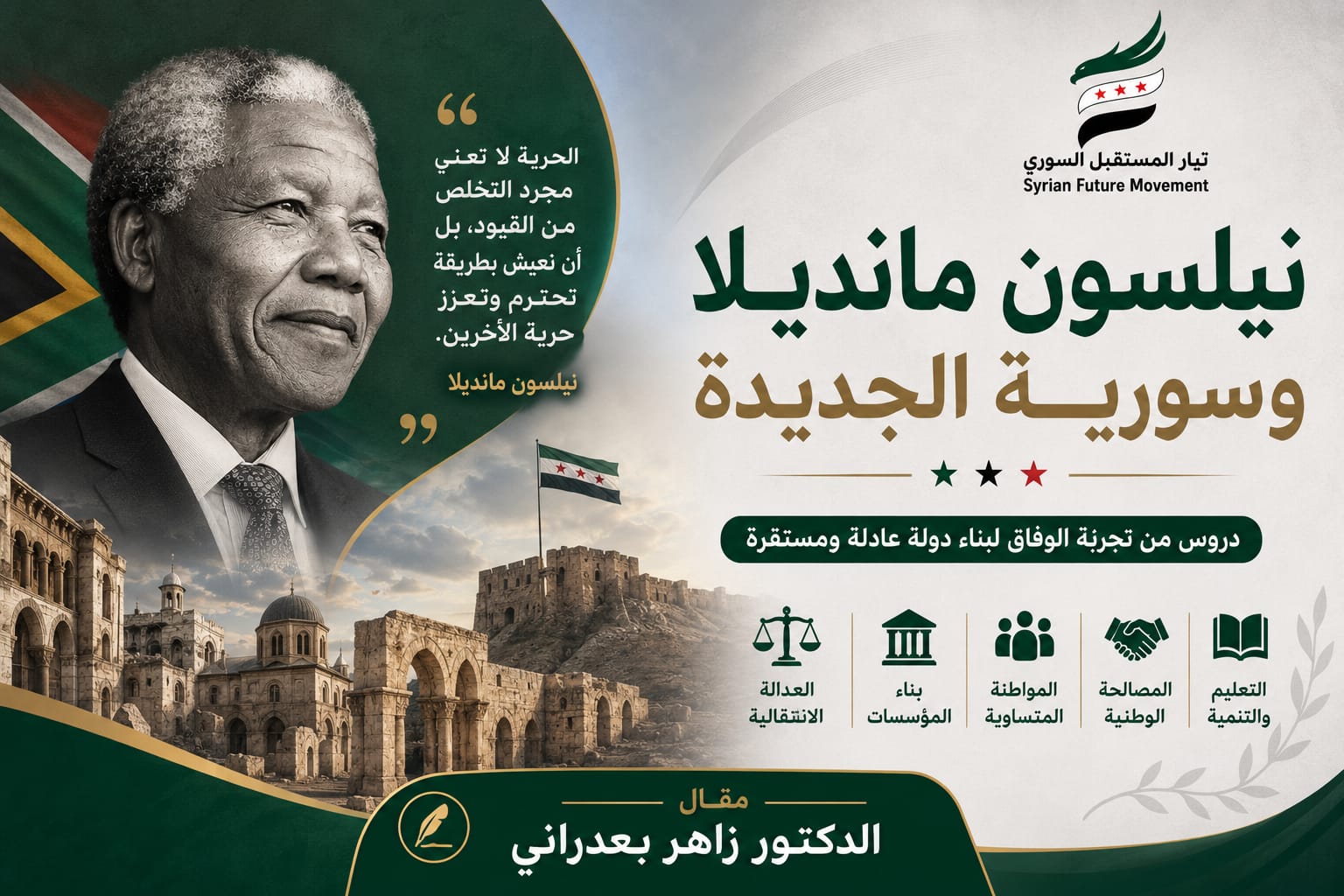
Every year on July 18th, the world celebrates Nelson Mandela International Day, honoring a man who was not merely the president of South Africa, but a global symbol of the transition from conflict to statehood, from revenge to justice, and from division to national reconciliation.
However, commemorating Mandela should not be solely about celebrating his person, but rather an opportunity to revisit the ideas he championed and examine their applicability to countries emerging from conflict, particularly Syria, which today faces one of the most complex phases of state-building after decades of tyranny and years of war.
One of Nelson Mandela’s most famous quotes is: “Freedom is not simply the removal of chains, but living in a way that respects and enhances the freedom of others.”
This statement almost perfectly encapsulates the current Syrian challenge! The fall of tyranny does not automatically guarantee the establishment of a state, just as the overthrow of a regime does not necessarily equate to the creation of a new political system.
Freedom that does not translate into institutions, a constitution, laws, and justice may devolve into a new conflict between competing forces, each with its own understanding of liberation.
Therefore, the post-liberation phase is often more difficult than liberation itself.
Perhaps the most important lesson we learn from Mandela’s experience is that liberation movements may succeed in overthrowing regimes, but they do not automatically succeed in governing states.
There is a fundamental difference between the legitimacy of a revolution and the legitimacy of a state. The former is built on sacrifice and struggle, while the latter is built on a constitution, institutions, and the rule of law.
History is replete with great liberation movements that faltered when they transitioned from the arena of revolution to the arena of governance because they failed to grasp that the tools for overthrowing a regime are not the same as the tools for building a state.
One of Mandela’s most profound sayings is: “Resentment is like drinking poison and then waiting for your enemy to die.”
With this statement, he did not mean to abolish justice or overlook crimes, but rather to distinguish between justice and revenge. This is one of the most significant challenges facing Syria today. Syrian society cannot build its future on a culture of revenge, nor can it build it on ignoring the crimes committed.
Therefore, transitional justice becomes the only path that achieves a difficult equation: holding those responsible for crimes accountable, providing redress for victims, preventing the recurrence of violations, and preserving the unity of society and the state.
Here, Mandela said, “Courage is not the absence of fear, but the triumph over it.”
This statement applies to nations as much as it does to individuals.
Rebuilding a state after war requires political courage in making decisions that may be unpopular but are essential for building the future. These decisions include: establishing independent institutions, respecting the rule of law, launching organized political life, combating corruption, and enshrining the principle of citizenship.
Mandela’s name is often associated with him personally, but South Africa’s success was not solely due to the presence of an exceptional leader, but also to the transfer of leadership to constitutional institutions capable of continuing after his passing.
Herein lies one of the most important lessons for Syria: states are not built on leaders alone, but on institutions capable of managing differences, regulating the transfer of power, and protecting rights and freedoms.
Today, as Syria moves toward restructuring its institutions, the real challenge lies not in choosing individuals, but in building the foundations of good governance that ensure the state’s survival is not dependent on the survival of any single official.
Strong states are measured by the strength of their institutions, not the strength of their leaders, and by their ability to correct their mistakes through the law, not by changing individuals.
Indeed, relying on individuals may bring a temporary victory, but relying on institutions is what creates stability.
One of Mandela’s most famous quotes is: “Education is the most powerful weapon which you can use to change the world.”
This lesson is perhaps doubly important in the Syrian case; reconstruction does not begin with cement and steel alone, but with rebuilding the human being, rehabilitating schools and universities, launching scientific research, cultivating a culture of dialogue, and creating a generation that believes in the state more than it believes in individuals.
Mandela also said, “A true leader is one who lets others believe they have done the work.”
This is a profound definition of democratic leadership, which is not based on creating an inspiring individual, but rather on empowering society, distributing responsibilities, and launching initiatives.
While Mandela triumphed over apartheid, the Syrian challenge is different, but no less complex.
What is needed today is not only to overcome the effects of war, but also to establish a new social contract based on the rule of law, equal citizenship, transitional justice, an independent judiciary, responsible political pluralism, and the building of strong institutions that transcend individuals.
Nelson Mandela’s greatest legacy to the world was not only his victory over apartheid, but also his demonstration that nation-building is more difficult than regime change, that tolerance does not negate justice, that reconciliation does not mean forgetting rights, and that freedom is only complete with the establishment of institutions to protect it.
Syria today does not need to replicate the South African experience, as each country has its own unique circumstances. However, it does need to draw upon its profound lessons: that freedom is a responsibility, that justice is the foundation of reconciliation, and that institutions are the true guarantee of national stability.
If Syria has turned a dark page in its history, the real challenge today is how to write the next chapter so that Syrians are not forced to relive the tragedy.