
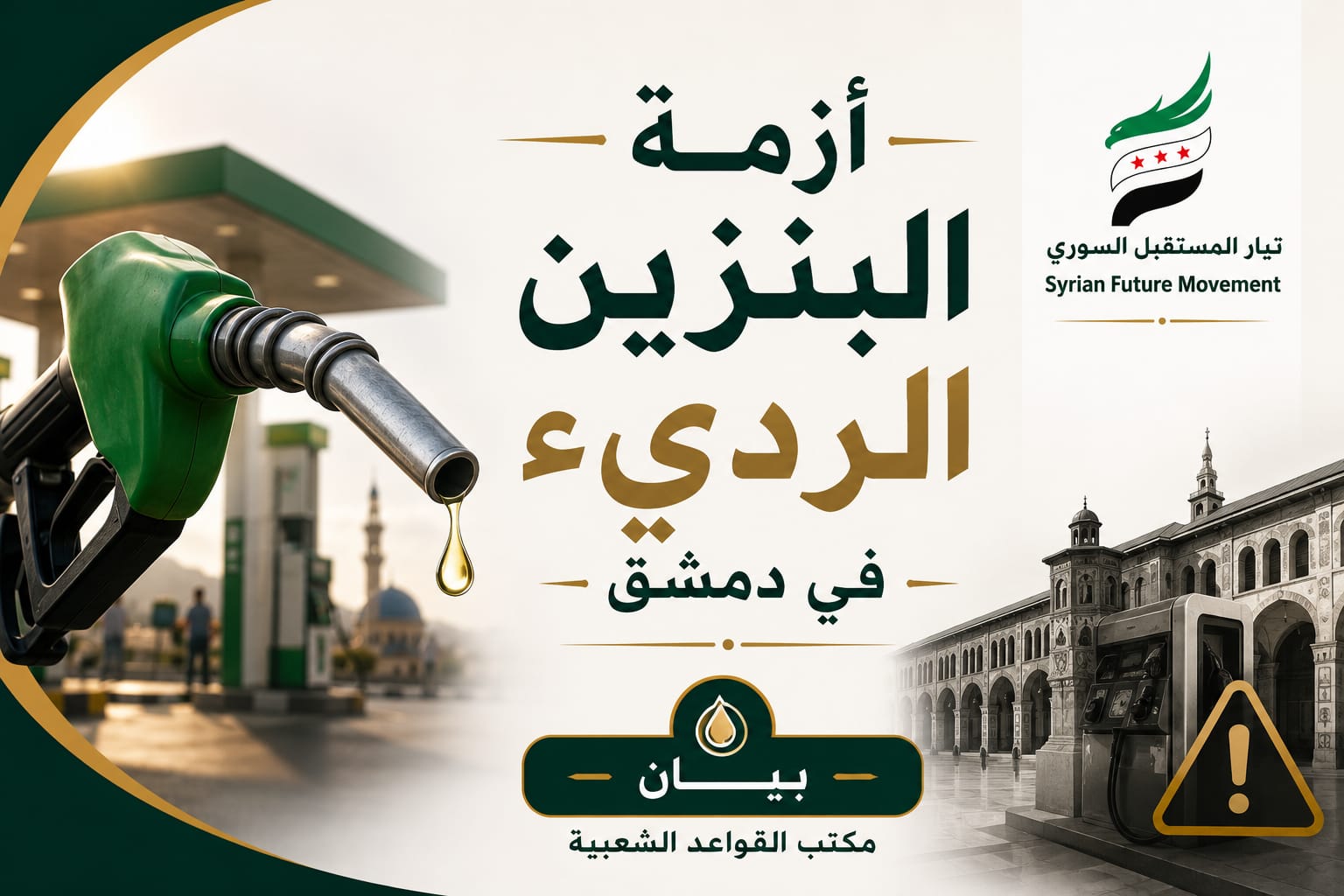
The Syrian Future Movement is following with great concern the growing number of complaints circulating in the media and on social media platforms over the past few hours from drivers in Damascus regarding sudden breakdowns of their vehicles after refueling at various gas stations.
While expressing its full solidarity with the affected citizens, the Syrian Future Movement warns of the serious repercussions of this phenomenon on public safety and property, as well as on the national economy. It calls upon the relevant authorities to assume their responsibilities in protecting consumers and ensuring the quality of fuel available in the market.
The Syrian Future Movement is presenting testimonies from citizens that reflect their daily suffering and warn of an impending economic catastrophe.
The suffering of Syrians is no longer limited to waiting for hours to obtain gasoline; a new crisis has emerged: the increasing complaints about the poor quality of fuel.
On July 12, 2026, a driver told Syria TV that he filled his car at the Al-Fayhaa station, but it stalled after driving no more than ten meters. He noted that the gasoline smelled different than usual, leading him to believe it was substandard.
In a similar incident, another driver said he waited for about four hours to get gasoline at the Hamish station, only to discover that the fuel had damaged the pump, causing his car to stall repeatedly and preventing him from getting home.
Several drivers confirmed that long waiting times no longer guarantee access to quality gasoline, while buying fuel from street vendors remains a risky option due to the lack of oversight regarding its source and specifications.
The Syrian Future Movement points out that repair shops and the spare parts market are experiencing a silent economic crisis. Alongside the drivers’ complaints, car mechanics have confirmed a significant increase in fuel system-related malfunctions over the past two weeks. Several mechanics explained that most of the malfunctions were concentrated in fuel pumps, injectors, spark plugs, and fuel filters—components directly affected by any impurities or low-quality gasoline.
One mechanic pointed out that contaminated or low-quality gasoline leads to inefficient combustion within the engine, increasing carbon buildup, causing engine misfires, overheating, and reduced performance. He noted that modern cars are the most affected by this problem due to their reliance on sophisticated electronic fuel injection systems that require high-quality fuel.
The repercussions of this problem weren’t limited to car owners; they extended to the spare parts market. Auto parts dealers confirmed a surge in demand for fuel system components, particularly fuel pumps, spark plugs, and fuel filters, as a result of the increasing number of malfunctions.
Experts warn that continued use of substandard fuel can lead to greater mechanical damage over time, including damage to parts of the fuel system and engine, thus increasing maintenance costs and impacting the operational lifespan of vehicles.
The Syrian Future Movement appreciates the Ministry of Energy’s stance, but emphasizes that an apology and the exclusion of a single shipment are insufficient to address a structural crisis.
Syrian Energy Minister Mohammed al-Bashir previously announced the exclusion of a gasoline shipment for failing to meet specifications. In an official statement, he confirmed that the shipment had not been released to the market and attributed the congestion at gas stations to its exclusion, coinciding with increased demand following the price reduction. He apologized to citizens for the hardship caused by the crisis.
While we respect this step, we reiterate that the continued complaints indicate the problem is more profound than a single shipment. The lack of regular and sustained monitoring of fuel quality repeatedly endangers citizens and their property.
In this context, we recall the experts’ warning that modern vehicles, which rely on precise electronic fuel injection systems, are the most affected by these practices, threatening the sustainability of the national transportation fleet and increasing the financial burden on citizens.
The Syrian Future Movement presents a set of practical recommendations to address this crisis and prevent its recurrence. Based on its national responsibility, the Syrian Future Movement recommends the following:
- Forming regular and surprise inspection committees at all gas stations in Damascus and its countryside to collect samples of the gasoline sold and test them in specialized laboratories to ensure compliance with standard specifications. Immediate legal action should be taken against violators, up to and including the closure of offending stations and the revocation of their licenses, in line with the demands of drivers and technicians.
- Activating the role of the Standards and Metrology Organization and the Consumer Protection Authority, providing them with the necessary powers and resources to carry out their oversight duties independently and effectively. Regularly publishing the results of fuel quality tests is also recommended to enhance transparency and deter violators.
- Launching a broad national awareness campaign to educate drivers on how to identify the initial signs of adulterated fuel, the procedures to follow if their vehicles experience malfunctions, and to encourage them to report any violations.
- Establishing a fair and swift compensation mechanism for those affected, guaranteeing citizens’ right to recover material damages to their vehicles resulting from the use of substandard fuel, in accordance with best international practices in this field.
- Addressing the root causes of the adulterated gasoline phenomenon by tightening control over supply sources, combating smuggling and fraud, and strengthening cooperation between security, judicial, and regulatory bodies to ensure these illegal practices are not repeated.
The Syrian Future Movement reiterates that protecting citizens and ensuring the quality of services is a fundamental responsibility of the state, and that negligence in this matter threatens the safety of citizens and their property and undermines trust in state institutions.
We believe that the Syrian government and regulatory bodies are called upon today to take immediate and decisive measures to address this crisis.