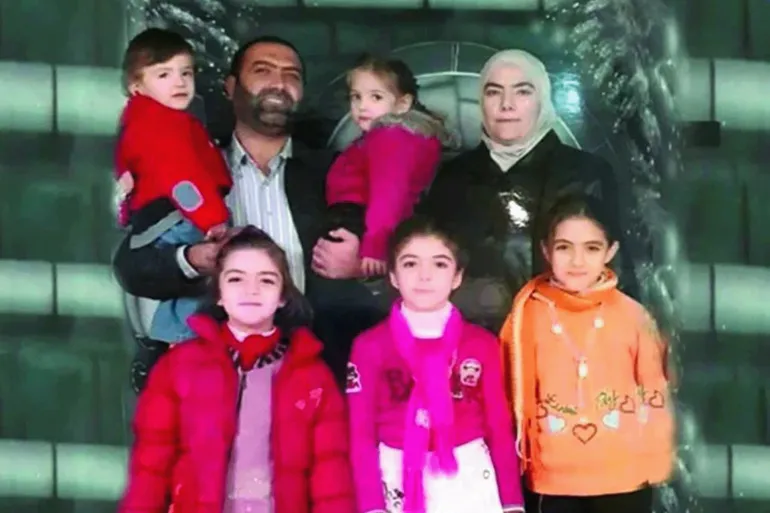
The Syrian Future Movement follows with profound emotion and respect the announcement issued on Saturday, May 30, 2026, by the National Commission for Missing Persons, which came after 13 years of suffering, reaching “reliable and corroborating” findings confirming the death of Dr. Rania Al-Abbasi’s six children, whose fate had remained unknown for all these years.
We see this case, which has shaken the world’s conscience, not merely as an isolated incident, but as a symbol of the suffering of thousands of families of the forcibly disappeared in Syria, and an embodiment of the brutality of the former regime, which targeted the entire Syrian family.
The Syrian Future Movement recalls with pride and reverence the life of the victim, affirming that her case exemplifies the systematic crimes perpetrated by the former regime:
Dr. Rania Al-Abbasi, a dentist and chess champion who represented Syria in numerous international arenas, was a model of productive and creative citizenship. However, the tyrannical regime not only stole her talents but also exacted revenge on her and her entire family simply for fulfilling their humanitarian duty of sheltering displaced people.
As we remember the details of this tragedy, we pay tribute to the souls of the six children: Dima, Intisar, Najah, Alaa, Ahmad, and Lian, whose ages ranged from two to thirteen years old at the time of their arrest. We affirm that their blood will not be shed in vain.
The Syrian Future Movement commends the professional and humanitarian efforts exerted by the National Commission for Missing Persons to uncover this truth, while emphasizing that revealing their fate does not end the case but rather opens the door to a broader phase of accountability. The Syrian Future Movement highly commends the professionalism demonstrated by the Commission, which included conducting thorough investigations and informing families of the results before their public announcement, in accordance with a humane protocol that respects their dignity and psychological well-being.
The Syrian Future Movement also reiterates that the Commission’s achievements today confirm that the issue of missing persons is not insurmountable; rather, it requires genuine political and institutional will.
In this context, the Syrian Future Movement recalls the warnings issued in the United Nations report on the transitional justice process in Syria (dated April 15, 2016) regarding the “fragility of this process” and the importance of “concerted national and international efforts,” which compels us to capitalize on this momentum.
The Syrian Future Movement reiterates its unwavering support for the transitional justice process and the investigation into the fate of the missing, a position reflected in numerous previous statements and research published on its official website, including:
- The statement on the “judicial ruling against the symbols of the former regime and their deprivation of civil rights” (dated May 10, 2026), in which we commended the commencement of public trials for the symbols of the ousted regime, considering it a consolidation of the principle of accountability.
- The statement on the “establishment of the joint Syrian-international working group to support the transitional justice process” (dated February 22, 2026), in which we welcomed the formation of the joint team between the National Commission for Transitional Justice and international bodies, viewing it as a step towards practical implementation.
- The statement on the “Bar Association forming a committee to follow up on the missing persons file” (dated May 4, 2026), in which we commended this professional and humanitarian initiative, considering it a first step towards breaking the official legal monopoly.
- The study “Reconstruction Priorities in Syria” (dated December 19, 2024) indicated that reconstruction cannot be complete without genuine national reconciliation based on uncovering the truth.
The Syrian Future Movement emphasizes that this case is one of 150,000 to 170,000 similar cases, according to estimates by the United Nations and human rights organizations, where hundreds of thousands of Syrian families are still waiting to learn the fate of their loved ones.
We recall the warning issued by Human Rights Watch in April 2026 regarding the suffering of the wives and children of the missing, who are deprived of their basic rights in a legal and economic vacuum. We affirm that this suffering is no less grievous than the crime of disappearance itself.
Based on its national responsibility, the Syrian Future Movement recommends the following to the government and relevant authorities:
- Continue investigations to locate and determine the remains, in full coordination with the relevant authorities, with the involvement of international forensic experts to ensure the accuracy of the procedures, and to enable the families of the victims to receive dignified burial rites.
- Activating the role of the National Commission for Transitional Justice and the Commission for the Missing, and providing them with the necessary resources and capabilities to address the enormous volume of cases, in accordance with the recommendations of the UN report which warned that “without adequate forensic capabilities, evidence cannot be properly collected or preserved.”
- Expediting the issuance of national legislation criminalizing enforced disappearance, in line with the provisions of the International Convention for the Protection of All Persons from Enforced Disappearance (ICPPED) adopted by the United Nations in 2006, while activating monitoring and accountability mechanisms.
- Providing immediate psychological, social, and economic support to the families of all the missing, as recommended by the Human Rights Watch report, to protect them from collapse and guarantee their rights to education and healthcare.
In conclusion: The Syrian Future Movement reiterates its call to all Syrians to unite and stand with the families of the victims during this difficult time, emphasizing that this issue is not just the issue of Rania al-Abbasi’s family, but the issue of every Syrian who has suffered under the tyranny of oppression.
Today, the government is called upon to prove its seriousness in achieving transitional justice, not with words, but by translating this symbolic issue into policies and practices that put an end to the suffering of hundreds of thousands of Syrian families and establish a new Syria governed by the rule of law and justice.