
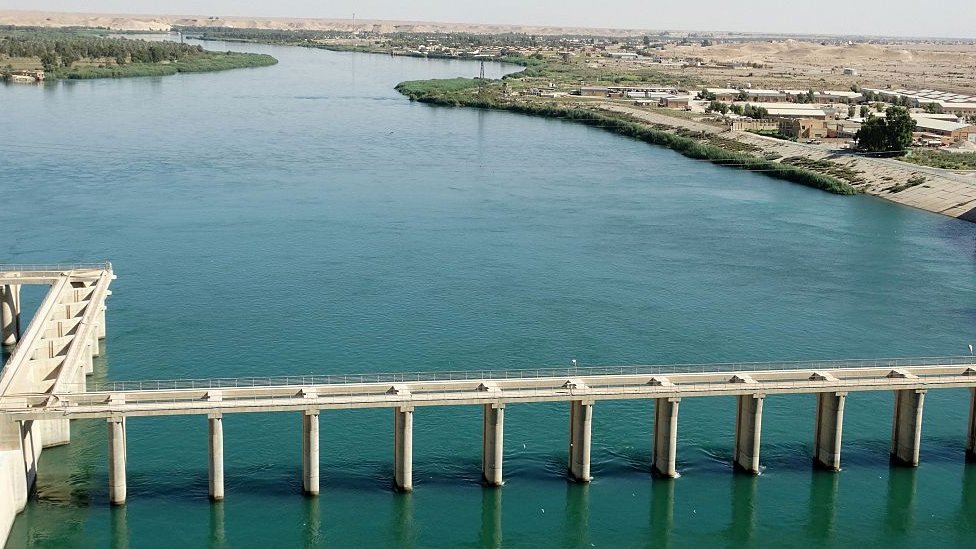
The Syrian Future Movement is following with grave concern the serious humanitarian and service-related developments resulting from the significant rise in the water level of the Euphrates River, and the direct threat this poses to the lives, homes, agricultural lands, and properties of civilians in the Raqqa and Deir ez-Zor governorates and surrounding areas.
Recent events have demonstrated that the issue of water and dams is not a mere technical matter, but rather a matter of human and national security that directly impacts the safety of residents and the stability of eastern and northern Syria, especially given the flooding and rising water levels along the banks of the Euphrates, and the resulting risks to bridges, embankments, water stations, and agricultural lands.
In light of these developments, the Syrian Future Movement commends the efforts undertaken by the Syrian Ministry of Emergency and Disaster Management, including issuing early warnings, raising the level of preparedness, advising residents in threatened areas to stay away from the river and low-lying areas, as well as the field measures aimed at protecting civilians and infrastructure, reinforcing embankments, and coordinating the response with relevant local and technical authorities.
We believe that the intervention of the Syrian Ministry of Emergency and Disaster Management in this crisis is a responsible step in the right direction, and it must be supported and strengthened with all available resources, because the lives and property of the people cannot tolerate negligence, delays, or narrow calculations.
The Syrian Future Movement emphasizes the following:
First: The necessity of considering what has occurred as a serious warning that requires the development of a permanent national emergency plan to deal with Euphrates River floods and the risks posed by dams, embankments, and bridges.
Second: Supporting the efforts of the Syrian Ministry of Emergency and Disaster Management and providing it with the necessary logistical and technical resources to ensure a rapid response and the protection of civilians in Raqqa, Deir ez-Zor, Aleppo, and all areas along the Euphrates River.
Third: Expediting the assessment of damages to homes, agricultural lands, water stations, roads, and bridges, and working to compensate those affected according to available resources and through a transparent and fair mechanism.
Fourth: Establishing a more effective early warning system along the Euphrates River and linking it to local operations rooms in the affected governorates to ensure that warnings reach residents well in advance of the danger.
Fifth: Addressing structural deficiencies in embankments, bridges, and drainage systems, and not relying solely on temporary, emergency solutions, as a recurrence of this crisis could lead to a larger humanitarian catastrophe.
Sixth: Establishing clear technical and diplomatic channels of coordination regarding transboundary water flows, in a way that protects the water rights of Syrians and prevents the use or management of water in a manner that causes widespread humanitarian harm.
Seventh: Involving local councils, civil society organizations, and humanitarian organizations in evacuation, shelter, and emergency support operations, especially for families residing near riverbanks and in low-lying areas.
The Syrian Future Movement warns against any complacency regarding this humanitarian issue and calls for treating it as a long-term national concern, not merely a temporary incident that will end with the receding water levels. Protecting the Syrian people, their land, water, environment, and infrastructure is a shared national and moral responsibility.
We also call for urgent solutions, including preventative evacuations, reinforcing earthworks, securing temporary shelters, and protecting water and electricity stations, alongside long-term strategic solutions that include rehabilitating water infrastructure, developing dam management, building an early warning and monitoring system, and establishing a clear national water security policy for Syria.
In this critical situation, the Syrian Future Movement extends its gratitude to all those working in the Syrian Ministry of Emergency and Disaster Management, as well as to the field teams and local personnel working to protect civilians and minimize damage. It affirms its solidarity with our people in Raqqa, Deir ez-Zor, and all affected areas.