

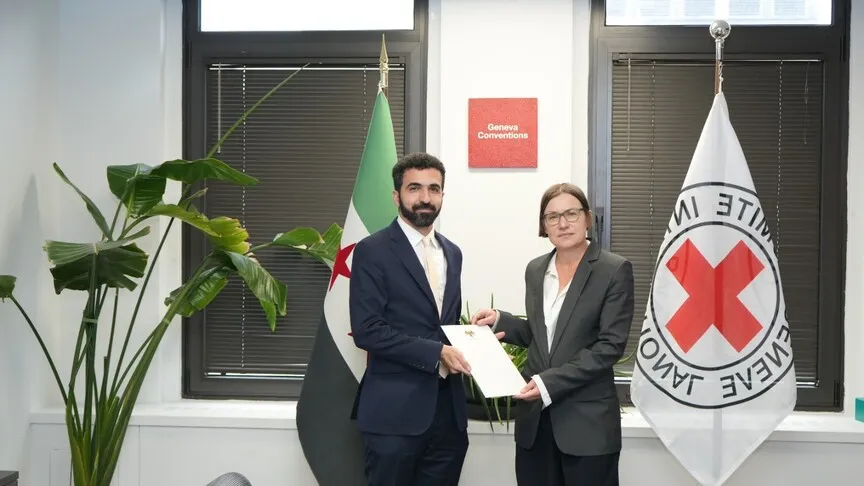
The Syrian Future Movement is following with great interest the announcement by the Ministry of Foreign Affairs and Expatriates on Thursday, May 21, 2026, of the Syrian Arab Republic’s accession to the “Global Initiative to Renew Political Commitment to International Humanitarian Law.” The Ministry described this step as reflecting the “new Syria’s” commitment to strengthening its engagement with the international system and consolidating respect for international humanitarian law.
Syria’s Permanent Representative to the United Nations, Ambassador Ibrahim Alabi, presented the instrument of accession to the President of the International Committee of the Red Cross (ICRC), Mirjana Spoljarić Eger. The Ministry described this step as a “fulfillment of the sacrifices and humanitarian suffering of the Syrian people,” which it considered a consequence of the “grave and systematic violations” committed by the ousted regime against the Syrian people.
The Syrian Future Movement appreciates this step, which reflects the Syrian state’s desire for responsible engagement with the international system and its commitment to the principles of international humanitarian law, particularly in the area of protecting civilians and alleviating human suffering. The Syrian Future Movement, while commending this initiative, recalls that the ousted regime, for decades, violated the most basic principles of international humanitarian law, including killing, torture, forced displacement, and starvation of civilians. Therefore, we see Syria’s joining this initiative today as a break with a legacy of impunity and a declaration that the new Syria stands on the right side of history.
The Syrian Future Movement highlights the details and importance of the initiative to which Syria has joined. It is a high-level international framework launched in September 2024 by six countries—Brazil, China, France, Jordan, Kazakhstan, and South Africa—in partnership with the International Committee of the Red Cross (ICRC). Its aim is to revitalize political momentum around the necessity of respecting the rules of international humanitarian law (IHL) and to develop practical and implementable recommendations for improving respect for this law during armed conflicts.
A high-level conference on “Humanity in War” is scheduled to be held in the Hashemite Kingdom of Jordan during the last quarter of 2026, representing an opportunity for Syria to reaffirm its commitments and its active participation in shaping the future of international humanitarian law. The International Committee of the Red Cross (ICRC) welcomed Syria’s accession, considering it an important step towards strengthening respect for international humanitarian law. The ICRC noted that areas of cooperation include disseminating the law at the national level, visiting places of detention, and supporting efforts to locate missing persons.
While the Syrian Future Movement appreciates this step as a sound strategic direction, it emphasizes that translating it into tangible reality requires more than mere political statements or a formal accession. Many countries have joined similar international agreements, but these have remained largely ineffective. For Syria’s accession to be truly significant, it must be followed by concrete actions, primarily:
- Repealing all laws and regulations that previously prevented international humanitarian organizations from accessing detention centers, as the new Syrian government recently committed to doing.
- Full openness to the independent monitoring mechanisms that the initiative may establish, and a prompt exchange of information and expertise.
- Expediting the completion of the transitional justice law, which guarantees accountability for all violators of international humanitarian law, based on the principle of no impunity.
Based on its national responsibility, the Syrian Future Movement recommends the following to the government and relevant authorities:
- Adopt a comprehensive national action plan to implement the initiative’s objectives, including a clear timetable and allocated resources. This plan should be subject to evaluation by independent oversight bodies, in cooperation with the International Committee of the Red Cross (ICRC).
- Integrate the principles of international humanitarian law extensively into the training curricula for military, security, and judicial personnel to ensure that compliance with these principles becomes institutional practice and not merely a political promise.
- Leverage participation in this initiative to strengthen the transitional justice process and uncover the fate of the missing, by activating technical cooperation with the ICRC in areas such as identifying victims, searching for the missing, opening mass graves in an organized and transparent manner, and guaranteeing the rights of victims’ families to know the truth and receive compensation.
- Utilize the initiative’s platform to promote the image of a “new Syria” as a state striving for peace and respect for the rule of law, through active participation in events and conferences held within the framework of the initiative, and by exchanging experiences with other countries. The Syrian Future Movement reiterates its welcome of Syria’s joining this humanitarian initiative, seeing it as a glimmer of hope for building a new relationship between the state and society based on respect for the law and human rights.
However, it also emphasizes that the true success of this step will not be measured solely by the extent of international praise, but rather by its ability to bring about a fundamental change in the culture of the Syrian military, security, and judicial institutions, placing the protection of civilians and their dignity above all else.
We affirm that Syria’s commitment to these principles is a true test of its ability to break with the past and move towards building a new Syria governed by the rule of law, not brute force.