

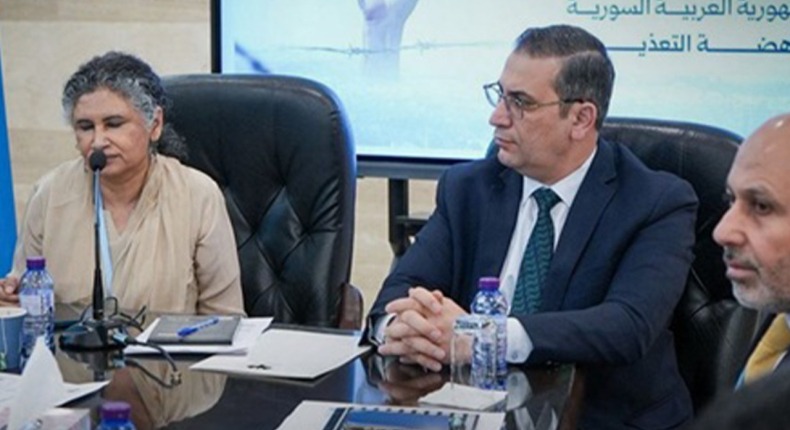
The Syrian Future Movement is following with great interest the statement issued by the Office of the United Nations High Commissioner for Human Rights (OHCHR) on Friday, May 15, 2026, welcoming the initial steps taken by Syria towards developing a national strategy to combat torture. This coincided with a workshop held by the Ministry of Foreign Affairs and Expatriates to draft this strategy, as part of the government’s efforts to rebuild the human rights system and align legislation with international standards.
Based on the Syrian Future Movement’s methodology of “supporting national solutions without endorsing any party unconditionally, and criticizing what threatens the state-building process without hostility,” we issue this statement to assess this step, while emphasizing the need to translate it into concrete action.
First, the Syrian Future Movement appreciates the UN’s commendation of Syria’s initial steps in developing a national strategy to combat torture, which UN officials described as “a step towards strengthening justice and accountability.”
We reiterate that combating torture, reforming the justice sector, and releasing arbitrarily detained individuals have been among the most prominent goals of the Syrian revolution and fundamental principles of the Syrian Future Movement since its inception, which it has consistently advocated in its statements and research. We also believe that initiating work on this strategy represents a response to the appeals of victims and their families, and a necessary step towards building trust between citizens and their state institutions.
Secondly, the Syrian Future Movement points out that Syria ratified the Convention against Torture and Other Cruel, Inhuman or Degrading Treatment or Punishment (CAT) in 2004, obligating it to take effective legislative and administrative measures to prevent torture.
Furthermore, the ongoing realities on the ground underscore the urgent need to address these painful issues and close the still-open files.
In the first quarter of 2026 alone, at least 210 new cases of arbitrary arrest and detention were recorded, according to human rights reports, in addition to the continued concerns about the situation of thousands of Syrian detainees in foreign prisons.
The Syrian Future Movement reiterates that what is being documented today is part of the legacy of a previous dictatorial regime, but the responsibility now lies with the new state to definitively close this file.
Third, while the Syrian Future Movement appreciates the initiative, it warns that initiating such a strategy without specific and transparent implementation mechanisms and timelines will keep it confined to the theoretical realm. Therefore, we emphasize that the true success of this strategy will be measured by its ability to produce tangible change on the ground, by the government’s commitment to opening all files related to torture and arbitrary detention, and by its willingness to hold those involved accountable, regardless of their positions.
Fourth, the Syrian Future Movement recalls its previous statements affirming the priority of protecting human rights and reforming judicial institutions, which were published on its official website, including:
The statement on the “judicial ruling against the symbols of the former regime and their deprivation of civil rights” (dated May 10, 2026), in which we commended the commencement of public trials for the symbols of the ousted regime, considering it a consolidation of the principle of accountability.
Statement on “Electronic Notification and Digital Transformation in the Syrian Judiciary” (dated May 8, 2026), in which we affirmed that modernizing the judiciary is part of the human rights system, which includes the right to a fair trial.
Statement on “The International Federation of Journalists’ Resolution in Support of Media Freedom in Syria” (dated May 10, 2026), in which we stressed that freedom of expression and the right to access information are two fundamental pillars for protecting all human rights and preventing their violations.
Fifth, based on its national responsibility, the Syrian Future Movement recommends the following:
- Establishing a clear implementation mechanism: The national strategy must include a binding timeline, dedicated financial resources for its implementation, periodic and transparent evaluation mechanisms, and utilize the technical support provided by the Office of the United Nations High Commissioner for Human Rights in this area.
- Immediate release of those arbitrarily detained: The government must immediately and simultaneously begin the process of releasing all those arbitrarily detained and abducted, and open the file on the missing in a transparent manner, as this is a fundamental step towards building trust.
- Reforming Judicial and Security Institutions: All state law enforcement agencies must undergo fundamental reforms, including training personnel on human rights principles, guaranteeing judicial independence, and holding accountable all those involved in past or present violations.
- Engaging Civil Society and Independent Experts: Syrian civil society organizations and independent legal experts must be involved in drafting and monitoring the implementation of the strategy to ensure its transparency and effectiveness.
In conclusion, the Syrian Future Movement reiterates its full support for every effort that contributes to building a human rights system that protects the dignity of the Syrian people and safeguards their freedoms. We also call on the Syrian government to continue on this path with steadfastness and transparency, and to translate international and regional commitments into concrete national policies. The future of a new Syria cannot be built on forgetting or overlooking the past, but rather on solid foundations of rights and justice that guarantee the non-recurrence of the tragedy of torture and arbitrary detention that Syrians have suffered for decades.