
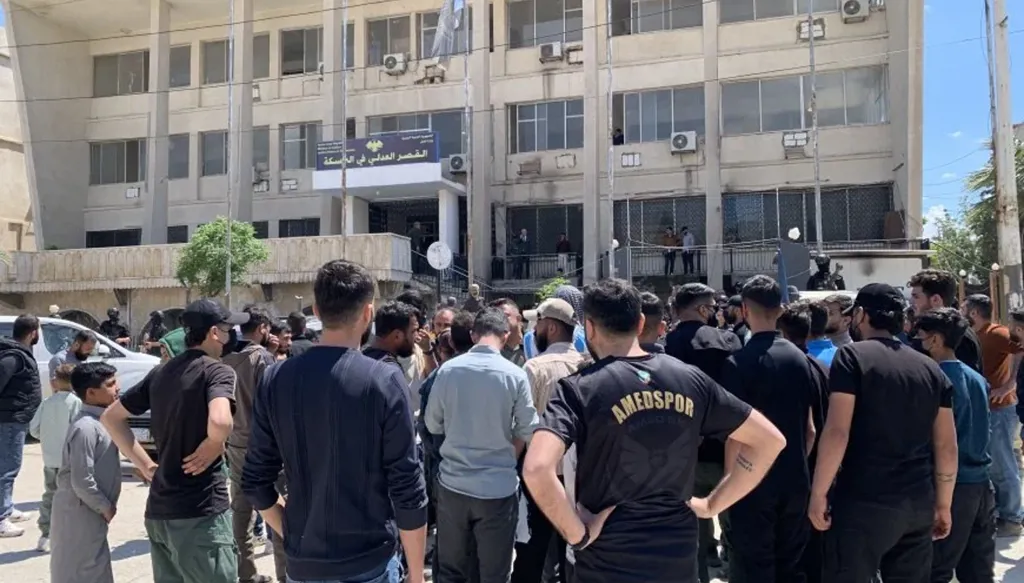
The Syrian Future Movement is following with great concern the developments on the ground in Hasakah Governorate, which culminated on Thursday, May 7, 2026, with an attack by members of the so-called “Revolutionary Youth” affiliated with the “Syrian Democratic Forces” (SDF) on the Palace of Justice building and its employees. The attack involved pelting the building with stones and tearing down its new sign, thus disrupting the handover of the Palace to the Syrian government and escalating tensions.
Based on the responsibilities of the Syrian Future Movement as an independent Syrian civil movement, and in accordance with our methodology of “supporting national solutions without unconditionally endorsing any party, and criticizing what threatens the state-building process without hostility,” we affirm in this statement our unwavering position supporting the integration of institutions and firmly rejecting all forms of obstruction of the transitional process, regardless of their source, while giving due consideration to the specificities of the Kurdish component and its cultural rights within the framework of national sovereignty.
First: The Syrian Future Movement asserts that the unfortunate events in Hasakah stemmed from an administrative procedure: the installation of a new sign for the Palace of Justice, replacing the old one in Arabic and Kurdish with a bilingual (Arabic and English) sign.
This administrative change, implemented by the Syrian government as part of its takeover of the Palace, was misinterpreted and given political and nationalist dimensions that far exceeded its purely administrative significance. Kurdish circles perceived it as an attempt to marginalize the Kurdish language. Field sources indicate that members of the “Revolutionary Youth” objected to the sign, claiming it was removing the Kurdish language, while official sources maintained that the change was due to errors in the sign’s writing.
Second: The Syrian Future Movement is following up on the subsequent measures taken. The Syrian Ministry of Justice issued a statement on Thursday, May 7, 2026, condemning these “acts of rioting and sabotage,” and affirming that the relevant authorities would take all necessary legal measures against those involved. Furthermore, Ahmed al-Hilali, spokesperson for the Presidential Team for Monitoring the January 29 Agreement, clarified on May 7 that Arabic remains the official language of the state and that its use in official institutions is mandated by law. He also pointed out that Decree No. 13 of 2026, which defines the identity of the transitional state after the fall of the former regime, stipulates that Kurdish is a national language and that its teaching is permitted in schools where Kurds constitute a significant percentage of the population.
Third: The Syrian Future Movement emphasizes that what transpired at the Palace of Justice exemplifies the complexities of the “judicial file,” a file described in reports on April 25, 2026, as the most significant obstacle to implementing the agreement. This statement is a continuation of the Syrian Future Movement’s consistent and publicly stated positions, published on its official website for years, referring to the statement issued on February 22, 2026, establishing the joint Syrian-international working group to support the transitional justice process. That statement affirmed that the success of the transitional justice process hinges on a balance between national sovereignty, transparency and international standards, and building public trust.
The Syrian Future Movement also recalls its statement issued on March 24, 2026, on the occasion of the “International Day for the Right to the Truth,” which stressed that “revealing the truth, providing justice for victims, and preserving their dignity are fundamental pillars of any successful political transition.”
Fourth: The Syrian Future Movement appreciates the efforts of the various concerned parties to restore stability and prevent any disruption to the process. On May 6, the Deputy Governor of Hasakah announced that the implementation of the integration agreement had entered a “new and more advanced phase,” referring to previous meetings held on January 29, 2016, during which an agreement was reached with the Syrian Democratic Forces (SDF) on a ceasefire and the integration of institutions.
Plans are also underway to open the Palace of Justice in Qamishli at a later date.
Fifth: The Syrian Future Movement expresses its deep concern regarding attempts to exploit the legitimate demand for Kurdish representation by groups engaging in subversive activities (such as the Revolutionary Youth), which harm their original cause and provide justification for a political setback. In this context, the Syrian Future Movement reiterates its firm position issued on January 14, 2016, entitled “Rejecting the Secessionist Calls of Hikmat al-Hijri in Suwayda,” in which it condemned all separatist calls that do not serve pluralism and diversity, and insisted on the necessity of maintaining a unified Syria.
Sixth: The Syrian Future Movement calls for addressing contentious issues within the framework of the integration process according to the following principles:
Rejection of all acts of violence: Condemnation of any attack, whether against state institutions (the Palace of Justice) or against peaceful demonstrators with legitimate demands.
Separation of representation from implementation: Rejection of any form of “bargaining” that links national demands (language) to the implementation of the state’s fundamental sovereign rights (taking over the Palace of Justice), in order to avoid exacerbating the situation.
Strengthening societal trust: Protecting the rights of the Kurdish component to define its identity within local institutions, in accordance with the Constitutional Declaration and related decrees.
In conclusion: The Syrian Future Movement declares that the continuation of the integration process of judicial and service institutions is the true guarantee against any future escalation, and its first priority is the unification of the armed forces, the judiciary, and the administration, because administrative pluralism remains fertile ground for tension. The Syrian Future Movement, as declared in its previous statement on the “File of Missing Children and Children of Detainees in Syria” dated April 13, 2026, remains committed to ensuring that “transparent and comprehensive transitional justice” is the only means to address the root causes of the problems.
The new Syria is inclusive of all its citizens, but it will never be built on the rule of force through violence or at the expense of the sovereign symbols of the unified state.