From Stagnation to Field Test:
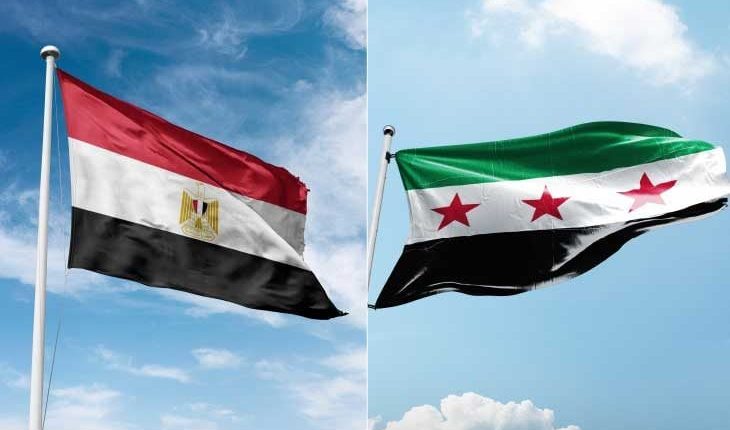
Since the fall of the Assad regime in December 2014, Syrian-Egyptian relations have witnessed a rapid but cautious dynamism. The first visit of the Syrian Foreign Minister to Cairo on May 3, 2016, accompanied by the Minister of Economy and Industry, served as a real test of the two countries’ ability to overcome years of stagnation.
This visit was preceded by sideline talks between Presidents Ahmed al-Sharaa and Abdel Fattah al-Sisi on the sidelines of the Cyprus Summit at the end of April 2016, which observers described as carrying “real signs of rapprochement.”
This article offers an assessment of the current state of bilateral relations, analyzing the intersection of economic interests with the political and security concerns that continue to hinder the path to full normalization.
Intertwined Interests and Institutional Steps:
The Syrian-Egyptian Business Council:
Minister al-Shaar issued a decree establishing the “Syrian-Egyptian Business Council.” This council represents an institutional channel for activating cooperation between the private sectors of the two countries and is the result of previous memoranda of understanding between the federations of chambers of commerce and industry.
Energy File – A Common Ground for Effective Cooperation:
On January 5, 2026, Egypt and Syria signed two Memoranda of Understanding for the supply of natural gas and petroleum products to support Syria’s energy needs and electricity generation. The agreement stipulated the supply of approximately 60 million cubic feet per day of Egyptian gas to Syria, in exchange for allowing the transit of gas and electricity from Egypt and Jordan to Lebanon through Syrian territory, using the 1,200-kilometer-long Arab Gas Pipeline connecting the four countries.
Trade Exchange – An Ambition Beyond Reality:
The current trade exchange between the two countries does not appear to reflect their actual potential. Initial estimates indicate that direct trade remains below the aspirations of both sides, while Syrian and Egyptian government sources confirm a clear desire to increase trade levels in the coming period.
This coincides with Syria’s urgent need for building materials, machinery, fertilizers, and access to export markets for its diverse agricultural and industrial products.
Reconstruction – The Biggest Opportunity:
According to a World Bank report issued in October 2025, the cost of reconstructing damaged physical assets in Syria is estimated at approximately $216 billion, distributed as follows: $75 billion for residential buildings, $59 billion for non-residential facilities, and $82 billion for infrastructure.
Egypt possesses accumulated expertise in infrastructure and housing, and this is viewed in Damascus as a golden opportunity to “market” the strategic partnership with Cairo and compensate for the severe shortage of foreign funding. Political and Security Concerns – Deliberate Hesitation:
Careful Egyptian Caution:
Egypt is one of the Arab capitals that has dealt with the new Syrian administration with marked caution since the political transformations.
Cairo has been monitoring the features of the new authority in Damascus and its repercussions on regional balances, and has refused to engage in broad political steps before ensuring the Syrian government’s ability to control the files of “extremism and elements of transnational organizations.”
Outstanding Issues:
Reports indicate ongoing disagreements regarding some individuals wanted by the Egyptian judiciary. Decisions were recently issued to deport a number of Syrians “for reasons related to security and the public interest.”
In response, the new Syrian administration has taken some reassuring measures (including the arrest of certain individuals), but a sense of “distrust” still characterizes the official Egyptian position, even though it has begun to gradually diminish.
The Diplomatic Framework – Individual Steps or a Systematic Policy?:
The visit reflects that both sides are pursuing the relationship along “parallel tracks”: Syria seeks to accelerate cooperation and capitalize on the current momentum, while Egypt keeps the political file within a framework of “monitoring and testing,” even as it strongly pushes forward on energy and trade issues. The Syrian Future Movement’s Position:
- The economic zone is the most mature: Energy and reconstruction files should be leveraged as a primary driver for strengthening trust between the two countries, along with the preparation of detailed reports on Syria’s needs for Egyptian expertise.
- Accelerating Institutionalization: While no political decision can negate Syria’s urgent need for Egyptian support in the electricity and infrastructure sectors, the Syrian government must redouble its efforts to coordinate with Cairo through security and intelligence channels to address the issue of “wanted individuals” in a manner that does not violate the principle of not extraditing dissidents whose lives are threatened, nor contravene international law and human rights conventions.
- The Issues of Syrians in Egypt Require a Parallel and Swift Track: The increasing cases of arbitrary arrest and deportation have sparked resentment within the Syrian community, with documented cases of individuals registered with the UNHCR being arbitrarily detained. The Syrian government must strongly raise this issue on the agenda of bilateral meetings.
Conclusion:
The Syrian-Egyptian relationship represents a test of the seriousness of the new regime in Damascus and its ability to translate its political rhetoric into stable regional understandings.
Minister Al-Shaibani’s first visit achieved progress on economic and institutional channels, but political and security obstacles remain on the ground.
In light of the above, we in the Syrian Future Movement recommend the following:
- First: Adopting a roadmap to transform the Joint Business Council into a tangible executive body with a defined timetable.
- Second: Intensifying direct, high-level security and intelligence dialogue with the Egyptian side to address the issue of wanted individuals and foster an atmosphere of trust.
- Third: Raising the issue of the Syrian community’s situation in Egypt to the forefront of diplomatic discussions and requesting an agreement on a clear mechanism to regulate their legal status.
- Fourth: Following up on the implementation of energy agreements in parallel with initiating formal dialogue on the mechanism for Egyptian companies’ participation in reconstruction.
In conclusion, our eyes are now on the results of this visit in the coming days: Will we see the understandings translated into concrete action on the ground, or will progress remain cautious with only a slight shift in pace?