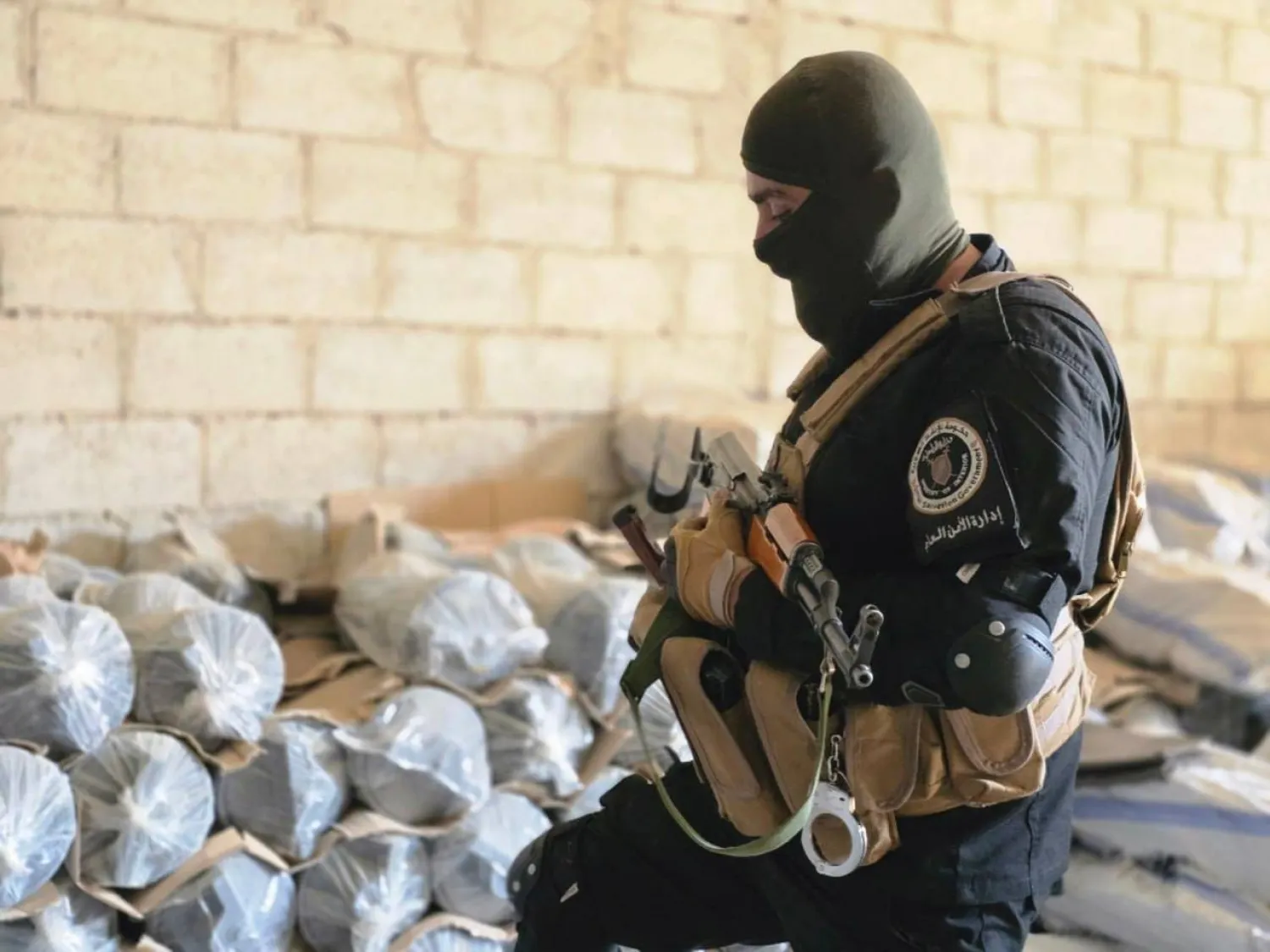
The Syrian Future Movement is following with great interest the news of the successful security operation carried out by the competent authorities in Homs on Sunday, April 5, 2026, which resulted in the arrest of five individuals and the seizure of 42 kilograms of Captagon in the Shinshar area of western rural Homs.
The Syrian Future Movement commends this step, which reflects the state’s seriousness in combating the scourge of drugs that threatens Syrian society. It sees this as an embodiment of the state’s responsibility to protect its citizens from this imminent danger.
In this context, the Syrian Future Movement reviews the dimensions of this national issue, based on its firm position previously expressed in its statements, most notably the statement issued on the occasion of the “International Day Against Drug Abuse and Illicit Trafficking” on June 26, 2025 (available on the official website sfuturem.org), in which we emphasized that combating drugs is not limited to security operations alone, but requires a comprehensive strategy that includes prevention, awareness, rehabilitation, and legal prosecution.
The Syrian Future Movement relies on accurate and documented statistics and reports that illustrate the scale of anti-drug efforts in Syria in recent times:
- Seizures during the first quarter of 2026: On April 4, 2026, the General Directorate for Drug Control in Syria announced the seizure of more than 10 million Captagon pills, 1,046 kilograms of hashish, and 173.5 kilograms of cocaine. They also reported carrying out 205 targeted operations and dismantling more than 15 local and regional networks during the first three months of the year.
- Declining Captagon Production in Syria: A report issued by the United Nations Office on Drugs and Crime (UNODC) on December 22, 2025, confirmed that Captagon production in Syria witnessed a significant decline during 2025, despite ongoing security challenges in some areas.
- Link to Organized Crime: Multiple international reports, including those from the International Crisis Group and the International Committee of the Red Cross, indicate that drug revenues contribute to financing organized crime networks and some armed factions, creating a parallel war economy that undermines reconstruction and stabilization efforts.
The Syrian Future Movement draws attention to the fact that Homs Governorate, due to its central geographic location and expansive rural landscape, has become a major transit route for drug smuggling between Syrian regions and abroad in recent years.
Field sources also confirm that the recent operation carried out by security forces in Homs targeted a network that was using abandoned houses and remote farms as centers for storing and distributing narcotics, which necessitates continuous monitoring of these areas.
Based on the above, the Syrian Future Movement demands the following:
- Intensifying security operations in all governorates, especially in rural and border areas that witness heavy activity by smuggling networks, while providing logistical and technical support to security forces to combat this transnational crime.
- Launching a comprehensive national strategy to combat drugs, encompassing prevention (including awareness campaigns in schools and the media), treatment (establishing specialized centers for the psychological and medical rehabilitation of addicts), and legal prosecution (increasing penalties for traffickers and dealers).
- Strengthening regional and international cooperation in exchanging intelligence and coordinating joint operations to combat drug trafficking, particularly with neighboring countries (Jordan, Lebanon, and Iraq) that suffer from the influx of drugs from Syria, in order to achieve shared interests.
- Engaging civil society, educational institutions, and religious organizations in awareness campaigns about the dangers of drugs, and launching alternative youth programs (sports, cultural, and vocational) to occupy their free time and protect them from the scourge of addiction.
- Holding accountable all those involved in protecting drug networks, regardless of their positions or affiliations, and ensuring that no official or influential figure proven guilty of covering up or participating in these activities escapes punishment.
The Syrian Future Movement affirms that combating drugs is an existential battle no less dangerous than the fight against terrorism.
The continued spread of this scourge will destroy the potential of Syrian youth, tear apart the social fabric, and transform Syria into a fertile ground for organized crime. The security operation in Homs is an encouraging step, but the road is still long, and therefore we appeal to the Syrian government and the international community to put the fight against drugs at the top of the priorities of the next stage.
There is no future for Syria without healthy youth, and no healthy youth without a drug-free society.