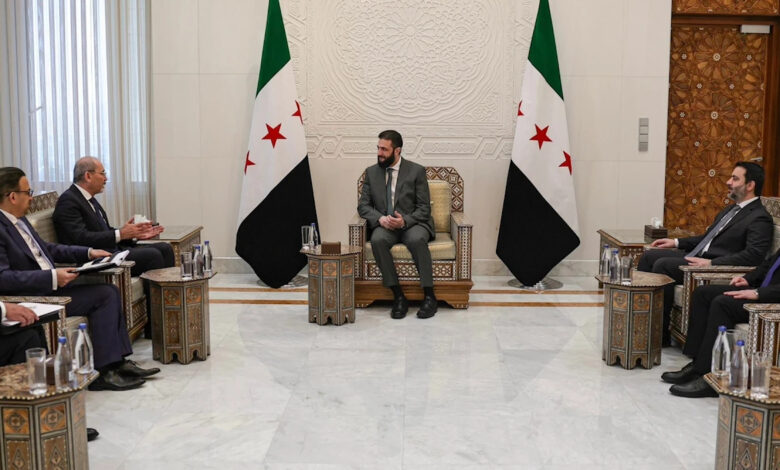
President Ahmad al-Sharaa’s meetings with media influencers and civil society activists on March 3, 2026, and with a delegation from civil society organizations on March 7, 2026, represent attempts to strengthen government engagement with informal sectors.
These two meetings, held at the People’s Palace in Damascus, appear to reflect efforts to transition from the previous military-style rule to a more inclusive framework, focusing on stability and economic and humanitarian recovery.
According to reports from the Syrian Arab News Agency (SANA), the first meeting focused on the role of media in promoting national awareness, while the second emphasized partnership in humanitarian response.
However, the absence of political entities and parties from these meetings, amidst ongoing security tensions such as the sectarian and border attacks in March 2026, highlights a key challenge hindering the opening of a new chapter toward political pluralism.
Advantages and Disadvantages of the Two Meetings:
The two meetings represent a step towards strengthening the domestic legitimacy of the transitional government, which assumed power on March 29, 2025, under the leadership of President al-Sharaa, for a five-year term until the adoption of a permanent constitution and the holding of national elections.
In the first meeting (March 3, 2026), the President listened to proposals from journalists and activists regarding local and regional challenges, emphasizing the need for “integrated efforts and teamwork” to support stability and development.
This approach appears to contribute to building trust with the public, especially given the return of more than 1.3 million Syrian refugees between December 2024 and January 2026, according to reports from the United Nations High Commissioner for Refugees (UNHCR), which bolsters the humanitarian and economic response.
The second meeting (March 7, 2026) focused on the transition from emergency response to early recovery programs, addressing challenges such as a lack of coordination. UNHCR provided assistance to over 1.2 million returnees by the end of 2025.
These meetings appear to reflect a shift towards partnership with civil society, as commended by the UN Commission of Inquiry on March 6, 2026, which emphasized the importance of empowering civil society organizations to promote reconciliation.
However, the drawbacks lie in the selective nature of these meetings, which have drawn criticism for being limited to those close to the administration and loyalists, while ignoring independent journalists and genuine opposition figures, as reported by Enab Baladi and Human Rights Watch in March 2026.
Furthermore, the president emphasized in the first meeting that meeting all needs in one year was “impossible,” citing resource constraints, while the World Bank estimated reconstruction costs at a conservative $216 billion in its October 2025 report. The focus on service-related issues, without addressing transitional justice or elections, has also drawn criticism, with complaints of a lack of transparency and contradictions in official discourse, as well as concerns that the meetings could be used to justify restrictions on the opposition amidst ongoing security tensions.
This absence of political participation also reinforces concerns about continued centralized control, hindering comprehensive recovery amidst ongoing sectarian and economic tensions, including Israeli pressure in the south and along the Lebanese border in March 2026.
Absence of Political Entities:
The absence of any Syrian political entities or parties from these meetings highlights a significant gap in the transition process.
Despite presidential decrees issued on May 17, 2025, establishing a Transitional Justice Commission and a National Commission for the Missing, these bodies had not, as of September 2025, conducted extensive consultations with political parties or victims’ groups, as reported by Human Rights Watch in its 2026 annual report.
This absence impedes the opening of a new chapter toward political pluralism. The transitional phase should be an opportunity for parties to gain insight into governance, including addressing economic challenges such as the return of 1.07 million refugees in 2025, which requires political participation to ensure the equitable distribution of aid.
However, this situation reflects a challenge to the balance of power, as the exclusion of parties could lead to the entrenchment of a “sham democracy.” The transition will fail if it is not built on deeper requirements, such as the participation of all parties, especially in the context of regional tensions like the conflicts in the northeast with the SDF in January 2026 and the border tensions in March.
Advantages and disadvantages of opening a new chapter of pluralism:
Opening a new chapter towards political pluralism during the transitional phase has significant advantages, based on Arend Leffhardt’s theory of “consociational democracy,” which emphasizes power-sharing in divided societies to prevent sectarian conflicts.
On the positive side, this opening enhances stability by integrating parties into the decision-making process, which helps address regional and internal tensions such as those in Latakia and Tartus in March 2025. It also supports economic recovery, as it can attract international investment thanks to the lifting of sanctions, with growth projections higher than World Bank estimates due to the return of refugees. This approach reflects John Rawls’s principle of “justice as fairness,” where pluralism ensures a fair distribution of political opportunities, thus fostering social reconciliation in a post-conflict society.
However, the downsides include the risk of increased tensions if participation is not managed properly. Studies in “Power-Sharing in Post-Conflict Democracies” (2023) suggest that transitional forms can lead to a resurgence of conflict if they are short-lived, or to a “sectarian power-sharing arrangement,” as seen in Iraq and Libya, deepening divisions rather than resolving them.
This also raises a Habermasian challenge regarding “rational communication,” as exclusion can lead to a loss of trust, hindering the building of a sustainable democratic society. This is especially true given the risks of “managed pluralism” within the context of a strong transitional authority, as in Syria, where it can be used to reinforce central control rather than promote a genuine distribution of power.
Furthermore, the focus on pluralism may slow economic reforms, while secondary sanctions continue to exert pressure. And without full investment, as stated in the IMF report of November 2025.
Conclusion:
To overcome these challenges, the Syrian Future Movement recommends holding a presidential meeting of Syrian political entities and parties within the next two months, focusing on discussing the permanent constitution and elections.
We also recommend that this meeting include representatives from all Syrian parties, with the invitation of international observers from the United Nations to ensure transparency.
Finally, we believe that this step will strengthen transitional justice, as recommended by the International Commission of Inquiry, and open the door to genuine participation that contributes to building a stable and pluralistic Syria, while taking into account the ongoing security risks.