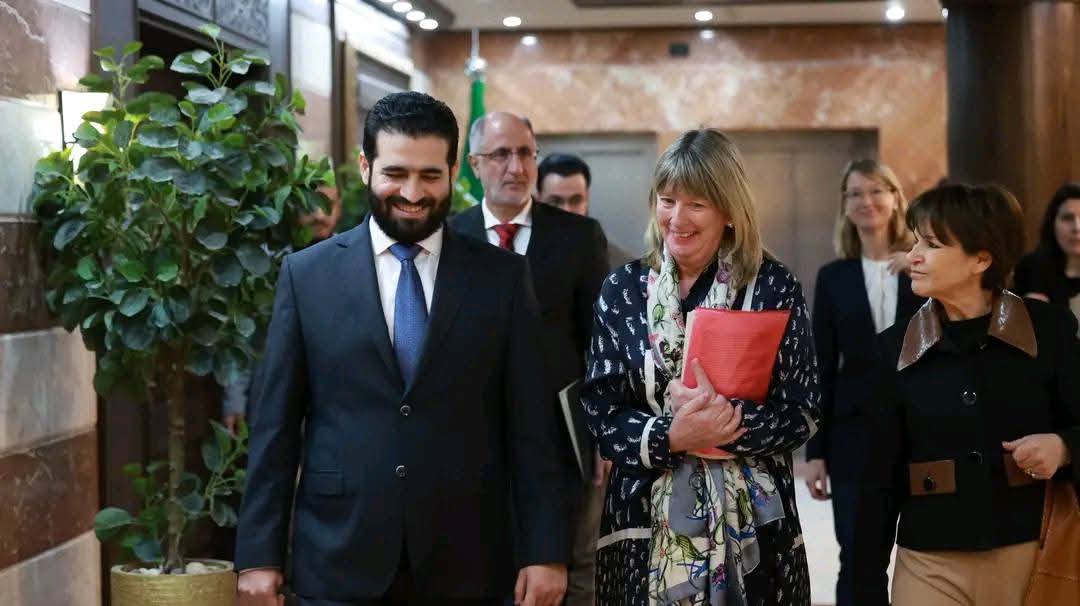
The Syrian Future Movement is following the meeting between Interior Minister Anas Khattab and a delegation from the Independent International Commission of Inquiry on the Syrian Arab Republic (COI), headed by Commissioners Mounia Ammar and Fionnuala Núñez.
The meeting discussed the findings and recommendations of the Commission’s recent human rights reports, with the Ministry affirming its commitment to studying these recommendations in accordance with national laws and international standards.
The Syrian Future Movement notes that this meeting comes at a sensitive transitional stage in Syria, as the country strives to rebuild the state on the foundations of institutions and the rule of law, following decades of systematic and grave human rights violations.
According to documentation by the Syrian Network for Human Rights (SNHR), at least 3,666 civilians were killed in 2025 (including 328 children, 312 women, and 32 deaths due to torture), while the total number of deaths resulting from torture since March 2011 has exceeded 45,000 (most of them in detention centers of the former regime). This highlights the continued risks of insecurity, intercommunal violence, and the remnants of war (such as landmines and unexploded ordnance).
SNHR also documented dozens of daily extrajudicial killings in its February 2026 reports, including cases involving children and women.
The Syrian Future Movement affirms that these figures reflect a deep wound in the Syrian social fabric and underscore the necessity of comprehensive and transparent transitional justice mechanisms that include all parties without exception, focusing on:
- The immediate disclosure of the fate of the missing and forcibly disappeared (more than 180,000 documented cases as of late 2025), through strengthening the role of the National Commission on Missing Persons and activating full cooperation with the Independent International Commission on Missing Persons in Syria (IIMP), including opening prisons and former detention centers to international monitors.
- A radical reform of the security and police sector is necessary, including: the immediate removal of personnel involved in past or present violations (including incidents in the coastal region, Suwaida, and elsewhere); the adoption of binding professional codes of conduct; intensive training on international rules of engagement and the protection of civilians; and ensuring the independence of internal investigations while referring serious criminal cases to an independent judiciary.
- Transparency and institutional accountability must be strengthened through the establishment of independent oversight mechanisms within the Ministry of Interior; the publication of regular public reports on the results of investigations into incidents of violence and violations; and the involvement of civil society organizations, victims, and representatives of various communities in the formulation of security policies to ensure that violations are not repeated.
- A comprehensive transitional justice process must be supported, one that addresses not only the violations of the former regime but also all parties responsible for violations, ensuring that impunity is not tolerated, and providing fair reparations and psychological and social rehabilitation for victims, in accordance with international humanitarian and human rights law standards.
- Continued and serious cooperation with international mechanisms, including the full renewal of the mandate of the International Commission of Inquiry (under Chapter IV), facilitating the work of the International, Impartial and Independent Mechanism (IIIM), and supporting full access for international observers to enhance confidence and build the credibility of national efforts.
The Syrian Future Movement views this meeting as a positive step towards establishing human rights as the foundation for building the future Syria: a unified, civil state that embraces all its social and cultural components, protects the dignity of its citizens, guarantees the rule of law without discrimination, and rejects all forms of dictatorship and foreign occupation.
We call upon all national and international parties to support this path with technical and financial resources to translate pledges into concrete actions that achieve justice, stability, and genuine national reconciliation.