

Abstract:
This research paper examines the phenomenon of motorcycle proliferation in Syria after 2011, with a particular focus on 2025, which witnessed a sharp increase in fatal accidents involving speeding motorcycles (particularly those known as “bart”).
The study is based on the premise that the crisis lies not in the means of transportation itself, but rather in the continuing regulatory and legal vacuum resulting from the collapse of the central state and the multiplicity of local regulatory authorities. Using an analytical approach that deconstructs the relationship between power, knowledge, and society, the paper demonstrates that the proliferation of motorcycles reflects the reconfiguration of the Syrian public sphere as an unregulated and politically and economically fragmented space.
The paper concludes that the solution lies not in prohibition or banning, but in rebuilding a “new cognitive regulatory authority” based on local knowledge, factual data, and participatory policies between state and society.
First – Introduction and Research Problem:
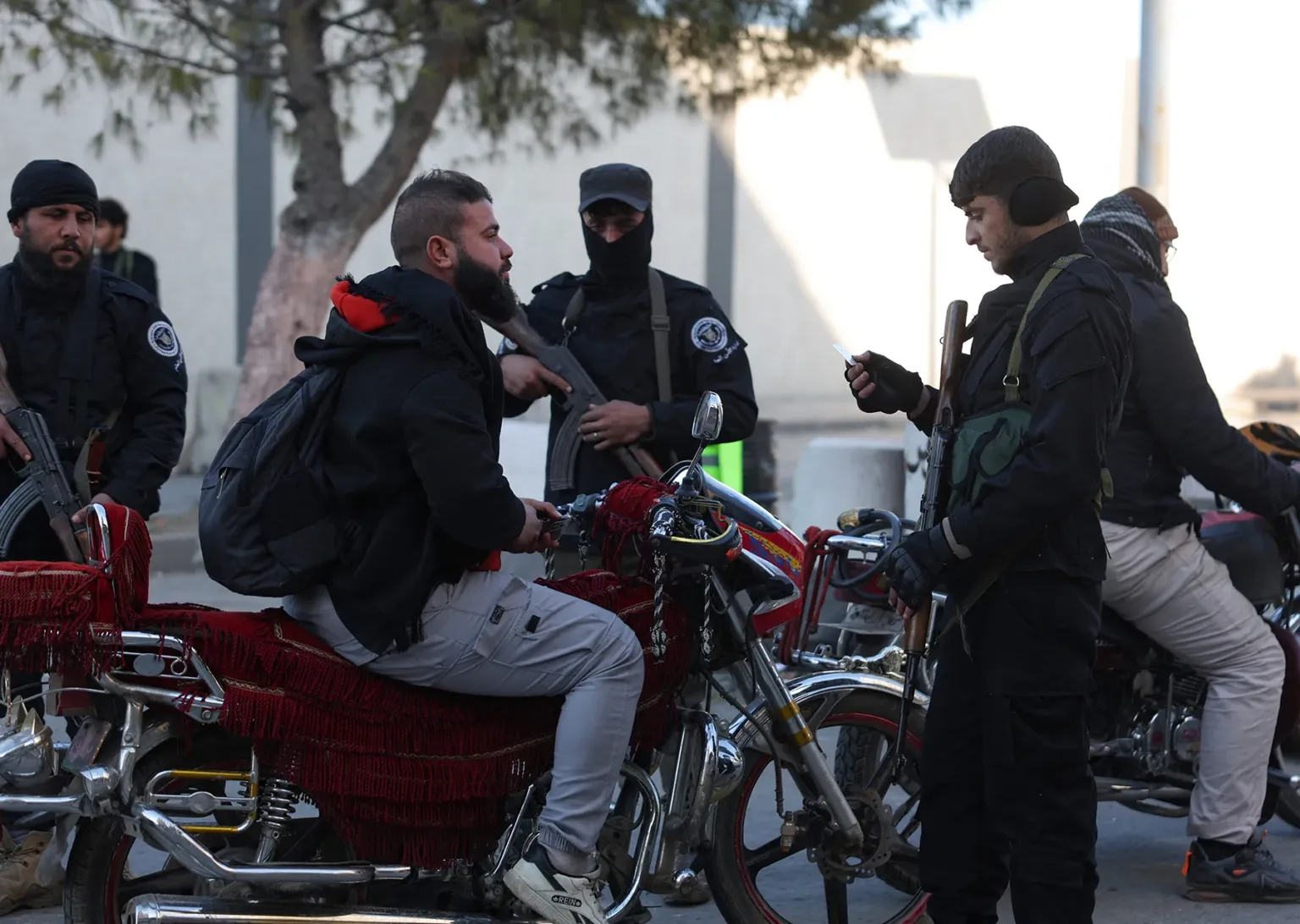
Since 2011, motorcycles in Syria have transformed from a limited means of transportation into a comprehensive social phenomenon. In light of the collapse of infrastructure and the decline of public transportation, motorcycles have become a means of livelihood, but at the same time, they have become a mobile system of chaos that embodies the absence of law and state. The paper poses the following problem:
How can we understand the motorcycle phenomenon in Syria as a reflection of the shifts in power and society after the war, and what are the possible regulatory means to regulate them without compromising their social function?
Second – Research Methodology and Statistical Mechanism:
The paper adopts a descriptive and analytical approach, relying on an analysis of local media discourse and social representations of security and chaos. Data was collected during October 2025 based on:
- Systematic monitoring of incident headlines published on local platforms (Syrian news agencies, police websites, and reliable community pages).
- Limiting news items that included accurate casualty figures or a clear description of the incident.
- Excluding anonymous or undated posts.
Counting Methodology: The “media-verified minimum” principle was adopted, meaning that only incidents with clear numbers were counted, to avoid exaggeration. We believe this type of media field count is appropriate in conflict environments where regular official statistics are absent.
Third – Statistical Results (October 2025):
Total number of reported incidents: 25, explicitly mentioned in the sources (a subtotal based on: 22 incidents reported from Idlib + individual incidents in Daraa, Qamishli, Aleppo, and elsewhere).
Reported motorcycle-related deaths during October 2025 (reported with clear numbers in the sources): 3 deaths (the death of a young man in Daraa, the death of a young man (16) in Qamishli, and the death of a girl in Aleppo).
Reported injuries (explicit figures in sources):
- Confirmed injury (one person was injured in an accident in Daraa; another source indicates multiple injuries but without precise figures). Note that reports covering longer periods indicate dozens/hundreds of injuries in northern areas when September and October are combined.
- Table of incidents documented by sources (examples of each incident are provided with the source)
- (Incidents/indications found with clear numbers or reports are listed; the list is not final but represents a reliable compilation of what has been reported.)
- Idlib Governorate — A traffic campaign was launched, stating that the campaign came after 22 motorcycle-related accidents (Statement by the Head of the Traffic Branch: 10/10/2025; 22 was cited as the number of accidents that prompted the campaign). — Source: Local coverage/Traffic Branch statement.
- Daraa — A collision between a motorcycle and a car on the Damascus-Amman international road (11/10/2025): One young man died and another was injured. — Source: Local coverage.
- Qamishli — Accident on the Northern Belt (published date October 2025): A 16-year-old boy died in a collision between a bicycle and a truck. — Source: Local publication/social media accompanying local coverage.
- Aleppo — A girl died in an accident resulting from “tashbeeb” (bicycle stunts) (late/mid-October 2025, according to a local publication): One death. — Source: Local publications/Facebook.
- Deir ez-Zor/Al-Mayadeen — Security campaigns against reckless driving (late/mid-October 2025): Campaigns led to the arrest of several drivers and the confiscation of bicycles (as an indicator of the local prevalence of the phenomenon, not every accident included a death/injury figure). — Source: Local/news report.
Methodological notes (to assess higher/more accurate figures):
- Reliance on local media and social media sources: Many accidents are first reported on local pages and Facebook/Instagram and then republished; Therefore, we relied only on explicit figures or local official statements to avoid duplication, even though Idlib Governorate only mentions some of them, not the other governorates.
- Distinguishing between “accidents” and “procedures/confiscations”: Some reports mention the confiscation of motorcycles (for example, in Deir ez-Zor, 60 motorcycles were seized in a campaign) as a precautionary measure rather than an incident. These are mentioned as an indication of the scale of the phenomenon, but they are not included in the accident count unless they are listed as an “accident.”
Gaps:
There is currently no published central database (Ministry/Unified Traffic) that provides national monthly figures. Therefore, what we present is the lowest estimate reported by the media, not the actual total number of accidents.
A brief summary, based on preliminary compilation:
A. 25 reported accidents during October 2025 in Syria (accidents reported by local sources/Idlib Traffic Branch/local publications).
B. 3 confirmed deaths related to motorcycle accidents during the same period, according to local reports that can be consulted.
Available data indicates a significant increase in motorcycle accidents during 2025. According to a report published by Enab Baladi, Syria has witnessed an increase in the number of motorcycle accidents since the beginning of this year, recording 847 accidents resulting in 62 deaths, indicating a 7.32% increase in the death-to-accident ratio (enabbaladi.net).
In Idlib Governorate, the first three days of Eid al-Adha recorded 9 deaths and 50 injuries as a result of traffic accidents, most of which were caused by motorcycles (syria.tv).
Fourth – Analysis:
In light of the analytical approach, motorcycles are read not as a means of transportation, but rather as a dynamic social text that reveals:
- The disintegration of central authority: the street has become a space outside of traditional control.
- Society’s self-reproduction: new groups of youth and workers are adopting parallel patterns of movement and work.
- The fluidity of the boundaries between civil and military: the use of motorcycles for both personal transportation and security tasks.
- The dominance of “partial knowledge”: the absence of official statistics has made the local community a source of data, meaning that “the street has become a producer of its own knowledge.”
From this perspective, the motorcycle crisis, as it is a traffic crisis, is a symbol of the collapse of the old control system and the beginning of the formation of a new, fragmented system of authority and knowledge.
Fifth – Discussing public policies:
Dealing with the phenomenon with a mindset of prevention or repression reproduces the same chaos. The effective approach is to shift from the “authority of surveillance” to the “authority of participatory regulation,” i.e., involving the local community in building safety rules. The paper proposes the following steps:
- Issuing a unified law for licensing and numbering all motorcycles Motorcycles.
- Establish a national digital database linking the owner, the motorcycle’s number, and the driver’s license.
- Adopt a mandatory annual technical inspection for motorcycles.
- Regulate the import of fast motorcycles such as Part and prohibit their circulation without a special permit.
- Launch a national traffic education program in schools and institutes.
- Incentivize the transition to environmentally friendly electric motorcycles in major cities.
Sixth – Conclusion:
The motorcycle phenomenon in Syria after 2025 represents an accurate reflection of the disintegration of central authority and society’s shift toward new forms of self-regulation. The solution proposed by the Syrian Future Movement is not to reproduce the old regulatory authority, but rather to formulate a new knowledge-participatory system that regulates public space based on a balance between freedom and security.
We believe that regulating the use of motorcycles is the beginning of restoring trust between citizens and the state and building a new concept of civil discipline in post-war Syria.
References
- Local traffic reports – Idlib, October 2025.
- Local news websites (Syria TV, Enab Baladi, Zaman al-Wasl).
- Publications from provincial police directorates on social media (data from October 10–18, 2025).
- Media interviews and open community sources.
- Postmodernist literature on the analysis of power and society (Foucault, Baudrillard, Girard).