

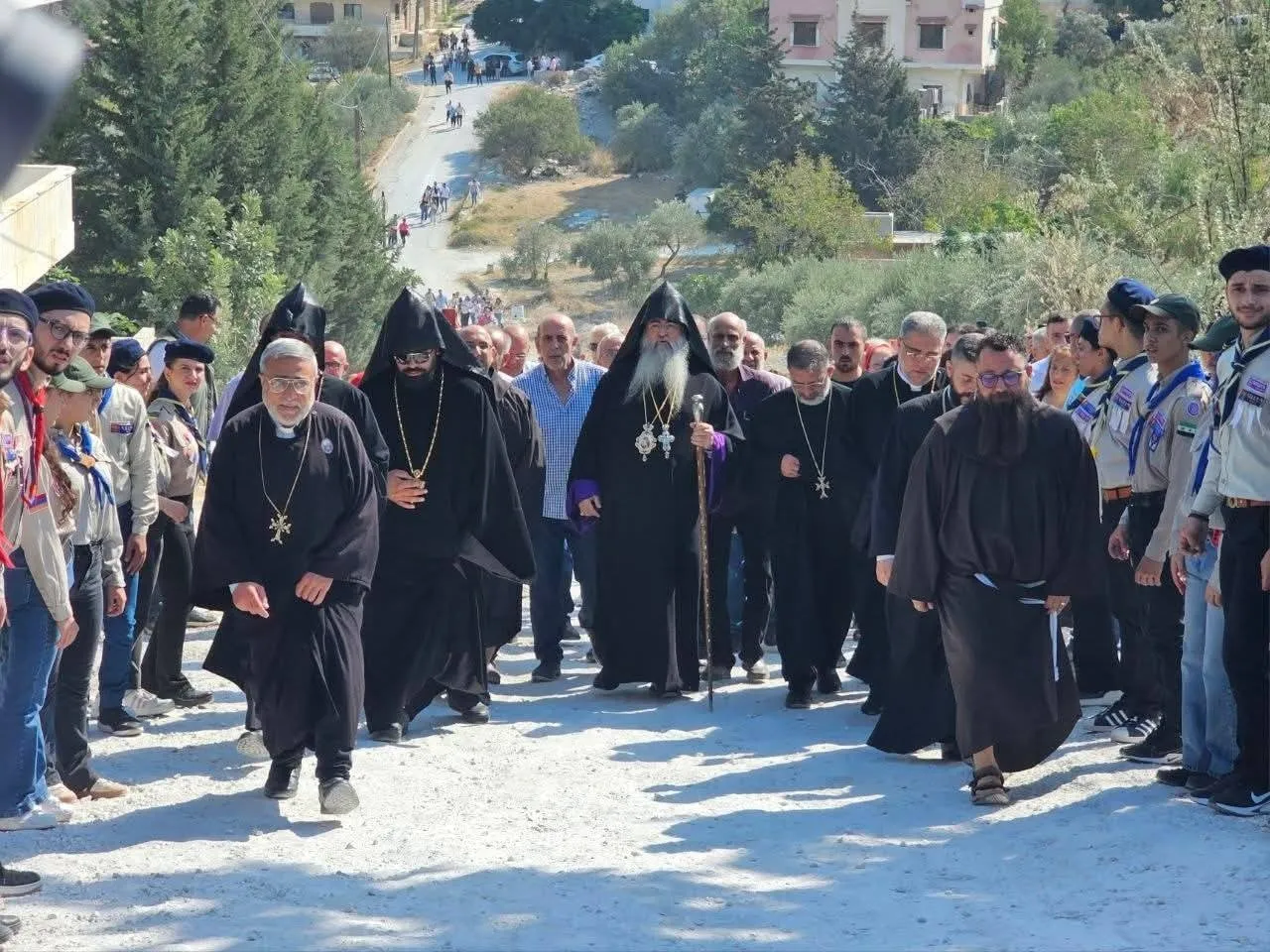
At a historic moment that reflects the depth of Syria’s cultural heritage and our people’s determination to preserve their religious and cultural diversity, the Syrian Future Movement extends its warmest congratulations to the Armenian Orthodox community and all the Syrian people on the occasion of the reopening of Saint Anna Church in the village of Al-Yaqoubiyeh in the Jisr al-Shughur countryside, west of Idlib.
The Syrian Future Movement views this event, which coincides with the celebration of Saint Anna’s feast day—one of the most prominent religious holidays for the Armenian community in Syria—as a symbol of hope and renewal in a time of suffering, and as evidence that the national will is capable of overcoming challenges to revive the heritage that unites us.
The Syrian Future Movement recalls the status of the Church of Saint Anna as one of the oldest Christian monuments in Syria, dating back to the early Christian centuries. Its construction dates back to the fifth century AD during the reign of Queen Helena, making it a living witness to the Byzantine and Armenian history of the region. The church is located in the heart of the village of Yaqubiyeh, which witnessed a medieval Armenian settlement between the eighth and twelfth centuries. It is distinguished by its unique architectural style that combines Byzantine and Armenian elements, including its domes and stone walls bearing historical inscriptions. The church was an annual pilgrimage site for members of the Armenian Orthodox community, as they flocked on the last Sunday of August to celebrate the feast of Saint Anna, the mother of the Virgin Mary, a symbol of fertility and protection in the Eastern Christian heritage. However, the tragic events of the previous war led to its closure since 2011, with many of the village’s residents being displaced, and religious activity halted for more than a decade, until it was partially reopened in August 2022 for the first celebration after Absence, then in February 2025, to receive pilgrims from Aleppo, Kassab, and Latakia, before the completion of comprehensive restoration work for its official reopening on Sunday, August 31, 2025, under the leadership of Archbishop Makar Ashkarian, Armenian Orthodox Metropolitan of the Archdiocese of Aleppo and its Dependencies, and with the participation of Archimandrite Levon Yeghiayan. The Syrian Future Movement, which firmly believes in the right of every Syrian to a dignified life and equal coexistence under the umbrella of sound citizenship, views this opening as a positive step toward restoring national unity, which has long been the essence of Syria as a beacon of civilization that unites religions and ethnicities. After the fall of Assad, who claimed to protect minorities, the church is not merely a historical building, but a symbol of spiritual and cultural resilience. It reminds us that Syrian diversity—whether Christian, Armenian, Muslim, or otherwise—is the source of our strength, not our division. Given the current Syrian situation, which requires building bridges of trust between communities, we call for strengthening such initiatives by ensuring the full protection of religious landmarks and encouraging the safe and dignified return of displaced persons to their areas, free from any political exploitation or narrow agendas. The Syrian Future Movement affirms its commitment to a comprehensive national vision based on social justice and equality, where every historical landmark, such as the Church of Saint Anne, becomes a starting point for building a future that unites us all, and a new era for a united Syria that respects its heritage and protects the rights of its people—Muslims and Christians, Arabs, Armenians, and Kurds—for the sake of a free and just homeland that thrives on peace and reconstruction.