

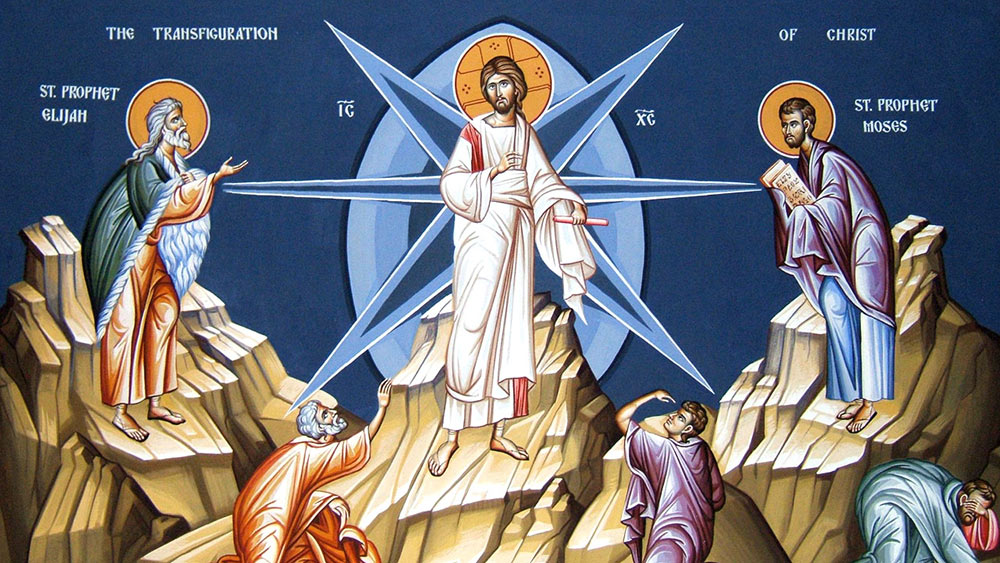
Every year on August 6, Christian churches around the world, including Syrian churches, stand in a moment of reverence and contemplation before a great event in the history of Christian salvation: the Feast of the Transfiguration of Jesus Christ on Mount Tabor.
It is not merely a ritual commemoration, but a spiritual illumination bearing profound indications of Christ’s identity, inviting us to explore its spiritual and moral dimensions as a way of life and an internal and societal transformation.
The account of the Transfiguration is told in the Synoptic Gospels (Matthew 17, Mark 9, Luke 9), where Jesus took three of his closest disciples: Peter, James, and John, and led them up a high mountain. There, “the appearance of his face was transformed, and his garments became white like the light.” Moses and Elijah appeared to him, symbols of the Law and prophecy in the Old Testament, speaking with him.
Then a voice came from the cloud, saying, “This is the beloved prophet, in whom I am well pleased; listen to him.”
This event marks a turning point in the disciples’ consciousness, as Jesus is no longer merely a teacher or prophet, but the Word of God.
The Transfiguration, then, is a proclamation revealing the glory of Christ and offering a glimpse of the Resurrection and the light that will overcome darkness.
Thus, the symbolic dimensions are:
- The meeting of heaven and earth. The mountain, as the site of the Transfiguration, symbolizes the meeting point between the temporal and the eternal, between man and God.
- The appearance of Moses and Elijah reveals that Christ is the fulfillment of the Law and prophecy, uniting the Hebrew and Christian faith visions.
- The whiteness of the garments, a sign of purity and glory, is a call to inner purity as a prelude to spiritual vision.
- The divine voice, an affirmation of Christ’s prophecy and missionary mandate.
These symbols give the feast a contemplative dimension that transcends the limits of ritual, inviting us to interpret the event as a constant manifestation of God’s light amidst life’s challenges.
In Syria, where civilizations and religions meet, the Feast of the Transfiguration occupies a special place in the Christian conscience and is celebrated through masses, hymns, and spiritual reflections.
However, given the complexities of the current situation, it becomes useful to recall the feast as a starting point for drawing inspiration for the meanings that will help us build a post-tyranny era and establish a homeland that embraces all.
In light of the suffering of the Syrian people, their deep divisions, and their long-standing wounds, the Feast of the Transfiguration takes on an additional dimension: a moral and societal transfiguration that calls for:
- Transformation from darkness to light. Just as Christ was revealed in the midst of the darkness of night, Syria today is called to emerge from the rubble of war and destruction, shining a new light of justice and reconciliation.
- Transfiguration does not begin in heaven, but rather with the human being who seeks truth and rejects violence.
- Reconciliation between religious legacies. Moses and Elijah in their transfiguration symbolize the integration of Sharia and prophecy, while in Syria they can be a symbol of the convergence of Christianity and Islam in a shared national space, where symbols of faith are restored as a source of convergence, not conflict.
- Raising the divine voice above sectarian and political voices. The voice that said, “Listen to Him!” must be restored as a call to listen to the voice of human conscience, rather than slogans of hatred and division. Every sect in Syria carries a rich heritage that can be transformed into a building block for the nation, not a tool for destruction.
- Moral leadership instead of coercive authority. Jesus, in the Transfiguration, was not a king in palaces, but rather a great man of spiritual glory. Furthermore, what Syria needs is a leadership endowed with vision and conscience, not force and oppression. How do we translate the Transfiguration into a national project? By establishing a national spiritual discourse that integrates religious visions and elevates shared values: mercy, justice, and dignity, and by promoting moral and religious education in schools and homes, the spiritual meanings of the holidays are restored to build awareness and institutionalize inter-sectarian dialogue, so that the symbolic meeting between Moses, Elijah, and the Christ of the Transfiguration becomes a model for a Syria that is inclusive. Cultural and symbolic initiatives should also be supported, and the Feast of the Transfiguration should be adopted as a national occasion to reflect on the meanings of peace and tolerance.
The Feast of the Transfiguration, with its light, tranquility, and divine messages, can become a symbol for rebuilding Syria, not only in its urban fabric, but also in its people, its thought, and its national project. When God reveals Himself to man, he is called to enlighten those around him. If the Transfiguration in Christianity was an event in the history of salvation, Syria today needs a “national transfiguration” event, in which the souls of the martyrs and the oppressed are reborn in a new light, one that embraces wounds and transforms them into energy for life.