

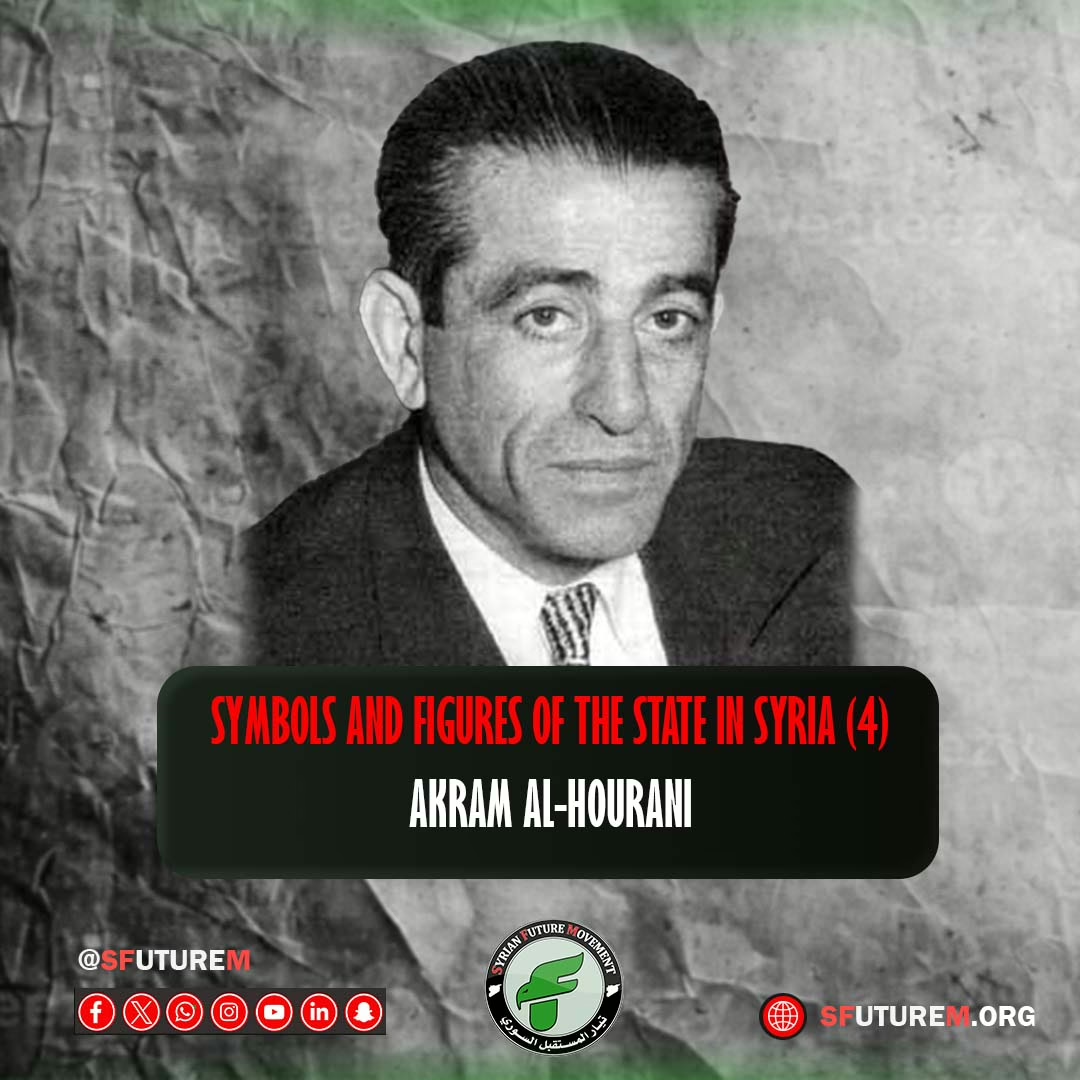
- He is Akram Rashid Muhyiddin al-Hourani, born in the Syrian city of Hama in 1911.
- He received his initial education at Dar al-Alam al-Tarbiyah, a model school founded by Syrian (and later Iraqi) King Faisal I, son of Sharif Hussein bin Ali.
- His father, Rashid Muhyiddin al-Hourani, was a textile merchant, a small landowner, and a pious man from the city of Hama.
- He mastered Arabic and Turkish and left behind a large library of books on language, literature, history, logic and medicine.
- He was in contact with secret societies (Arab Girl) and had close ties with scholars, intellectuals, and merchants.
- He was elected as one of the Muslim representatives in Hama’s administrative council and supported the peasants and merchants of that period against the families of the big landlords.
- He ran for the Envoy Council representing Hama and Homs in Istanbul but was not appointed due to opposition from large families.
- He participated in the 1925 revolution, as Akram al-Hourani’s political consciousness began to form during the events of the Great Syrian Revolution (1925-1927).
- After al-Hourani graduated from the Institute of Science and Education in Hama, he went to Damascus and enrolled in the state-affiliated Elite Secondary School (Maktabat Anbar), from which he graduated.
- He attended the Jesuit University in Beirut to study medicine.
- A year later, he returned to Damascus (1931 AD), where he enrolled in its university to study law.
His involvement in planning the assassination of MP Subhi Barakat led him to leave Beirut. - After graduating from law school, he practiced law until he was elected as a member of parliament in 1943.
- In 1936, after graduating from law school, he joined the Syrian Social Nationalist Party, attracted by its secular principles.
- He remained an active member until he was expelled in 1939.
- In 1941, al-Hourani, some Syrian army officers and other volunteers from the rest of the national political spectrum traveled to Baghdad to support Rashid Ali al-Kilani’s revolution against the British.
- They were detained for a while by the French Mandate government in Deir ez-Zor on the Syrian-Iraqi border after their return.
- He led the peasant uprising in the Hama countryside against the feudal lords, and was elected as a deputy from Hama in 1943, 1947, and 1949.
- He contributed to incitement against the French presence in Hama in 1945.
- After his election in 1943, he strengthened his ties with some of the young officers who graduated from the military college in Homs, such as Adnan al-Maliki and Adib al-Shishakli.
- He first took over the Ministry of Agriculture.
- In December 1949, he assumed the Ministry of Defense in the government of Khaled al-Azm.
- He resigned in April, and his policy at the Defense Ministry was to control the military, and to make personal connections, to employ them in his political project.
- He had a prominent role in building the army’s intelligence apparatus to tighten control over it.
- As defense minister, he sided with the Communists in parliament against the alliances and against the Muslim Brotherhood in the name of secularism and liberalism, accusing them of being agents of colonialism.
- In October 1950, Akram al-Hourani obtained a license to establish the Arab Socialist Party and made the city of Hama its headquarters.
- Al-Hourani organized his peasant followers in the Arab Socialist Party and used them against the big landlords. The agitation campaign culminated in a conference in Aleppo (September 1951) attended by thousands of peasants, which was the first conference of this kind (revolutionary!!) in the Arab world.
- When Shishakli took control of the government, al-Hourani fled to Lebanon, where he was joined by Michel Aflaq and Salah al-Bitar. In their exile in 1952, the three decided to merge the Arab Baath Party and the Arab Socialist Party to become the Arab Socialist Baath Party.
- Akram al-Hourani was named Vice President of the United Arab Republic by Gamal Abdel Nasser after the realization of unity between Egypt and Syria in 1958.
- He turned against unity and resigned from its responsibilities in 1959.
- Hourani fled to Lebanon and began launching attack after attack against Gamal Abdel Nasser’s rule.
- After the coup of September 28, 1961, he moved to Damascus and became one of the pillars of the separatist era, along with his companions.
- After the March 8, 1963 coup (which brought the Baath to power), he was stripped of his political and civil rights and briefly detained.
- In four volumes, he published his memoirs, which are considered an important reference from a critical period in our Syrian history.
- During World War I, he contracted cholera.
- Akram al-Hourani died in Amman in February 1996. His funeral was attended by a few people, including some of his enemies from the Muslim Brotherhood, and he was buried there.
We at Syrian Future Movement, as we recall the memory of the founding statesmen of Syria, we recall one of Syria’s influential statesmen, and one of the symbols of the first Syrian state’s flags who contributed to influencing its structure, “Akram al-Hourani”, in a sequential file that we present to you to include the symbols and flags of the Syrian state, in our desire to link our contemporary revolutionary present to a solid past and historical stations, with the hope of reviving in our people the need to build and create statesmen par excellence. We hope to revive in our people the need to build and create statesmen par excellence, to learn from their experiences, benefit from their negatives, and build on their positives, so that they preserve the homeland, safeguard the gains, and restore the Syrian state to its glory after years of oppression, tyranny, and corruption.