
The current stance of the transitional authority, as exemplified by the position of the Syrian Foreign Ministry, as expressed by Minister Asaad al-Shaibani in Brussels (May 11, 2026), appears to represent an epistemological shift in Syrian political discourse, and indeed in official Arab discourse in general.
This rejection of the terms “minority/majority” in social, religious, and ethnic contexts carries profound philosophical dimensions that warrant analysis.
First, let’s distinguish between the three uses of the term:
The problem lies in the field of discourse in which it is employed, across three axes:
- Political (Parliamentary/Partisan) Use
This is the functionally neutral use. Speaking of a “ruling majority” and an “opposition minority” in the British House of Commons or the French National Assembly describes a temporary political relationship, not an existential label for individuals.
A party that is a minority today may become a majority tomorrow. Therefore, this usage does not affect the essential identity of the individual, nor does it confine them to a closed mold. - Descriptive (Socio-Demographic) Use:
This is where the problem begins. When we say “Syrian Christians are a minority,” or “Syrian Alawites are a minority,” or “Syrian Kurds are a minority,” we are not describing a temporary political situation, but rather establishing existential identities that move from the realm of shared citizenship to the realm of perpetual categorization. This is something the new Syrian discourse seems to reject. - Ideological (Racist/Sectarian) Use:
This is the worst kind, as these terms are used to justify marginalization (minorities have no right to rule), to incite violence (the majority is threatened by the minority), or to impose international trusteeship (minorities must be protected).
This is the very use that the long Syrian revolution fought against, and it is what the new state seems to be trying to fundamentally overcome.
Second, Syria and a Critique of the “Politics of Recognition”:
The actions of the new Syrian state (post-Assad) can be interpreted within the framework of a critique of the “politics of recognition” school of thought, championed by Charles Taylor and others. This school argues that collective identities (such as minorities) require official recognition to guarantee the equitable distribution of rights, thereby paving the way for self-governance, and perhaps even federalism and power-sharing, similar to the Lebanese model.
However, the Syrian experience today, particularly after decades of sectarian manipulation by the old regime and the subsequent years of revolution, has demonstrated that official recognition of minorities has not guaranteed their freedom. On the contrary, it has made them hostages to the struggle for sectarian spoils.
The former regime used the logic of a “ruling minority” (the Alawites) to justify its tyranny, while the revolution sometimes employed the logic of an “oppressed Sunni majority” to legitimize violence.
But it can be objectively stated that both sides at the time practiced a form of numerical discrimination against the other.
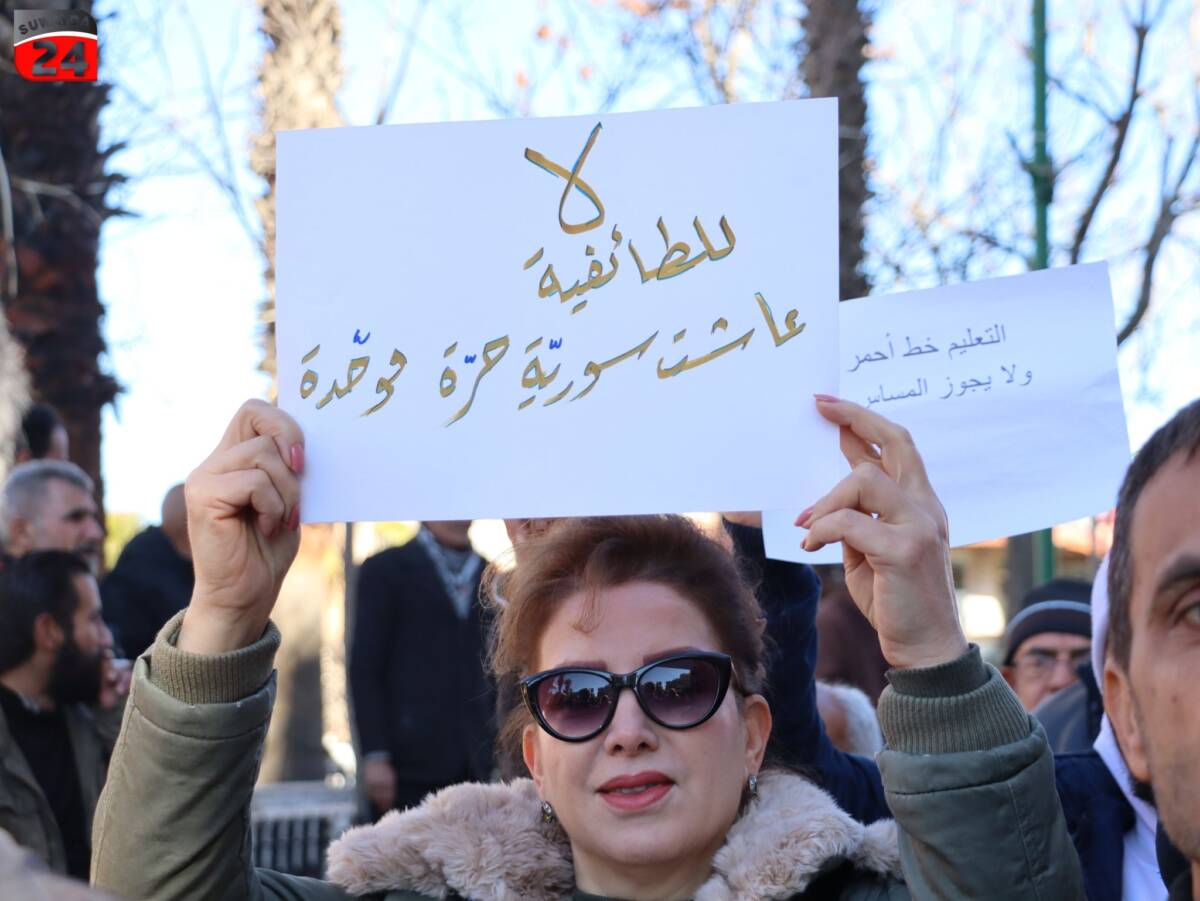
The new Syrian position offers an alternative: citizenship devoid of all sectarian and ethnic labels, where citizens are not asked, “Who are you?” (i.e., what is your religion or ethnicity?) Rather, it’s “What do you want?” (i.e., what is your political and civic stance?)
This is close to the French republican model in its theoretical form, but with a greater awareness of its pitfalls (such as the forced denial of cultural particularities).
However, the new Syria differs in that it does not possess a firmly established secular heritage like France, and the success of this model in the post-civil war context, which is a manifestation of the previous phase, is not guaranteed.
Some analysts criticize the new Syrian “unifying discourse,” considering that it ignores the necessity of mutual recognition as the basis for a genuine social contract.
Third, the “blocking minority”—a quintessential parliamentary term:
This term (which is usually associated with Western parliamentary systems, especially Westminster, the British system of government) is one of the purest political uses, as it:
Refers to a numerical parliamentary minority that has the right to obstruct decisions (for example, through a veto in the Senate, or by withholding confidence from the government).
It does not extend into society, nor does it categorize people or distribute political rights based on identity.
Its function is to achieve balance, not discrimination.
If the new Syrian state confines these terms to the political-institutional sphere only, this will not be racism, but rather democratic professionalism. The mistake lies in the leakage of these terms to describe society as a whole, such as saying, “The Alawites are the obstructive minority in parliament”—then the term becomes toxic because it reproduces sectarianism within the legislative institution itself.
Fourth, can differences be denied?
Herein lies the real philosophical dilemma. The new Syrian state says: “There are no minorities or majorities in Syria; we are all equal citizens.”
This is an ambitious normative statement, but it clashes with a harsh descriptive reality. Religious and ethnic differences do exist, and historically, they have been exploited politically and militarily.
The question here is: Does acknowledging the existence of differences (as a description) necessarily mean adopting them as a basis for rights (as a standard)?
The answer is: No.
We can acknowledge (descriptively) that Syria has citizens belonging to multiple sects, ethnicities, denominations, and religions, without making this affiliation the basis for distributing rights or power. This is the fundamental difference between:
The sectarian state (Lebanon being a model), where positions and resources are distributed according to sectarian affiliation, thus freezing identities and deepening divisions.
The civil state (the new Syrian model that is gradually taking shape, as we see) disregards affiliations in the realm of rights and policies, but does not deny their existence in the private and cultural spheres.
It should be noted that what Minister Shibani rejects is not the existence of pluralism itself, but rather its transformation into rigid political factions. This is a progressive stance that protects society from the trap of “political sectarianism.” It requires theorists and frameworks for this approach, and it should not be left adrift, which could lead to clashes with religious or philosophical arguments that might obstruct it internally.
Fifth, a critique of those who criticize the Syrian discourse:
Some voices (usually Western) criticize this Syrian position, arguing that it “denies the rights of minorities.” However, this criticism conflates:
Individual rights (freedom of belief, language, and cultural practices): These are guaranteed in the new Syrian Constitutional Declaration.
Group rights (sectarian quotas in parliament, ethnic veto power, and special representation): These are rejected by the new Syrian government.
Yes, she is right to reject it, as it is the root of the sectarianism that has torn Syria, Lebanon, and Iraq apart—a point with which we in the Syrian Future Movement explicitly and implicitly agree.
Successful global experiences (such as secular India, despite its problems) have demonstrated that recognizing groups does not protect them; rather, it demands their allegiance to their traditional leaders and transforms them into electoral blocs ripe for political exploitation.
Therefore, the new Syrian state’s rejection of the terms “minority/majority” outside their parliamentary-political context is:
- A sound, normative stance because it stems from the principle of equal citizenship and should be supported, encouraged, and formalized.
- A realistic stance because it aims to dismantle the mechanisms that perpetuate the sectarianism that has devastated the country.
- A stance open to criticism if it transforms into a forced denial of cultural and religious diversity, or if it is used to justify the marginalization of any particular group.
Therefore, the true achievement will be when Syria can celebrate its social diversity (in weddings, holidays, cuisine, and languages) while ignoring it politically (in the constitution, elections, appointments, and institutions). This is the challenge of a “multicultural republic” that prevents pluralism from becoming “institutional division.”
However, the question awaiting an answer from the Syrian experience is not “Do minorities exist?” but rather “How do we guarantee the rights of all citizens without transforming their differences into political boundaries?” This is what we hope the new Syrian experiment will realistically and accurately answer.