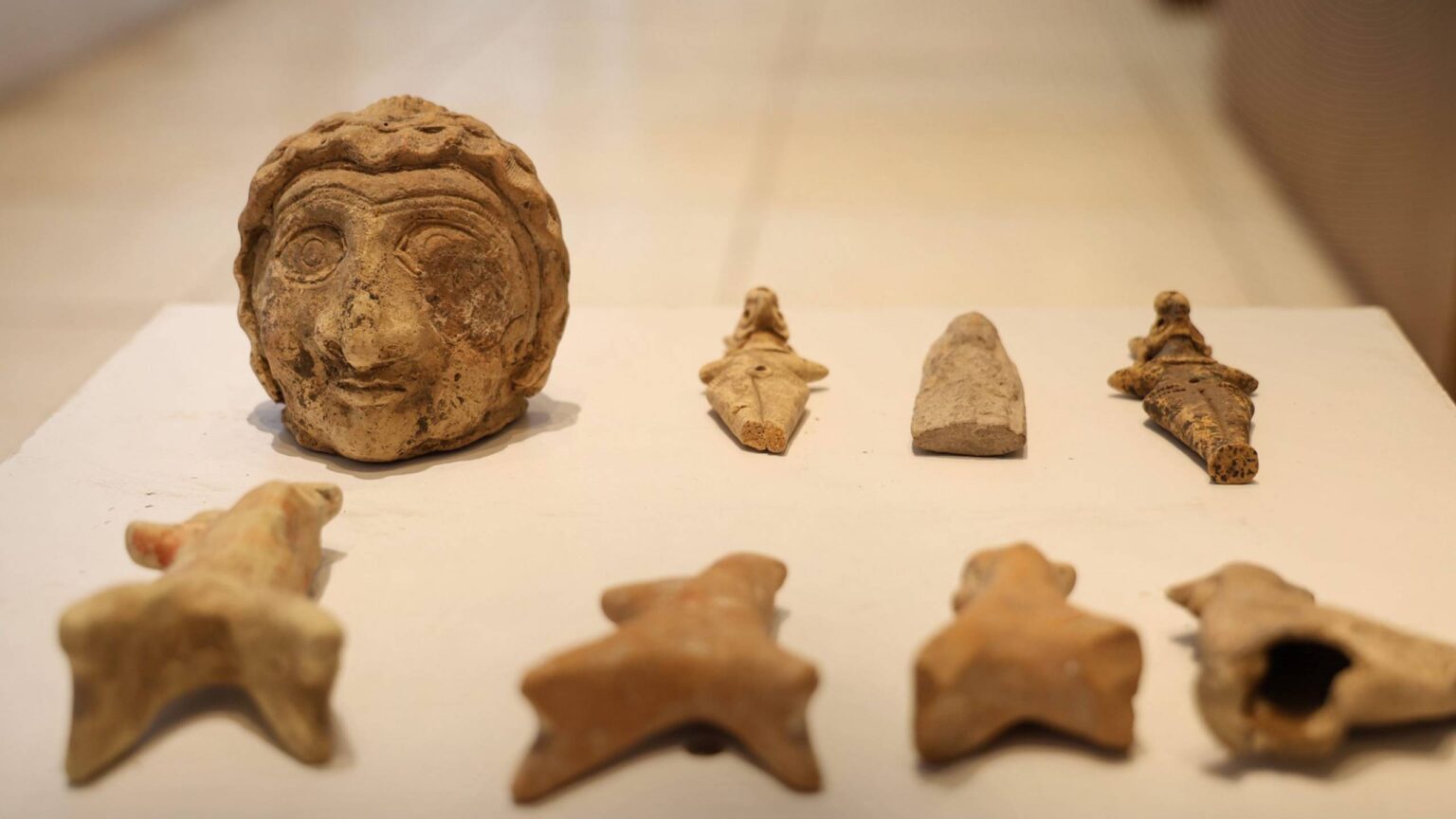
The Syrian Future Movement commends the national initiative taken by Nidal Abdul Qader—a citizen from the town of Rankous in the Damascus countryside—who handed over approximately 3,200 diverse archaeological artifacts to the Directorate-General of Antiquities and Museums. Having collected and purchased most of these items with his own personal funds over the course of several years, his actions reflect an exceptional civic awareness regarding the importance of preserving national heritage and safeguarding our shared cultural memory.
The Syrian Future Movement views this initiative as an exemplary model of responsible citizenship. It was not merely a handover of objects, but a voluntary decision to invest personal resources to protect a collective national legacy at a time when state institutions were unable to ensure the protection of antiquities—a contribution that deserves both recognition and formal documentation.
The Syrian Future Movement notes that Ammar Kanawi, Director of the Museums Department, explained that the collection includes four terracotta figurines from the Middle Bronze Age, Roman and Byzantine pottery, as well as various coins and metal tools. The Directorate is currently in the process of cataloging, documenting, and studying these items to verify their authenticity; they are set to be displayed in a dedicated exhibition wing titled “Syria Recovers Its Antiquities.” The Syrian Future Movement recommends that the transitional government, the Ministry of Culture, and the Directorate-General of Antiquities and Museums formally honor Mr. Nidal Abdul Qader in a manner befitting his initiative. This should go beyond mere verbal expressions of appreciation; it should include awarding him a national certificate of recognition, inscribing his name in the national honor roll of heritage protectors, and inviting him to the opening of the exhibition wing where the artifacts he surrendered will be displayed—serving as a living testament that the Syrian citizen is the primary guardian of their own heritage.
The Syrian Future Movement further emphasizes that such recognition should not be limited to this individual alone. Instead, his initiative should be transformed into a permanent national policy through the establishment of an annual “Heritage Protectors” award. This award would be granted to citizens who surrender archaeological artifacts and would be accompanied by tangible benefits—such as priority access to museums, invitations to exhibitions, or streamlined administrative procedures when dealing with the Ministry of Culture. Symbolic recognition alone is insufficient; institutional acknowledgment is essential to fostering a culture of heritage preservation. The Syrian Future Movement points out that Syria does not exist in a legal vacuum regarding the protection of cultural heritage. The country has ratified the 1954 Hague Convention for the Protection of Cultural Property in the Event of Armed Conflict—along with its First Protocol—as well as the 1970 UNESCO Convention on the Means of Prohibiting and Preventing the Illicit Import, Export and Transfer of Ownership of Cultural Property. Furthermore, Syria is a party to the 1972 World Heritage Convention.
The Syrian Future Movement maintains that these commitments impose positive obligations upon the Syrian state, including the establishment of a national system for the inventory of cultural property, the regulation of the antiquities market, the prevention of illicit exports, and the provision of mechanisms—in cooperation with other nations—to recover smuggled artifacts.
The Syrian Future Movement notes that citizen-led initiatives, such as the one undertaken by Abdul Qader, partially compensate for institutional shortcomings in fulfilling these duties; however, such efforts do not absolve the state of its legal responsibilities.
The Syrian Future Movement further notes that Syria has already begun to reap the benefits of international cooperation in this field. In September 2026, for instance, the country recovered 36 archaeological artifacts from the United States. This development demonstrates that the recovery of such items is indeed possible when the necessary political and diplomatic will is present. It also highlights that what Syria lacks is not the prospect of recovering its antiquities, but rather the institutional mechanisms required to transform such recoveries into a consistent, long-term policy rather than an isolated, one-off event.
The Syrian Future Movement points to successful international experiences in the recovery and protection of antiquities—models from which lessons can be drawn:
The experience of Peru: Between 2015 and 2023, Peru succeeded in recovering over 10,000 cultural artifacts and filing approximately 1,000 international claims. This was achieved through a robust regulatory framework, international cooperation, proactive diplomacy, and institutional coordination between the Ministries of Culture and Foreign Affairs—an experience documented by UNESCO in a comparative study released in June 2026.
The experience of the United Kingdom and the Organization for Security and Co-operation in Europe (OSCE): In 2021, a “Heritage Crime Task Force” was established, comprising 80 officers and experts from law enforcement, customs, the judiciary, museums, and academia. In 2025, this task force assisted in securing and cataloging approximately 200 artifacts—originating from Cambodia, Bactria, and Gandhara—in preparation for their repatriation to their countries of origin.
The Syrian Future Movement asserts that these examples demonstrate that the successful protection of cultural heritage does not rely solely on the efforts of individuals; rather, it requires a permanent institutional mechanism, international cooperation, a national database, and oversight of the antiquities market—elements that remain either absent or underdeveloped in Syria.
Acting out of a sense of national responsibility, the Syrian Future Movement (SFM) makes the following recommendations:
First: Establish a permanent national mechanism for receiving archaeological artifacts from citizens, with centers in every governorate. This process should feature streamlined procedures, ensure prompt documentation, and provide citizens with an official receipt for the items they hand over—consistent with the Directorate’s stated policy that its doors remain open to the public.
Second: Provide legal protection for citizens who surrender archaeological artifacts. This should be established through an explicit provision that exempts them from any criminal liability regarding their prior possession of these items, ensures they are not subjected to extortion or pressure, and recognizes their contribution—as protecting those who report heritage items is essential to encouraging others to follow suit.
Third: Develop a unified, digital national database for Syrian antiquities, encompassing archaeological sites as well as registered, missing, and recovered artifacts. This database should be accessible to security agencies, customs authorities, and Interpol, serving as a practical tool to combat illicit trafficking. This aligns with the SFM’s recommendation in its document titled “The Syrian Future Movement and the Protection of Antiquities” (dated April 17, 2024), which called for “the precise documentation of Syrian antiquities through the creation of a database of archaeological sites.”
Fourth: Collaborate with international mechanisms to recover smuggled antiquities by strengthening cooperation with UNESCO, Interpol, and the World Customs Organization. This includes drawing upon Peru’s experience in filing international claims and the European task force’s expertise in tracking trafficking networks.
Appointing liaison officers within Syrian embassies to follow up on restitution cases, and building upon the successful recovery of 36 artifacts from the United States in September 2026 to expand the scope of such claims.
Fifth: Launching a national awareness campaign regarding the value of heritage—targeting schools, universities, and media outlets—and highlighting examples such as the citizen Nidal Abdul Qader. The goal is to instill the understanding that antiquities are not merely “decorative ornaments,” but rather the memory and identity of the nation. This aligns with the aforementioned document from the Syrian Future Movement, which emphasizes that “historical antiquities reflect the patterns, image, and evolution of our cultural heritage, and contribute to strengthening the cultural and historical identity of the Syrian people.”
The Syrian Future Movement commends the initiative taken by Nidal Abdul Qader, viewing it as evidence that the Syrian people—despite years of war and destruction—retain a profound awareness of their civilizational identity. It further underscores that protecting heritage is not the sole responsibility of the state, but rather a partnership between the state and society.
The Syrian Future Movement calls upon the transitional government to honor this citizen and to transform his individual initiative into a permanent national policy. Such a policy should be grounded in Syria’s international obligations, draw upon successful global precedents, and place heritage at the core of the project to build a new state. For a nation that fails to protect its antiquities is a nation that fails to protect its own memory—and, consequently, does not deserve a future.