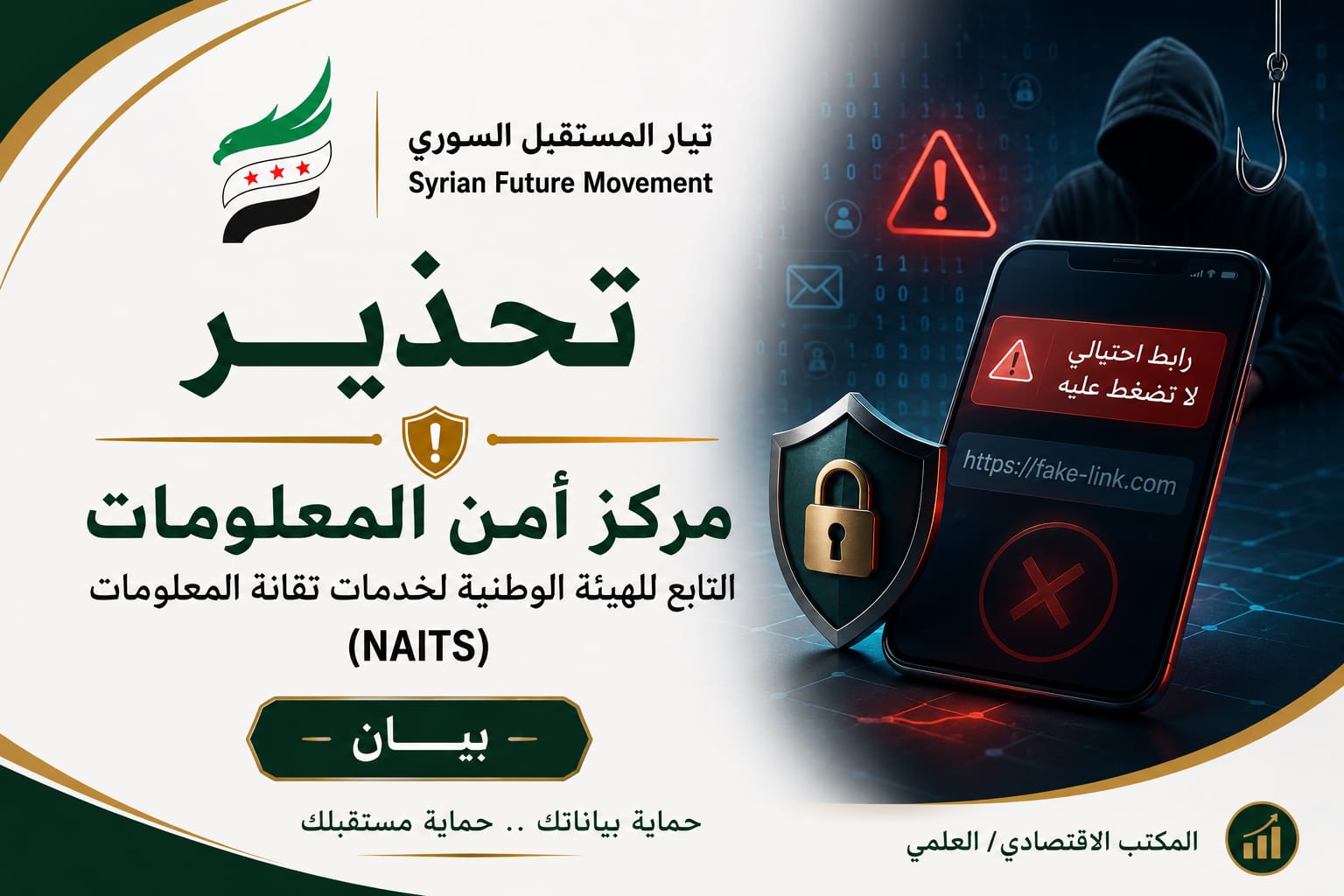
The Syrian Future Movement is closely following the warning issued by the Information Security Center of the National Information Technology Services Authority (NAITS) on Friday, July 10, 2026, regarding the proliferation of fraudulent advertisements and links on social media platforms promoting fictitious profits with the aim of stealing data and money.
While the Syrian Future Movement appreciates this institutional vigilance, it places this warning within its broader theoretical and economic context, as an embodiment of the ongoing struggle between building trust in the digital space and the mechanisms for exploiting it, and as a true test of the state’s ability to protect its citizens in the age of digital transformation.
Firstly, the Syrian Future Movement points out that the phenomenon of fraudulent links is a crisis of trust and a breakdown in the relationship between the individual and the institution in the digital space. It reflects a state of “moral danger” resulting from the knowledge gap between citizens and the technological system, and the associated “market failure” stemming from information asymmetry.
The Syrian Future Movement analyzes this phenomenon in light of information economics theories, where digital fraud represents a sophisticated form of “market failure,” based on the information asymmetry between the fraudster and the victim.
Fraudsters possess advanced knowledge of social engineering techniques and psychological vulnerabilities, while the average citizen lacks the necessary knowledge and technical tools to distinguish fraudulent offers from genuine opportunities.
It is also worth noting that the digital space, despite being a space of freedom and openness, remains fertile ground for exploiting this knowledge gap, especially in light of difficult economic conditions that drive some to seek a quick way out of their financial difficulties.
Data from Kaspersky indicates that users in the Middle East clicked on more than 47 million phishing links in one year (between November 2024 and October 2025), all of which were detected and blocked by Kaspersky security solutions. The data also indicated that 88.5% of phishing attacks aimed to steal login credentials, and that fake e-commerce pages accounted for 48.5% of the financial phishing landscape in the Middle East during 2025, followed by fake bank pages at 26.1%.
Secondly, the Syrian Future Movement emphasizes that protecting banking data is a fundamental pillar for building trust in the digital economy and a necessary condition for the success of any financial and banking transformation. It asserts that compromising this protection threatens the credibility of financial institutions as a whole and hinders financial inclusion efforts.
The Syrian Future Movement also draws attention to the fact that losses resulting from cyberattacks globally pose a significant economic challenge.
According to estimates by the research firm Cybersecurity Ventures, global losses from cybercrime reached approximately $9.5 trillion in 2024 and are expected to rise to $10.5 trillion in 2025—a figure exceeding the GDP of most major economies.
In this context, phishing attacks pose a direct threat to financial inclusion, as they undermine citizens’ trust in using digital banking services and hinder the state’s efforts to modernize the financial sector.
The Syrian Future Movement emphasizes that the success of digital transformation in Syria depends on the state’s ability to provide a secure digital environment that protects citizens from the risks of fraud and strengthens their trust in financial institutions.
Third: The Syrian Future Movement reiterates its firm positions supporting digital transformation and the protection of digital rights, published on its official website, including:
- The statement on the opening of the “One-Stop Shop” center at the Port of Latakia (dated July 11, 2026), in which it stressed that digital transformation requires advanced technological infrastructure, transparent oversight mechanisms, and investment in human resources, which also applies to the necessity of protecting banking data.
- The statement announcing the launch of the “Civil Affairs” application (dated June 21, 2026) emphasized that automating administrative services contributes to reducing corruption and favoritism, provided a secure digital environment is in place.
- The statement outlining the “Central Bank of Syria’s 2026–2030 Strategy” (dated May 7, 2026) indicated that s a fundamental pillar for achieving monetary stability and sustainable development .digital transformation in the financial and banking sector i s a fundamental pillar for achieving monetary stability and sustainable development.
Fourth: Based on its national and economic responsibility, the Syrian Future Movement recommends the following:
- Bridging the knowledge gap by launching comprehensive national awareness programs on the risks of digital fraud, methods for identifying fraudulent links, and ways to protect personal data, in line with the recommendations of the Information Security Center, and in a manner that contributes to reducing citizens’ vulnerability to fraud.
- Developing the technological infrastructure by strengthening the capabilities of security and regulatory bodies in combating cybercrime, updating banking protection systems, and adopting advanced mechanisms for detecting and preventing cyberattacks, as stipulated in the Central Bank of Syria’s strategy.
- Strengthening international cooperation through participation in regional and international initiatives to combat financial fraud and cybercrime, and exchanging expertise and information with leading countries in this field, similar to Syria’s participation in the 2026 Global Anti-Fraud Summit.
- Activating oversight and accountability mechanisms by increasing penalties for perpetrators of cyber fraud, ensuring the swift resolution of cases referred to the judiciary, and enhancing the role of regulatory bodies in monitoring the performance of financial and technological institutions. The Syrian Future Movement reiterates its position that digital transformation is a strategic path to building a developed knowledge economy, and that protecting banking data is not a luxury, but rather a fundamental requirement for the sustainability and success of this transformation.
We believe that the Syrian government, financial institutions, and civil society are called upon today to work together to enhance digital security, raise public awareness, and build a safe and attractive digital environment for investment, befitting a modern Syria. Syria and the aspirations of its people.
For its part, the Syrian Future Movement will remain supportive, critical, and observant of this issue, striving to build a new Syria on the foundations of knowledge, justice, and sustainable development.