Introduction:
Oil has never been merely an economic commodity; it has been—and remains—one of the most important tools for shaping the international balance of power.
Since its discovery at the beginning of the 20th century, pipelines have been as closely linked to politics as to economics, to the point that energy maps have become a direct reflection of maps of influence, alliances, and conflicts.
In this context, the Kirkuk-Banias pipeline has returned to the forefront of events, not merely as a technical project to restart a line that has been out of service for decades, but as an indicator of strategic shifts that could redraw the balance of power in the Levant.
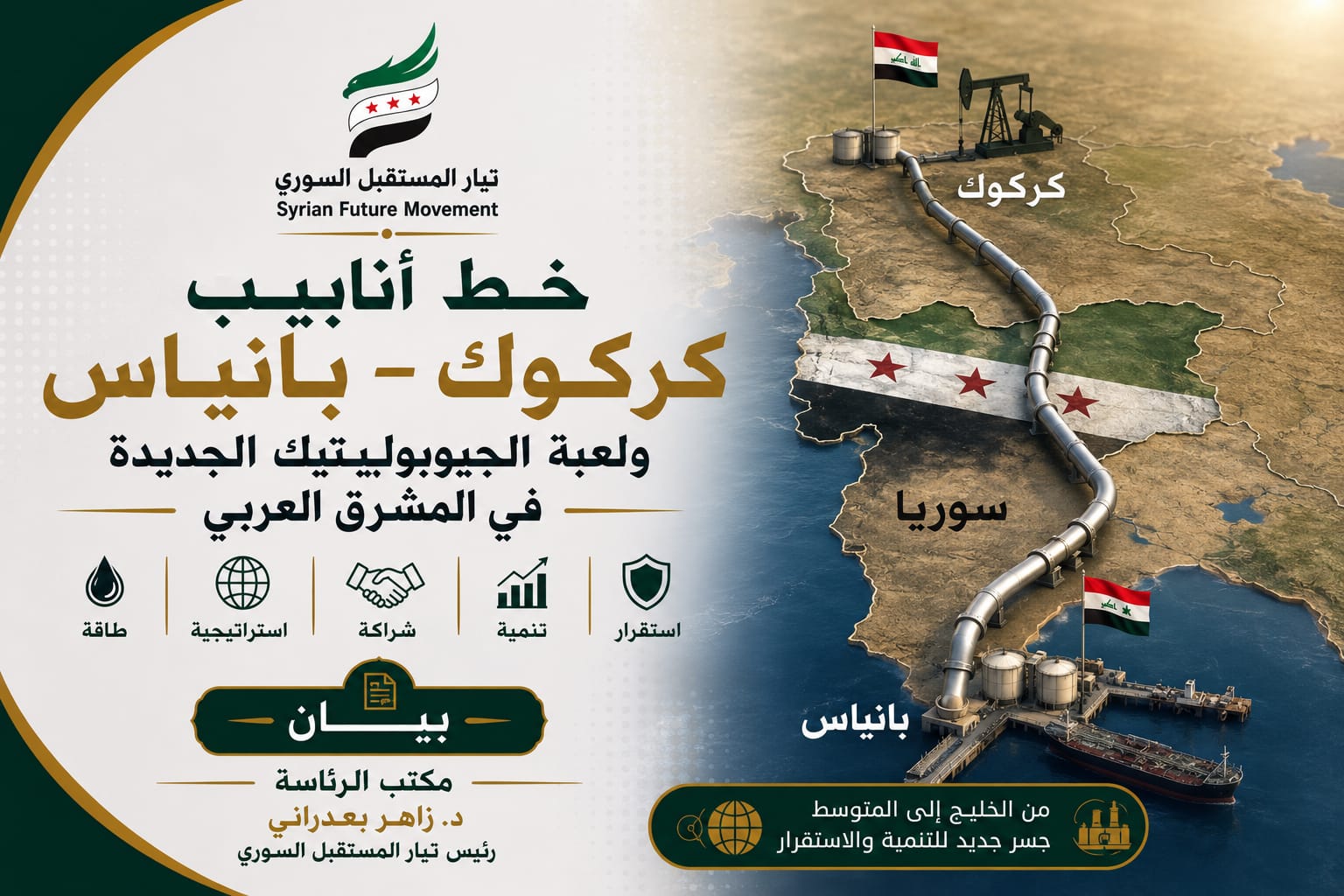
Recently, there has been increasing evidence of understandings between the United States, Iraq, and Syria to revive this historic pipeline, which stretches from the Kirkuk oil fields in Iraq to the Syrian port of Banias on the Mediterranean Sea, a distance of approximately 800 kilometers. This move reflects the desire of the parties involved to rebuild a new network of economic and security interests in the region.
Although the project is still in the stage of discussions and studies, its mere return to the negotiating table reveals profound shifts in the strategic thinking of the countries involved, raising questions that extend beyond oil to the future of the entire regional order.
Are we witnessing a new economic project?
Or the beginning of a new phase in the redistribution of influence among the United States, Turkey, Iran, and Russia, with Syria re-emerging as a geographically insurmountable obstacle?
Historical Background:
The Kirkuk-Banias pipeline was established in 1952 as one of the most important pipelines for exporting Iraqi oil to the Mediterranean Sea, and for decades it contributed to making Syria a key partner in the regional energy trade.
However, political transformations in the region led to its disruption on more than one occasion, before it finally ceased operations during the Iran-Iraq War when Damascus sided with Tehran. Large sections of the pipeline were then destroyed and neglected after 2003, causing the region to lose one of its most vital economic arteries.
Today, after the fall of the Assad regime and Syria’s entry into a new political phase, the project has resurfaced with a completely different vision. Instead of being merely an oil pipeline, it is viewed as part of a broader project to reintegrate Syria into the regional and international economy.
Therefore, this project should not be analyzed solely from an energy perspective, but rather from the perspective of the geopolitical transformations taking place across the entire Levant.
First: The Geopolitical Dimension… From Breaking the Bottleneck to Re-engineering the Levant:
The Strait of Hormuz is currently one of the most sensitive maritime chokepoints in the world, with approximately a quarter of global oil trade passing through it. This has made it a pivotal point in American strategy for decades, and conversely, a key bargaining chip in the hands of Iran.
With escalating tensions between Washington and Tehran, and growing concerns about disruptions to navigation in the Gulf, the need for alternative routes has emerged to reduce the global markets’ dependence on this highly sensitive strait.
Hence, the Kirkuk-Banias project can be understood as more than just a pipeline; it is an attempt to create a strategic land corridor directly linking Iraqi oil fields to the Mediterranean Sea, bypassing the maritime and political risks in the Arabian Gulf.
But the project’s significance doesn’t end there. The pipeline traverses Syrian territory, which has been one of Iran’s most important spheres of influence in the region for years.
Therefore, its reactivation under American auspices effectively means Syria’s shift from a position within a closed regional axis to a new position within a different economic and security system—a transformation that could redefine Damascus’s place in the international balance of power.
This perhaps explains the direct American interest in the project, viewing it as a model for economic integration projects in the Levant, rather than simply a limited oil project.
The project also reflects a shift in the Western perspective on the new Syria, seeing it as a partner whose stability can be invested in, rather than as a perpetual battleground.
From a broader perspective, the pipeline’s reactivation represents the beginning of a shift in international competition in the region from control of military geography to control of economic geography—an equation that will determine the shape of influence in the Middle East in the coming decades.
Second: The Economic Dimension… More Than Transit Fees:
Economically, the project yields varying gains for all participating parties.
Iraq will gain an additional export outlet, granting it greater flexibility in managing its oil exports and reducing its reliance on Gulf ports and the Kirkuk-Ceyhan pipeline, thus strengthening its negotiating position with various regional partners.
For Syria, the benefits extend far beyond oil transit fees.
The pipeline could become the nucleus of an integrated service economy based on storage, refining, petrochemical industries, logistics, and investment zones, creating thousands of jobs and laying the foundation for a new phase of economic development.
Therefore, Damascus should view the project not merely as a financial resource, but as a national project to rebuild the Syrian economy on new productive foundations.
Many countries have built their wealth not from possessing oil, but from effectively managing its transit routes.
This could be Syria’s historic opportunity.
For the United States, the project represents a geopolitical investment as much as it is an economic one.
Every dollar invested in this project could later save many times that amount in the costs of protecting maritime routes, containing Iranian influence, or enhancing regional stability.
The project also offers American companies significant investment opportunities in rehabilitation, engineering, security, technology, and energy, which explains the clear American interest in participating in the technical studies and providing initial funding for the project.
The legal dimension… Sanctions may prove more difficult than security challenges:
Despite the project’s importance, one of the most sensitive challenges is not related to security or financing, but rather to the international legal framework.
Syria, despite its openness The political situation there is still subject to a system of US and European sanctions, some targeting individuals and entities, and others affecting broad economic sectors (though these appear to be in the process of being dismantled).
This raises fundamental questions:
Will the implementing companies be granted special legal exemptions?
Will international banks agree to finance the project?
Will global insurance companies be able to cover its operations?
The project’s success requires addressing these issues from the outset, because many major projects do not falter due to a lack of funding or political will, but rather due to the complexities of legal and banking compliance.
Therefore, any future agreement must include a clear legal framework that provides investors with the necessary guarantees and prevents sanctions from becoming a permanent obstacle to the project’s implementation.
Third: The Security Dimension… The Pipeline Between Geography and Threats:
If financing is the heart of the project, then security is its lifeblood.
History proves that pipelines have never been merely economic infrastructure, but rather prime military and political targets, as targeting them achieves strategic gains at a relatively low cost.
The Kirkuk-Banias pipeline stretches across hundreds of kilometers of Iraqi and Syrian territory, traversing desert and semi-desert regions, and areas that have witnessed activity by the Islamic State, armed militias, smuggling networks, and organized gangs over the past two decades. This makes protecting the pipeline a constant challenge, not a temporary task.
Furthermore, rehabilitating the infrastructure could take between two and three years, a lengthy period during which the project will remain vulnerable to sabotage attempts or security threats.
Therefore, the project’s success will not depend solely on rebuilding the pipeline, but also on establishing a comprehensive security system that includes electronic surveillance, drones, satellites, rapid intervention units, and intelligence coordination among the countries involved.
This may be the first time in many years that Baghdad, Damascus, and Washington find themselves compelled to forge joint security cooperation around an economic project, potentially establishing a new paradigm for regional relations that transcends traditional calculations.
However, the most crucial question remains: Who will be responsible for protecting the pipeline?
Will it be a specialized Syrian force?
Or a joint Iraqi force?
Or limited international oversight?
Or will the United States confine itself to intelligence and technical support without a direct on-the-ground presence?
The answers to these questions will determine the project’s future more effectively than economic studies.
Fourth: The Kurdish Dimension… The Link That Cannot Be Ignored:
One of the most significant shortcomings in many analyses is the neglect of the Kurdish factor.
The city of Kirkuk is not merely the starting point for the pipeline; it represents one of the most sensitive regions in Iraq, where national, political, and economic considerations intersect between the federal government and the Kurdistan Regional Government.
Despite the temporary understandings reached regarding oil exports, the relationship between Baghdad and Erbil remains governed by complex issues related to jurisdiction, revenue sharing, field management, and the federal budget.
Any new strategic project that bypasses the Kurdistan Region or diminishes its role could be interpreted in Erbil as a recentralization of oil power in Baghdad, which could negatively impact the cooperation necessary for the project’s success.
Therefore, involving the Kurdistan Regional Government in negotiations from the outset is not a political favor, but a strategic necessity to ensure the project’s stability and sustainability.
Fifth: The Turkish Dimension… Between Competition and Integration:
It is difficult to envision any energy project in the Levant without considering the Turkish position.
For decades, the Kirkuk-Ceyhan pipeline has been one of the most important instruments of Turkish economic influence in the region, granting Ankara a pivotal position in energy trade between Iraq and Europe.
Therefore, the reactivation of the Banias pipeline will be interpreted in Turkey as a strategic shift that affects its status as a major energy transit route.
However, viewing the project as a zero-sum game would be an oversimplification.
The modern economy is based on the diversity of energy routes, not their monopoly.
It is in the interest of all parties for the region to become an integrated network of energy pipelines, rather than each project remaining hostage to political disputes.
Therefore, it would be wise for Damascus and Baghdad to initiate early dialogue with Ankara to clarify that the project does not aim to exclude Turkey, but rather to diversify strategic options in a way that serves regional energy security.
Avoiding the project from becoming an arena for political competition will be a crucial factor in its success.
Sixth: The Russian Dimension… The Absent Presence:
While the project may appear to be managed today under American auspices, ignoring Russia would be a strategic miscalculation.
Moscow remains an influential player in the Eastern Mediterranean, with deep-rooted military and economic interests on the Syrian coast, and is one of the world’s largest energy producers and exporters.
Therefore, it is unlikely that Russia will view with satisfaction a project that redraws the economic map of the Syrian coast without its involvement.
Moscow might seek to participate in the rehabilitation work, invest in the ports, or obtain a technical and operational role, thus maintaining some of its influence in the region.
It might also use its relationships with some regional powers to influence the project’s course if it feels the project aims to diminish its strategic presence.
Therefore, the project’s success may require a balanced approach to managing relations with Russia, ensuring it doesn’t become a new arena for international conflict over Syria.
Seventh: The Iranian actor… the biggest potential loser:
It is difficult to find a country that views the project with as much concern as Iran.
The project doesn’t merely threaten an oil transport route; it threatens an entire geopolitical philosophy built over the past decades on making Iraq and Syria part of its strategic sphere of influence.
Therefore, the reactivation of the Kirkuk-Banias pipeline under American auspices effectively means reducing reliance on routes controlled by Iran.
The ability to influence them and reintegrate Baghdad and Damascus into a different economic system.
Therefore, Tehran’s options may be distributed across several levels.
First, political pressure through allied forces within Iraq.
Second, using armed factions to disrupt the security environment surrounding the project.
Third, employing cyber capabilities to target operating and control systems.
Fourth, indirect escalation in the Strait of Hormuz to demonstrate that any attempt to circumvent Iranian geography will not be without consequences.
However, the project’s success would, conversely, mean a gradual decline in one of Iran’s most important sources of power in the Levant.
Eighth: The Israeli Dimension… Cautious Monitoring of a New Equation:
Although Israel is not a direct party to the project, it will be among the countries most closely monitoring its developments.
Every shift in the energy landscape of the Levant is reflected, in one way or another, in the surrounding strategic environment.
From one perspective, Israel may see the project as an opportunity to reduce Iranian influence, an objective that has aligned with its security priorities for years.
Furthermore, economic stability in Iraq and Syria could contribute to reducing the chaos that benefits armed groups linked to Tehran.
However, from another perspective, Israel will remain keen to ensure that the project does not become a strategic corridor granting rival powers significant economic or security influence on the Mediterranean coast.
Therefore, Tel Aviv is likely to closely monitor the project’s developments and base its final position on its impact on the regional balance of power, not solely on economic considerations.
Ultimately, the project is not only redrawing the energy map but also redistributing influence among international and regional powers, reaffirming that pipelines in the Middle East are not merely steel pipes, but lines that shape political maps before they transport oil.
Ninth: The Lebanese Dimension… From a Border Relationship to a Strategic Partnership:
If the Kirkuk-Banias project represents a historic opportunity for Syria, it also presents an equally important opportunity for Lebanon, provided both countries capitalize on it within a shared vision that transcends the legacy of political differences and establishes relations based on mutual interests.
President Ahmed al-Sharaa has repeatedly emphasized the importance of building a sound and balanced relationship with Lebanon, based on respect for sovereignty and cooperation, and free from policies of guardianship or mutual interference.
The Kirkuk-Banias project could serve as the first practical test of this vision.
The discussion should not be limited to the arrival of oil at the port of Banias, but should extend to establishing an integrated economic system on the eastern Mediterranean coast, where Syrian and Lebanese ports cooperate rather than compete.
The port of Banias could specialize in energy and its derivatives, while the port of Tripoli could become a logistics, industrial, and commercial hub serving the movement of goods from Iraq and Syria to European markets, along with the rehabilitation of the railway network and international roads connecting the two countries.
This integration, if realized, would transform the Syrian and Lebanese coast into a unified economic gateway to the Levant, creating tens of thousands of jobs and reviving the historical role of the Levant as a center of international trade.
Therefore, this project could be an opportunity to close a long chapter of conflict and open a new one characterized by partnership instead of hostility, and integration instead of competition.
Tenth: Thinking Outside the Box… The “Levant Economic Corridor” Project:
If Damascus truly wants to convince the US administration that investing in it is not a political burden but a strategic opportunity, it should not only propose a pipeline project, but a comprehensive vision for rebuilding the Levant.
Therefore, President Ahmed al-Sharaa could present Washington with a broader project based on establishing the “Levant Economic Corridor.”
This corridor would not be limited to oil, but would include:
- Oil pipelines.
- Gas pipelines.
- Regional electricity grids.
- Fiber optic and data cables.
- Railways.
- International roads.
- Ports.
- Joint industrial zones.
- Logistics centers.
- Free trade zones.
In this way, Syria, Iraq, and Lebanon would transform from neighboring countries into a single economic space, where interests are so intertwined that the cost of conflict would outweigh the cost of cooperation.
Such a vision aligns with American interests in achieving stability through economic means, rather than relying solely on military force.
Eleventh: The Chinese Dimension… Quiet Competition:
It cannot be ignored that the world is currently witnessing escalating competition between the United States and China for leadership of global trade and energy networks.
Through its Belt and Road Initiative, Beijing seeks to build land and sea corridors connecting Asia with Europe and Africa, while Washington is working to develop alternative routes that safeguard its interests and those of its allies.
In this context, the Kirkuk-Banias pipeline could become part of this global competition.
If the United States succeeds in linking Iraq, Syria, and Lebanon to a stable economic system, it will strengthen its presence in the Eastern Mediterranean and limit the expansion of Chinese economic influence in the region.
However, if the project falters, China may find an opportunity to enter later as a partner in financing or infrastructure, leveraging its extensive experience in implementing mega-projects.
This underscores that the project is not operating in a regional vacuum, but rather within an international competition that extends beyond the borders of the Middle East.
Twelfth: The Environmental Dimension… A Requirement, Not a Luxury:
In past decades, energy projects were measured solely by their production volume.
Today, however, their success is also measured by their adherence to environmental standards and sustainability.
Therefore, the reactivation of the Kirkuk-Banias pipeline must be accompanied by clear plans to protect agricultural lands, prevent oil spills, conserve water resources, compensate affected local communities, and implement internationally recognized best environmental practices.
Furthermore, the project’s commitment to these standards will increase its chances of obtaining the necessary approvals.
Funding and investment from international institutions, which now require environmental considerations in most major infrastructure projects.
Thirteenth: From a Crisis State to a Transit State:
Perhaps the most important thing the new Syrian leadership must realize is that geographical location does not inherently possess value, but rather its value lies in how it is managed.
For thousands of years, Syria was a crossroads of continents, a caravan route, the Silk Road, and a center of trade between the Gulf, Anatolia, and the Mediterranean.
Then, in recent decades, it transformed into an arena of regional and international conflicts, until its geographical location became more of a burden than an advantage.
Today, Syria has a historic opportunity to redefine itself.
Instead of being a country dependent on aid, it can become a country that thrives on logistics, energy, trade, investment, and regional connectivity.
Relatively small countries like Singapore, the UAE, and the Netherlands did not build their status solely on natural resources, but also on the effective utilization of their geographical location.
Syria possesses a location no less important than many of these countries, but it needs a new strategic mindset that transforms geography into a source of strength, not a cause of conflict.
Therefore, the real challenge lies not in restarting a single pipeline, but in building a new economic philosophy that makes Syria a regional hub for energy, transportation, communications, and logistics, thus restoring its historical role as the heart of the Levant and its bridge between Asia and Europe.
Hence, the success of the Kirkuk-Banias project should not be the end of the road, but rather the beginning of a series of major projects that will redefine Syria’s position in the new regional order and make it a partner in building stability, not merely an arena for competition among regional and international powers.
Fourteenth: The Forward-Looking Vision… Where is the Project Heading?
Major strategic projects are not measured by the moment of their announcement, but by their ability to withstand the complexities of politics, security, and economics. Therefore, the future of the Kirkuk-Banias pipeline remains contingent on a number of interconnected factors, foremost among them the political will of the countries involved, the security environment, and the ability of the parties to build long-term partnerships.
The project’s future can be envisioned through four main scenarios:
Scenario One: Conditional Success
This scenario hinges on Iraq, Syria, and the United States successfully completing the pipeline’s rehabilitation, securing it, and establishing the necessary legal and financial framework for its operation.
In this case, the project will not merely be a means of exporting oil, but a launching pad for a broad economic transformation in the Levant.
It may later expand to include:
- Natural gas pipelines.
- Regional electricity grids.
- Energy storage facilities.
- Petrochemical industries.
- Joint industrial zones.
- Ports and logistics services.
In this scenario, Syria regains its historical role as a transit country, its geographical location transforms into a sustainable source of income, and it transitions from an aid economy to a regional service economy.
Scenario Two: Security Failure
The project may face recurring security challenges, whether through sabotage operations, terrorist attacks, or targeting by armed groups that perceive it as a threat to their interests.
In this case, security costs will rise to levels that could render the project less economically viable.
Furthermore, implementation setbacks could lead to a decline in investor confidence and the postponement of other projects that were to be built upon it, plunging the region back into a cycle of uncertainty.
Therefore, the project’s success hinges on security before economics, and on building trust before injecting investments.
Scenario Three: Regional Competition
The project could become an arena of competition between regional and international powers.
Turkey will strive to maintain its position as a major energy transit hub.
Iran will work to limit any project that diminishes its influence.
Russia will not want to lose its remaining economic presence on the Syrian coast.
Israel will also monitor the project from the perspective of its impact on the regional balance of power.
In this context, the project’s success may hinge on Damascus and Baghdad’s ability to manage the delicate balance of power and avoid aligning with the axis politics that have plagued the region for decades.
Fourth Scenario: The Birth of a Strategic Corridor for the New Levant
This is the most ambitious scenario.
The Kirkuk-Banias pipeline could become the initial nucleus of an integrated economic corridor linking the Arabian Gulf to Iraq, then Syria, Lebanon, and the Mediterranean Sea.
In this scenario, it would no longer be just an oil pipeline, but a comprehensive network encompassing:
- Oil pipelines.
- Gas pipelines.
- Electricity interconnection.
- Railways.
- International highways.
- Fiber optics.
- Ports.
- Industrial zones.
- Storage and logistics centers.
In this case, the Levant would reclaim its historical position as a crossroads between Asia and Europe, and the economy would become the primary guarantor of political stability, as intertwined interests would reduce the likelihood of conflict and the cost of war.
Based on the foregoing, we in the Syrian Future Movement believe that the success of this project necessitates the adoption of a comprehensive national vision, and we present the following recommendations to the Syrian state:
First: Treating the project as a national project
The Kirkuk-Banias pipeline should be viewed as a sovereign and long-term strategic project, not a sectoral project limited to the Ministry of Oil or a specific executive body, given its political, economic, and security implications that extend beyond the energy sector.
Second: Establishing a Supreme National Authority for Transit and Energy Projects
Here, we call for the establishment of a supreme national authority to plan and oversee transit, energy, and logistics projects, ensuring unified decision-making, integration among institutions, and the development of a long-term strategic vision.
Third: Developing the national infrastructure
The project requires launching a national plan to develop the Banias port, modernize the road and railway network, and connect it to the Iraqi and Lebanese border crossings, thus transforming Syria into a regional hub for transportation, energy, and logistics.
Fourth: Strengthening The Legal and Investment Environment
The success of the project hinges on a stable legal environment, transparent investment procedures, and guarantees that attract international capital and companies, thereby bolstering confidence in the Syrian economy during the reconstruction phase.
Fifth: Adopting a Policy of Regional Integration
The Syrian Future Movement believes that the project’s success will be greater when linked to an integrated economic vision with neighboring countries, based on shared interests and mutual respect, transforming geography from a source of competition into a space for cooperation and development.
At the same time, we believe that the success of this project will not depend solely on Syrian performance, but will also be influenced by the ability of various regional and international actors to provide a stable political, security, and economic environment, and by their willingness to prioritize shared interests over the logic of axes and conflicts that have plagued the region for decades.
Thus, the future of the Kirkuk-Banias pipeline will be a true test of the will for regional cooperation and the ability of the Levant countries to move from crisis management to creating opportunities.
Our message here is, firstly, to the Iraqi government:
This project should be treated as a comprehensive national project, not a temporary governmental one.
Furthermore, the genuine involvement of the Kurdistan Regional Government will enhance political stability and provide the project with a broader domestic base.
It is also crucial to diversify oil export outlets to safeguard Iraqi interests from any geographical or political monopoly.
Secondly, to the Lebanese Republic:
This project represents a historic opportunity for Lebanon to move from a logic of competition to one of integration.
Instead of viewing Banias as a competitor to Lebanese ports, an economic partnership can be established, making the port of Tripoli a natural extension of trade flowing from Iraq and Syria.
The railway project between Tripoli and Homs can also be revived and eventually connected to the Iraqi network, restoring Lebanon’s historical role as a commercial gateway to the Levant.
Thirdly, to the US administration:
The success of this project requires a vision that transcends short-term electoral calculations.
Investing in the stability of Syria and Iraq is not merely supporting two countries, but an investment in global energy security, curbing the expansion of extremist organizations, reducing Iranian influence, and building a more stable economic environment in the Middle East.
Furthermore, supporting a comprehensive economic project would be far less costly than managing recurring security crises.
Fourthly, to the international community:
The reconstruction of Syria should not be reduced to rebuilding infrastructure; it must include rebuilding the economy and connecting the country to global trade and energy networks.
Every project that creates shared economic interests among nations is simultaneously a project to promote peace and stability.
Conclusion:
The project to restart the Kirkuk-Banias pipeline is not simply an oil project reviving a historical line that ceased operations decades ago; it could be a turning point in reshaping the geopolitical and economic landscape of the Levant.
If the parties involved succeed in overcoming the security, legal, and political obstacles, this pipeline could become the nucleus of a strategic corridor that reconnects the Arabian Gulf to the Mediterranean Sea and establishes a new era of regional integration.
However, the true value of the project will not be measured by the number of barrels it will transport, but rather by its ability to shift the region from a logic of conflict to one of shared interests, and from an economy of crisis to an economy of development.
The 21st century no longer grants nations their standing solely based on their underground resources, but also on their ability to manage their position above ground.
Syria, with its unique geographical location, stands today before a historic opportunity that may not be repeated.
It can either make the most of this location and transform itself into a transit state linking Asia to Europe, and the Gulf to the Mediterranean, or it will return once again to the cycle of conflicts that have drained it for decades.
The time has come for Syrian geography to transform from an arena where international powers clash into a platform where economic interests converge, and for the location that was once a cause of wars to become a bridge for development and cooperation.
History does not only immortalize nations that possessed resources, but also those that skillfully utilized their geography, transforming their location into strength, their crises into opportunities, and their conflicts into partnerships.
Perhaps this is the biggest challenge, and the most important bet, facing the new Syria in the stage of rebuilding the state and restoring its natural position in the heart of the Arab Levant.