
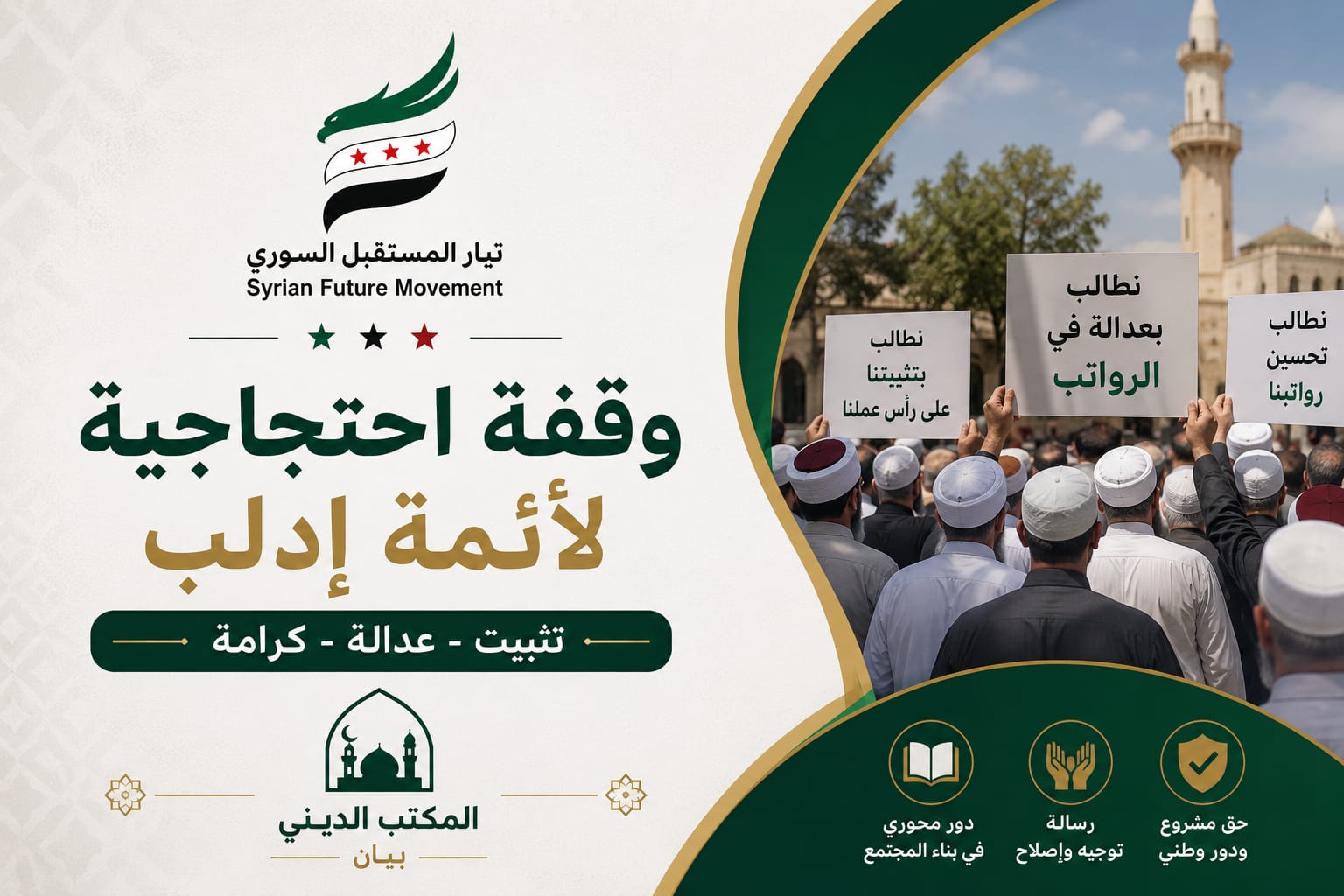
The Syrian Future Movement is following with great interest the peaceful protest held by imams, preachers, and muezzins in Idlib, during which they demanded permanent employment and improved salaries, comparable to those of other state employees.
The Syrian Future Movement highly values this commendable national initiative, considering it a legitimate right and a peaceful expression of a just demand.
We also see this protest as a cry of awareness and a profound message reminding everyone of the pivotal role imams and preachers play in preserving the social fabric and building character.
First, Theoretical Foundations – Imams and Preachers as a Pillar of Social Capital:
The demands of imams cannot be viewed in isolation from the vital role they play. A mosque is not merely a place of worship, but a comprehensive community institution, and the imam is the cornerstone of this institution. He is a key partner in building what is known in social science literature as “social capital”—that reservoir of trust, cooperation, and shared customs that binds society together.
In a Syrian context where social capital has been eroded by decades of tyranny and war, the role of imams becomes more vital than ever. They are seen as the bridge that rebuilds trust among people, the refuge that embraces individuals in their times of hardship, and the platform that disseminates the values of tolerance and coexistence.
This noble role demands the respect it deserves and cannot continue under such precarious living conditions.
Secondly, the reality of imams: between numbers and suffering.
The available figures (most of which are unfortunately unofficial) paint a clear picture of the magnitude of the challenge facing those working in the religious field:
- The scale of the responsibility: The number of mosques in Syria is estimated at 13,759, distributed across all governorates. This enormous number of places of worship requires thousands of imams, preachers, and muezzins to manage their affairs and care for their worshippers.
- The scale of the destruction: The war waged by the former regime spared no place of worship. 1,618 mosques were directly damaged, and at least 48 imams and preachers were killed by 2013, demonstrating the extent of the human and material losses in this sector.
- The hardship of living: Official statements indicate that the salaries of imams and preachers remain insufficient, with the minimum wage hovering around $100 USD per month—an amount that is inadequate to meet the cost of living and the vital role they play.
Despite some government decisions to increase salaries by 200%, the gap remains significant, as the increase primarily affected those already receiving benefits. This may explain the continued demands for stabilizing and improving their situation.
Third, the fundamental position:
Based on these facts, and in accordance with the methodology of the Syrian Future Movement, which is based on “supporting national solutions without unconditional endorsement, and criticizing what threatens the state-building process without hostility,” it affirms the following:
- Commendation for the message and understanding of the demands: We highly value the awareness of the imams and preachers of Idlib in expressing their demands through peaceful and legitimate means, and we affirm our full solidarity with them in their just demand to improve their living and working conditions.
- Demanding a comprehensive review of the salaries of those working in the religious field: We call on the Ministry of Religious Endowments to expedite the implementation of official promises to increase salaries and to develop a clear plan to unify and stabilize the salaries of all mosque employees, including those not officially affiliated, in line with other state institutions.
- The stability of imams as a cornerstone in state-building: We emphasize that the stability of imams and preachers in their positions is not a luxury, but rather an investment in societal stability. An imam who is secure in his livelihood is an imam capable of giving, guiding, and building society.
The Syrian Future Movement reiterates its call to pay attention to this important segment of society, which has shouldered the responsibility of guidance and reform.
Social justice cannot be complete without recognizing and honoring those who stand on the front lines defending thought and awareness.
We believe that investing in imams is an investment in Syria’s moral and spiritual future, and an integral part of building the state we all aspire to.