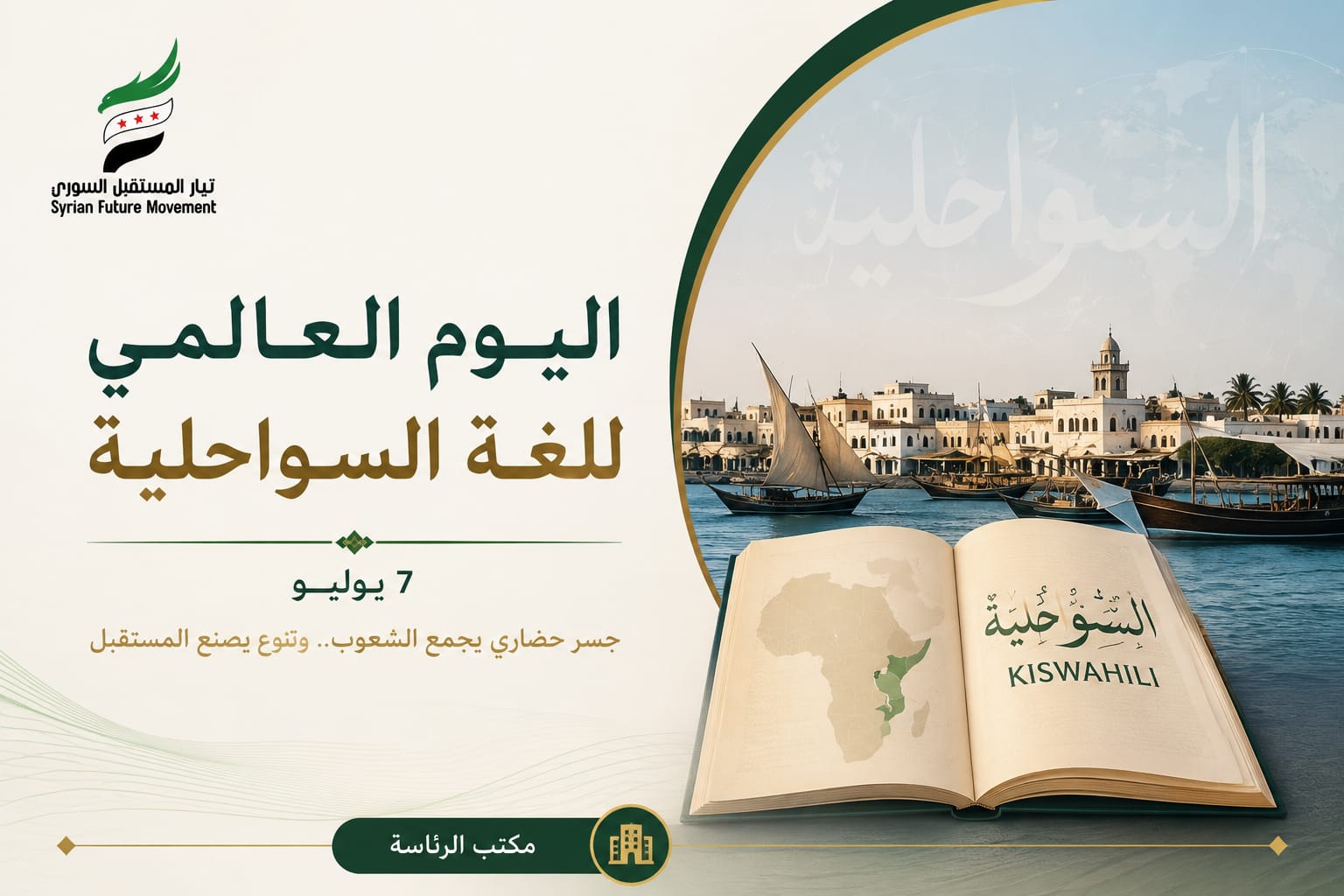
The General Conference of the United Nations Educational, Scientific and Cultural Organization (UNESCO), at its 41st session in 2021, adopted Resolution 41 C/61, designating July 7th as World Swahili Language Day, making it the first African language to receive this international recognition. This commemorates July 7, 1954, when the Tanganyika African National Union (TANU) adopted Swahili as an official language to unify the struggle for liberation and national sovereignty.
The Syrian Future Movement highlights the historical and structural value of this language, which is spoken today by more than 200 million people across East Africa and the Great Lakes region. Documented linguistic data indicates that approximately 40% of Swahili vocabulary is derived from Arabic, making it a living embodiment of centuries of shared cultural and commercial exchange between the Arab and African worlds.
The Syrian Future Movement, based on the UNESCO Global Education Monitoring Report (GEM Report) and the Human Development Indicators issued by the United Nations Development Programme (UNDP), believes that transnational languages represent a key driver of regional economic integration. The Syrian Future Movement sees this as an impetus for formulating future Syrian foreign policies capable of leveraging cultural diversity as a gateway to building strategic partnerships with emerging economic powers in Africa.
The Syrian Future Movement emphasizes the necessity of interpreting this international experience through a national and civilizational lens. Just as the Swahili language historically succeeded in uniting diverse ethnicities to create a shared identity, Syria, in its current transitional phase, absolutely needs to adopt cultural policies that elevate “shared citizenship” as a fundamental legislative and social tool for ensuring civil peace and rebuilding state institutions.
Based on the requirements of strategic planning for the transitional phase, the Syrian Future Movement recommends that Syrian academic institutions and think tanks establish specialized programs in cultural diplomacy and comparative development studies. These programs should focus on training young national talent and equipping them with the necessary linguistic and political knowledge to effectively and effectively manage Syria’s vital interests in international organizations and forums.
In conclusion, the Syrian Future Movement affirms its unwavering commitment to working towards a future Syria: a modern, civilized, and progressive state, founded on openness to the international agenda, believing in human diversity as a driving force for development, and striving to regain its position as an active diplomatic and cultural bridge contributing to global stability and peace.