

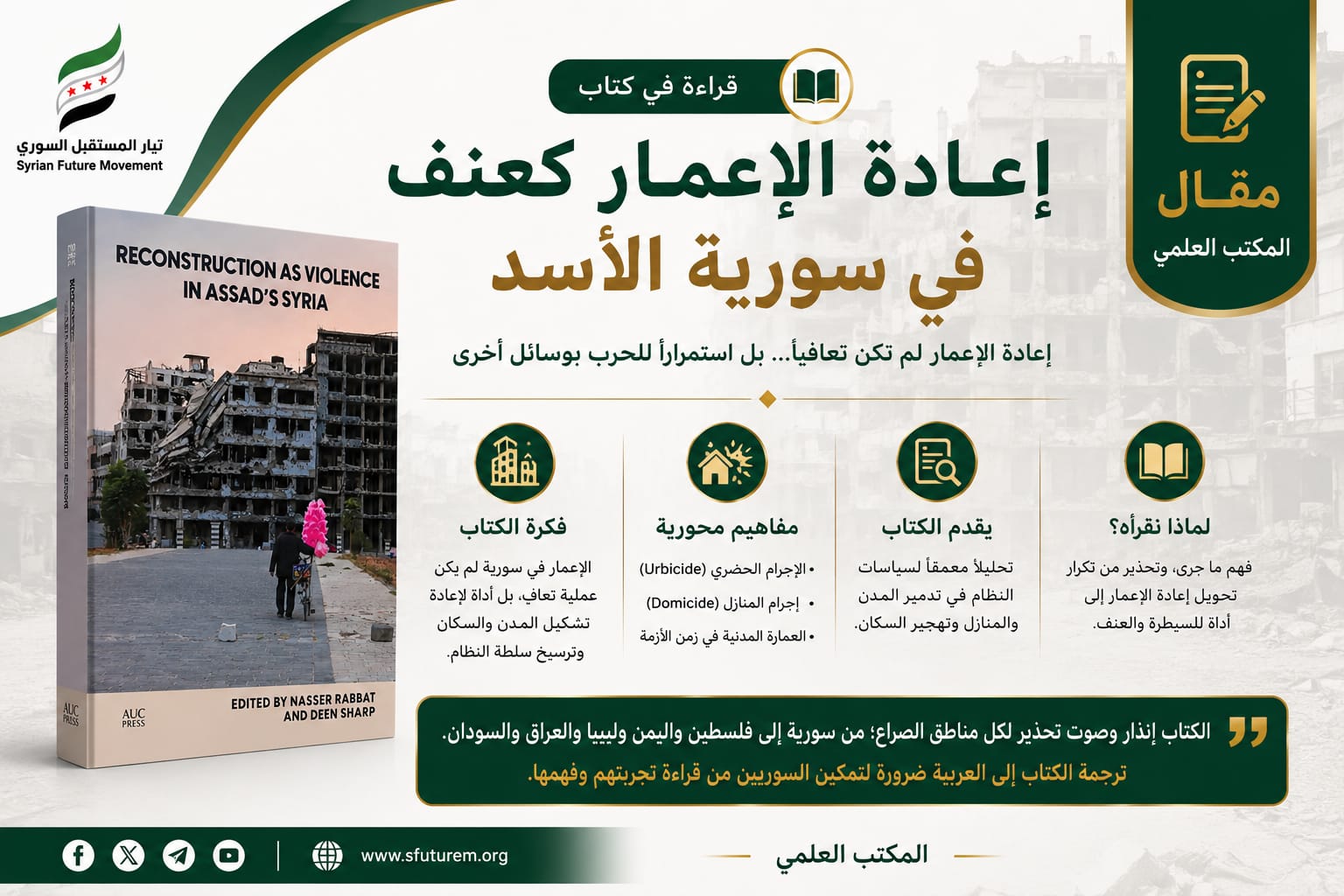
Published by the American University in Cairo Press on August 19, 2025, is a book with the provocative title: Reconstruction as Violence in Assad’s Syria.
The book emerged at a unique historical moment, just eight months after the fall of the Assad regime in December 2024, but it was written and completed beforehand, serving as a testament to a recently concluded era and a warning about a legacy that continues to this day.
The 262-page book is edited by Nasser Rabbat (Professor of Architectural History at MIT) and Dean Sharp (Researcher at the London School of Economics), with a foreword by Hashim Sarkis, former Dean of the School of Architecture at MIT.
It is part of the “Urban Middle East Studies” series published by AUC Press.
The central idea – When reconstruction becomes a weapon:
The book begins with a bold and surprising premise: reconstruction in Syria was not a peaceful recovery process, but rather a continuation of the war by other means. The authors challenge the traditional dichotomy separating the “phase of violence” from the “phase of reconstruction.”
In the Syrian context, reconstruction was not merely about repairing infrastructure, but a tool for reshaping the urban and demographic landscape, marginalizing “non-loyal” communities, and consolidating the regime’s control.
The book borrows the concept of “urban crime,” meaning the deliberate destruction of a city through the demolition of its infrastructure, architecture, streets, markets, and parks, with the aim of erasing local communities and dismantling the social fabric.
Structure and Content:
The book includes contributions from architects, urban planners, geographers, and historians, including:
- Sawsan Abu Zeineddine (Syrian architect)
- Ammar Azzouz (Oxford University researcher and author of Domicide)
- Wendy Pollan (Cambridge University)
- Higner Wattenbo (University of California)
Key Concepts Employed in the Book:
- Urbicide: The destruction of a city with the aim of erasing its identity and its inhabitants.
- Domicide: The destruction of homes as a tool for the forced displacement of residents.
- Civilian Crisis Architecture: Civil architecture in times of crisis as both a response and a weapon.
Key Findings and Conclusions:
- Assad’s 2017 Speech, “A More Homogeneous Syria”:
In 2017, Bashar al-Assad delivered a speech considered a turning point, declaring that Syria had become “more homogeneous,” and therefore “healthier”—a clear reference to the demographic and sectarian cleansing that had ravaged Syrian cities. - From “Homs Dream” to Nightmare:
The book reveals that the policy of selective reconstruction did not begin with the war.
In 2007, four years before the uprising, the regime had already drawn up plans to redevelop the city of Homs under the name “Homs Dream Project,” which included luxury towers and shopping malls, but masked a deeper intention: the demographic engineering of the city. - The Destruction of Sunni Neighborhoods in Homs:
The chapter by Sawsan Abu Zein El-Din examines the repercussions of these policies on the city of Homs.
In 2012, residents of Sunni neighborhoods like Baba Amr, which played a pivotal role in the uprising, were displaced. Sawsan writes, “The unification of Syria was a war waged by various means. At its core was the manipulation of the built environment in the targeted areas. Imposing homogeneity is a form of genocide.” - No city was spared:
The book presents a painful truth: “The war left no city, village, or historical site untouched, and many have either been lost forever or will take a generation or two to restore.” - A warning to the world:
The book is not limited to Syria; rather, it presents itself as “a warning, a voice of alarm, and perhaps a roadmap for overcoming the obstacles associated with inequality, injustice, and the nature of the conflict,” as Nasser Rabbat puts it.
It applies to Palestine, Yemen, Libya, Iraq, Lebanon, and Sudan, which are undergoing similar cycles of destruction and reconstruction.
Critical Reading:
A. Strengths:
- Bold Thesis: Presenting reconstruction as a continuation of violence is an original theoretical contribution, going beyond superficial analyses that reduce reconstruction to “infrastructure repair.”
- Specialization and Depth: Combining architects, urban planners, and historians gives the book multiple lenses for understanding the Syrian landscape.
- Exceptional Timing: Published months after the fall of the regime, the book is an important historical document for understanding the politics of the final phase of Assad’s rule.
- Conceptual Framework: Employing concepts like urbicide and domicide provides the analysis with a critical tool applicable to other conflicts.
B. Criticisms and Questions:
- Lack of Macroeconomic Analysis: The book focuses heavily on the urban and architectural dimensions, but it may neglect the major economic dimensions of reconstruction, such as: Who is funding it? What is the role of Russian and Iranian companies? How have sanctions affected it?
- Over-Conceptual Restriction: The reader may feel that the book forces the Syrian reality to fit the concepts of urbicide and domicide, rather than allowing reality to guide the analysis.
- The absence of a post-Assad perspective: The book mentions that the fall of the regime raises new questions about reconstruction under a transitional government, but it doesn’t offer answers. This isn’t so much a flaw as it is a call for a follow-up book.
- Specialized audience: Due to its academic nature, the book may not be accessible to the general reader. Concepts like urbicide and domicide require thorough explanation for those without a background in urban studies.
Conclusion:
Reconstruction as Violence in Assad’s Syria is more than just a book about Syria; it’s a warning against reconstruction as a tool of control and a call to rethink how cities are built after wars.
In the post-Assad era, this book remains an important resource for understanding what happened and a reminder that reconstruction doesn’t necessarily mean the end of suffering.
However, a major obstacle remains: the language.
The fact that the book is only available in English deprives the vast majority of Syrians—including urban planners, engineers, and activists—of direct access to its insightful analyses. Therefore, we conclude by recommending that this book be translated into Arabic as soon as possible, either by the publisher itself, or through an initiative by research centers. Or donors.
As Nasser Rabat says, “The book tries to present itself as a warning, a voice of alarm”—and this warning needs to be heard by Syrians in their own language.