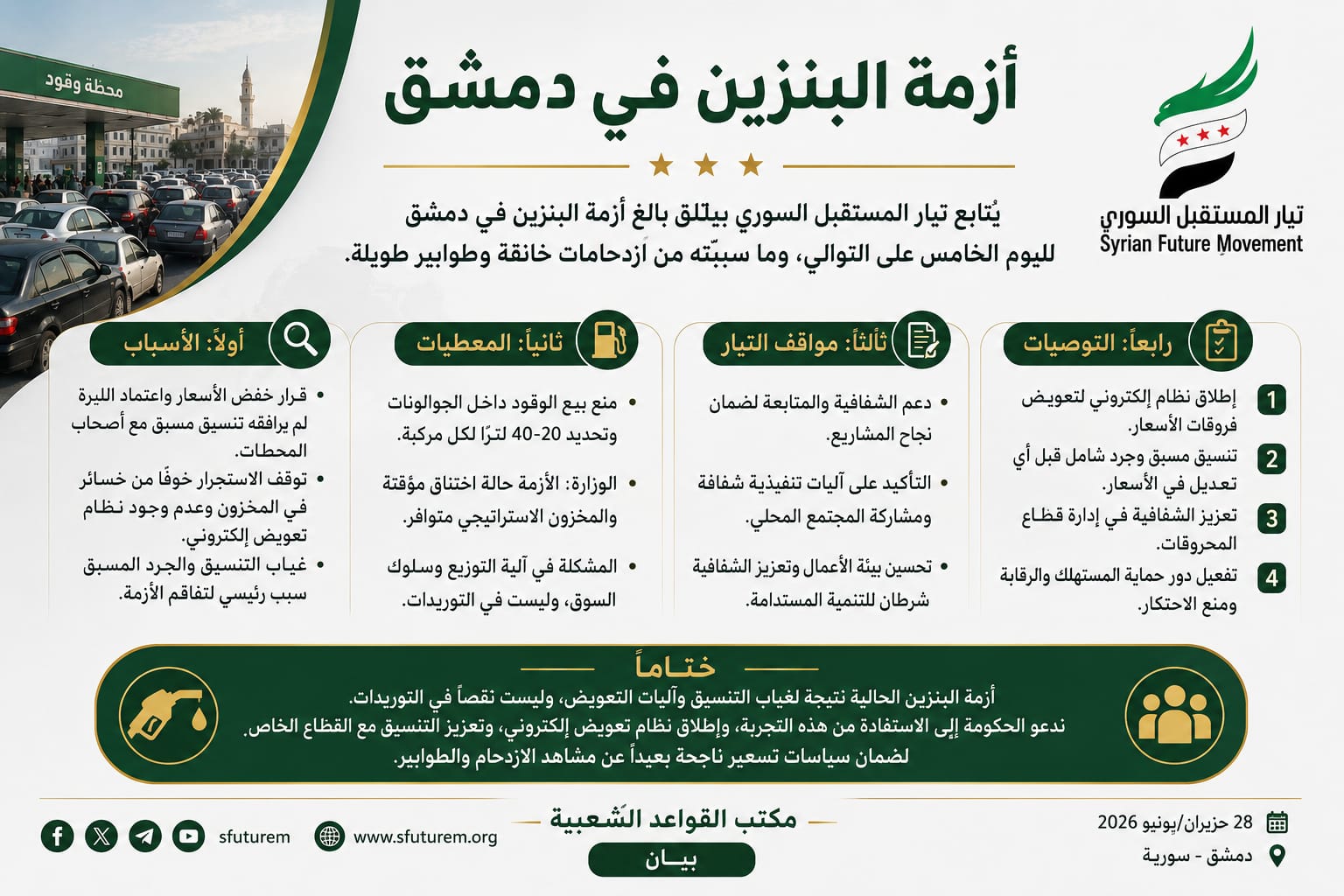
The Syrian Future Movement is following with great concern the fuel crisis that has gripped Damascus for the fifth consecutive day, with most private gas stations closed and severe congestion returning to the few remaining government-run stations. Queues stretch for more than two kilometers, forcing drivers to wait for hours to obtain fuel.
While the Syrian Future Movement appreciates the government’s efforts to alleviate the cost of living for citizens by reducing fuel prices, it expresses deep concern about the repercussions of the new pricing policy. According to expert analysis, this policy has led to a striking paradox: the price reduction has resulted in fuel disappearing from the market.
Firstly, the Syrian Future Movement analyzes the root causes of the crisis and attributes the worsening shortages to the lack of prior coordination and compensation mechanisms.
The Syrian Future Movement points out that the crisis began after the formation of a permanent committee to determine petroleum product prices on June 23, 2016, which mandated the use of the Syrian pound in all sales transactions.
However, the decision was not accompanied by prior coordination with private gas station owners, who stopped purchasing new quantities of gasoline for fear of incurring losses on stock purchased at the old prices, in the absence of an electronic system to compensate them for price differences.
A source in the Ministry of Energy confirmed that Syria currently does not have an electronic system to compensate station owners for price differences when they are adjusted, making the crisis likely to recur with any future price changes.
Here, the Syrian Future Movement recalls that Abdul Razzaq Habza, Secretary of the Consumer Protection Association in Damascus and its countryside, warned that refusing to sell fuel is a serious violation that could result in the closure of the station and the revocation of its license. He pointed out that the crisis could have been avoided through prior coordination between the relevant authorities and station owners, and by conducting an inventory of stored quantities before implementing the new prices.
Secondly, the Syrian Future Movement commends the Ministry of Energy’s measures, which included prohibiting the sale of fuel in jerrycans, regulating filling operations by setting quantities between 20 and 40 liters per vehicle, and intensifying procurement and distribution efforts.
We also note that the Ministry confirmed the crisis was a “temporary bottleneck in supply operations,” not a shortage of petroleum products, indicating that strategic reserves were available.
However, we warn that the continued absence of an electronic compensation system and weak prior coordination are key factors in the recurrence of this crisis with any new price adjustments, as the Secretary of the Consumer Protection Association cautioned.
We also recall that the crisis was primarily focused on gasoline, being the most consumed fuel, while no similar crisis was recorded for diesel. This confirms that the problem is not a shortage of supplies, but rather bottlenecks in distribution and a change in market behavior.
Third: The Syrian Future Movement reiterates its consistent positions supporting the improvement of the business environment and the enhancement of transparency in market management, published on its official website, including:
- The “Repairing Bridges and Developing Vital Roads” statement (dated June 3, 2026), which emphasized the importance of transparency and regular monitoring to ensure the success of projects.
- The statement announcing the “Comprehensive Plan for the Rehabilitation of Central Roads” (dated June 29, 2026) emphasized the need for transparent implementation mechanisms and local community participation in monitoring.
- The study “Reconstruction Priorities in Syria” (dated December 19, 2024) indicated that improving the business environment and enhancing transparency in market management are essential conditions for achieving sustainable development.
Fourth: The Syrian Future Movement presents a set of practical recommendations to overcome the current crisis and prevent its recurrence.
Based on its national responsibility, the Syrian Future Movement recommends the following:
- Expediting the launch of an electronic system to compensate gas station owners for price differences, similar to systems adopted in many countries, to ensure that private stations do not cease operations with any new price adjustments.
- Adopting a mechanism for prior coordination with gas station owners and the Consumer Protection Association before any new price adjustments, along with conducting a comprehensive inventory of stored quantities, to ensure a smooth and rapid transfer without bottlenecks.
- Enhancing transparency in the management of the fuel sector through regular announcements of strategic reserve quantities, distribution plans, and pricing mechanisms will bolster public and investor confidence.
- Activating the role of the Consumer Protection Association and regulatory bodies to monitor stations’ compliance with sales regulations, prevent any monopolistic practices, and ensure fuel reaches those entitled to it at fair prices.
In conclusion, the Syrian Future Movement reiterates that the current gasoline crisis is a result of the lack of prior coordination and compensation mechanisms, not a shortage in supplies. The Movement appreciates the government’s efforts to alleviate the cost of living for citizens, but emphasizes that pricing policies require transparent and comprehensive implementation mechanisms to guarantee their success.
We believe the Syrian government is now called upon to learn from this experience and expedite the launch of an electronic system for compensating price differences, while strengthening coordination with the private sector. This crisis should serve as a lesson in developing market management policies, rather than a repetition of scenes of overcrowding and long queues.
For its part, the Syrian Future Movement will remain supportive, critical, and observant of this issue, striving to build the new Syria on the foundations of transparency, social justice, and sustainable development.