

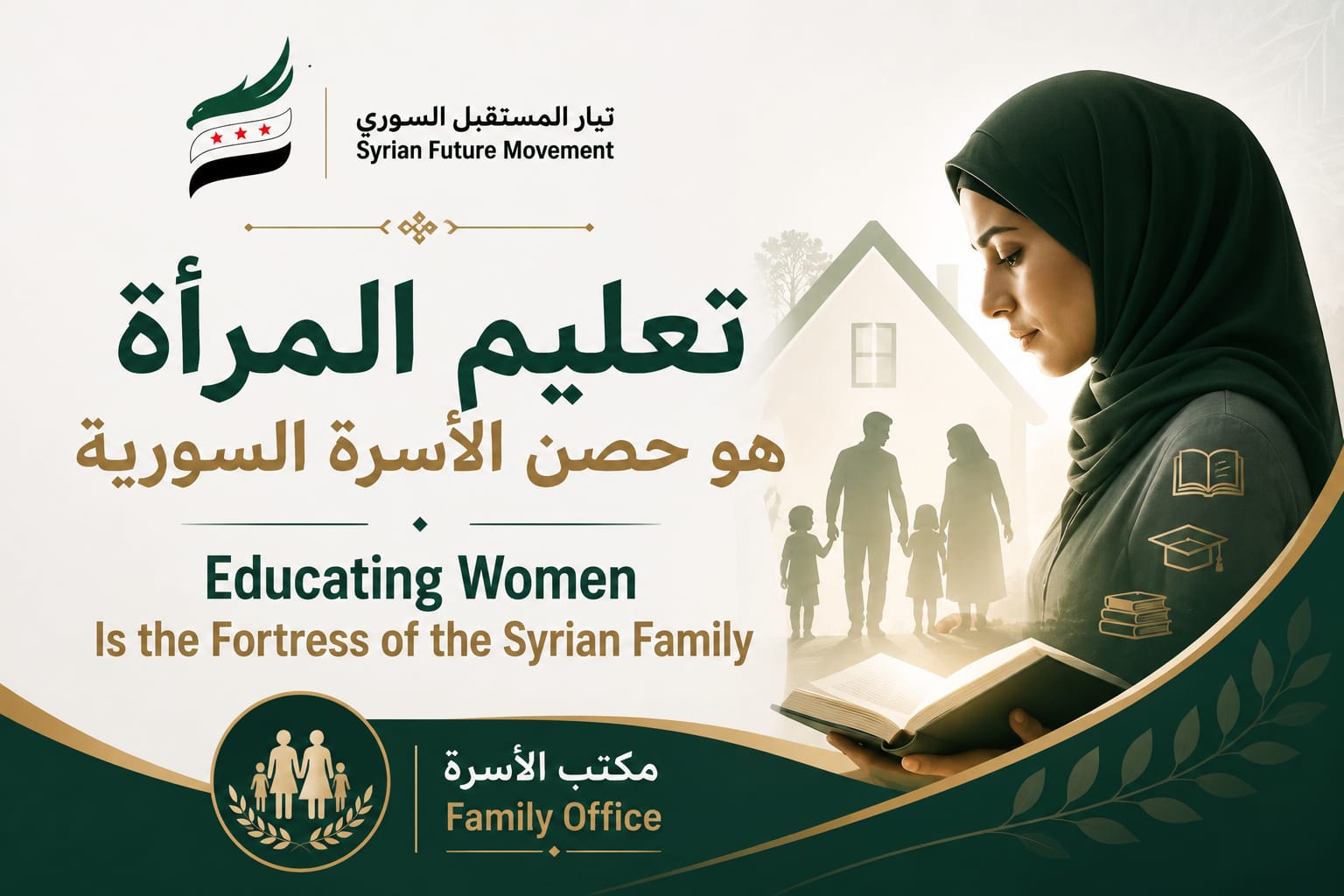
The family is the cornerstone of society, and its stability depends on its ability to raise its members properly, based on knowledge, awareness, and responsibility.
From this perspective, discussing women’s right to education is not merely an individual right or a legal demand, but rather a national issue that touches Syria’s present and future. Educating girls is a direct investment in building the family, developing society, and strengthening stability.
Islam has honored women, making the pursuit of knowledge both a right and a duty, without discrimination between men and women. Religious texts urge the pursuit of knowledge and learning, considering them the foundation for the flourishing of the earth and the establishment of a righteous life. Therefore, the call for women’s education is not simply a response to contemporary trends, but an extension of deeply rooted civilizational values that believe knowledge is the path to progress and that women are essential partners in building the family and society.
Human experience, as well as international studies, has proven that education is the first line of defense against many negative social phenomena, most notably early marriage. Early marriage deprives girls of their childhood, restricts their opportunities for learning and work, and places upon them responsibilities that exceed their psychological and physical capabilities, negatively impacting the family, society, and the state.
In the Syrian context, the challenges have intensified during the years of war, accompanied by displacement, poverty, disruption of education, and social disintegration. This has led, in some areas, to increased school dropout rates and a subsequent rise in early marriages, whether driven by fear, economic need, loss of a breadwinner, lack of awareness, or the absence of suitable alternatives. Therefore, reintegrating girls into education should be a fundamental part of the project to rebuild the Syrian people, alongside the reconstruction of infrastructure.
Early marriage should not be viewed merely as a family decision, but rather as a developmental and social issue closely linked to children’s rights, education levels, public health, economic development, and quality of life. It also affects the future of the human capital upon which nations depend for their progress.
Education is the most important means of preventing this phenomenon, as it equips girls with the knowledge to understand their rights and responsibilities, boosts their self-confidence, opens wider horizons for their participation in public life, and empowers them to make crucial decisions about their future.
Furthermore, girls’ continued education directly contributes to delaying the age of marriage, increases their chances of obtaining decent work, and grants them economic independence, enabling them to build more stable families based on partnership, awareness, and responsibility. It also empowers them to choose their life partner based on intellectual, moral, and human compatibility, free from the pressures of poverty or social norms that might lead to hasty decisions.
Reports issued by the United Nations Children’s Fund (UNICEF), the United Nations Population Fund (UNFPA), and the World Bank indicate a clear correlation between higher levels of girls’ education and lower rates of early marriage. Girls who complete secondary education are less likely to marry than those who drop out at an early stage.
The impact of a woman’s education extends beyond her own life; it also benefits her entire family. An educated mother is better equipped to care for her children’s health and upbringing, more committed to healthcare and immunization programs, more aware of sound parenting methods and healthy nutrition, and more eager to ensure her sons and daughters continue their education. This translates into improved public health indicators, lower poverty rates, and a higher quality of life within the family.
Furthermore, educated women contribute to increased family income, broader economic participation, and higher national productivity. This makes investing in girls’ education a truly economic investment, not merely spending on the education sector.
Numerous economic studies have confirmed that women’s education is among the most profitable social investments for sustainable development.
Conversely, depriving girls of education has serious consequences, beginning with lost opportunities for personal development and extending to increased likelihood of poverty, unemployment, and economic dependency. It also includes health risks associated with early pregnancy, a higher risk of domestic violence due to the imbalance in the marital relationship when the wife is still a child with an immature personality, and an increased risk of economic or social exploitation, or even human trafficking in fragile environments.
It is important to emphasize that addressing the phenomenon of early marriage should not be limited to enacting laws or increasing penalties, despite the importance of the legal framework. Rather, it requires addressing the root causes of the problem, primarily poverty, school dropout rates, weak social protection, and declining community awareness. Sustainable solutions begin in schools before they begin in courtrooms.
Furthermore, building a new Syria necessitates restoring education as a national priority, providing a safe learning environment for girls in all governorates, and supporting the most vulnerable families so they are not forced to sacrifice their daughters’ futures under the pressure of economic or social circumstances.
In the digital age, education is no longer confined within the walls of the school. E-learning and digital platforms have become among the most important tools that can ensure the continuity of girls’ education, especially in remote or conflict-affected areas. This requires investment in digital infrastructure and the development of e-learning content to guarantee access to education for all.
The responsibility for a girl’s education does not fall solely on official institutions; it is also the responsibility of the family. The father plays a pivotal role in encouraging his daughter to continue her education, instilling self-confidence in her, and protecting her from social pressures that might lead her to drop out of school or marry early. An educated mother also serves as a role model. In order to instill the value of education in her sons and daughters.
The Family Office of the Syrian Future Movement believes that women’s empowerment begins with their educational empowerment, and that protecting girls is not achieved by depriving them of life’s opportunities, but rather by enabling them to acquire knowledge, develop their personalities, and actively participate in building their families and their nation, within a framework of authentic values that respect human dignity, preserve the status of the family, and balance rights and responsibilities.
The Office also believes that an educated woman is not only a good mother or a successful employee, but also a partner in building civil peace, establishing a culture of dialogue, strengthening social cohesion, and participating in the reconstruction of Syria, because rebuilding nations after conflicts requires educated minds as much as it requires infrastructure.
A society that opens the doors of schools to its daughters is opening the doors of the future to its nation, because educating women not only creates educated women, but also creates conscious mothers, stable families, a more cohesive society, a more productive economy, and a more capable state.
Recommendations of the Family Office of the Syrian Future Movement:
- Enhance girls’ access to primary and secondary education and reduce school dropout rates.
- Launch national programs to support impoverished families, thereby alleviating the economic pressures that drive early marriage.
- Rehabilitate schools in affected areas and ensure safe access to education for all children without discrimination.
- Support e-learning and distance education as a complement to traditional education.
- Raise community awareness about the dangers of early marriage through educational, media, and religious institutions.
- Strengthen the role of the family, particularly parents, in encouraging girls’ education and continued schooling.
- Provide a safe and stimulating learning environment for girls in all Syrian regions.
- Support vocational and university training programs for women to enhance their participation in economic development.
- Review relevant legislation and policies to ensure the protection of children and families and to prioritize the best interests of the child.
- Encourage partnerships between governmental institutions, civil society, and religious and educational institutions to promote a culture of education and family protection.
- Establish a national database to monitor school dropout and early marriage, which will help in developing evidence-based policies.
Protecting a girl’s right to education is not just a women’s issue; it is a national issue that affects the future of the family, the stability of society, and the state’s ability to progress.
Every girl who remains in school is a step towards a more educated, just, and stable Syria. Every school place reserved for a girl today may create a conscious mother tomorrow, an educator of future generations, a leader in her community, and a true partner in building the nation. Therefore, investing in women’s education is not just an investment in an individual, but an investment in the future of all of Syria.