Abstract:
This article examines the unprecedented rise in sacrificial animal (sheep) prices in Syrian markets ahead of Eid al-Adha 2026, at a time when the current rainy season is showing a marked improvement compared to previous years.
The article aims to uncover the direct and indirect causes of this price paradox, relying on recent data and reports issued by international and local organizations.
The findings indicate that the price increase is not due to drought, but rather to a complex combination of factors: a structural decline in livestock numbers (estimated at 40-50%), rising feed and transportation costs, the spread of animal diseases, export policies that have reduced the local supply, and commercial hoarding practices that have capitalized on the abundance of natural grazing land.
The article also addresses the impact of restrictions on livestock movement between different areas of control as an additional logistical factor. It concludes with a practical recommendation to adopt the sacrifice of cattle (through a seven-share system) as a legitimate and economically viable alternative, offering a set of realistic recommendations directed to all relevant parties without engaging in a political assessment of any authority.
First, the methodological framework:
This article employs a secondary data analysis approach, tracking price, health, and productivity indicators from multiple sources between January and May 2026. Sources were selected based on two criteria:
- Rectivalence (preference was given to 2026 data) and
- Relative reliability (UN reports and media outlets focused on the Syrian economy).
Causal analysis was also used to investigate the relationship between climatic, economic, and logistical variables, acknowledging that some hypotheses (such as the behavior of commercial stockpiling) are based on repeated field observations rather than comprehensive official statistics.
Secondly, the reality of the 2026 rainy season:
The current rainy season (2025-2026) is witnessing a relative improvement in most governorates, in contrast to the successive drought seasons that plagued Syria between 2021 and 2025. According to data from the Syrian Ministry of Agriculture (not officially published), the wheat planting plan has been completed at approximately 86% of the targeted area, with production expected to reach 2.3 million tons.
In the coastal regions, Qadmous recorded cumulative rainfall of 115 mm, and Jbab Sheikh Badr 109 mm up to April 2026. This climatic improvement makes the paradox of rising sacrificial animal prices more apparent and raises questions about the underlying factors.
Third, Price Indicators in Syrian Markets:
The latest price readings (up to mid-May 2026) show the following variations:
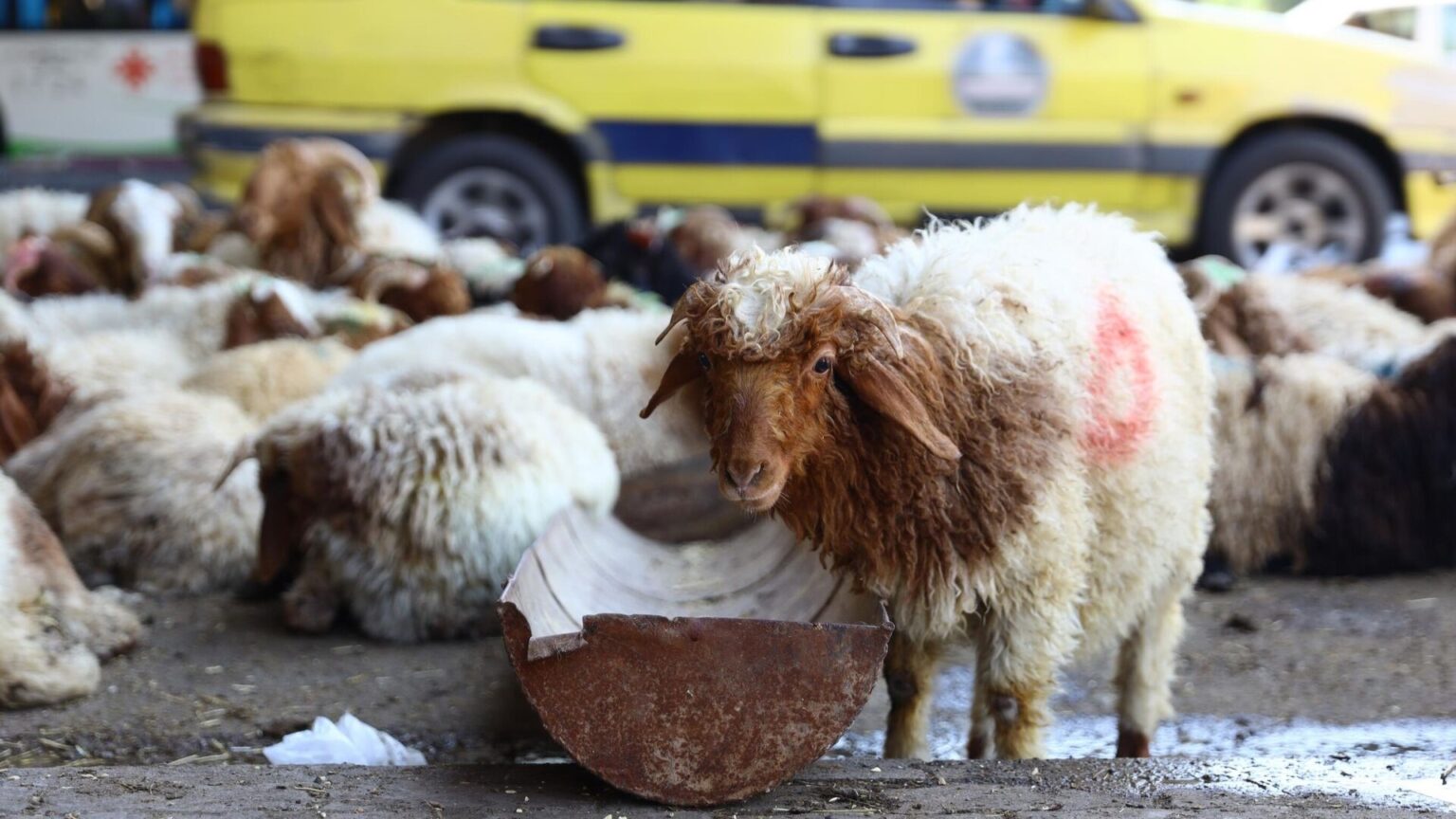
- The price of a kilogram of live (standing) lamb in most local markets ranges between 85,000 and 95,000 Syrian pounds. A whole lamb suitable for sacrifice (weighing 50-70 kg) costs between 4.5 and 6 million Syrian pounds, with significant differences between governorates. Damascus and its surrounding countryside record the highest prices, while prices are relatively lower in the eastern regions and production areas.
- In Daraa Governorate and the southern regions, meat prices have witnessed a significant increase. The price of a kilogram of live lamb has exceeded 80,000 Syrian pounds, while a kilogram of slaughtered (boneless) lamb has surpassed 250,000 Syrian pounds. Similarly, the price of a kilogram of live calf ranges between 65,000 and 75,000 Syrian pounds, while a kilogram of slaughtered calf reaches approximately 200,000 Syrian pounds in city centers.
- According to the May 2026 economic reports, red meat prices continued their sharp upward trend, leading to a decline in demand for sacrificial animals by up to 50% in some areas due to the weakening purchasing power of the Syrian pound.
- According to the April 2026 World Food Programme (WFP) reports, red meat prices continued their steady upward trend, a clear indication of the erosion of the Syrian pound’s purchasing power.
Fourth, the direct causes of the increase:
Here is the text, revised to reflect the economic reality and market prices in Syria according to May 2026 data:
Direct causes of the increase:
Sharp increase in production costs (feed and transportation):
- Feed prices reached unprecedented record levels; the price of a ton of bran in local markets exceeded 6.5 million Syrian pounds (equivalent to approximately US$440 at the parallel market exchange rate), and the price of a ton of feed barley approached 8.5 million Syrian pounds (approximately US$580), while the price of a ton of hay reached The price of a white sheep is approximately 3 million Syrian pounds.
- The chronic fuel crisis has also drastically inflated transportation costs, with the price of a liter of diesel on the black market ranging between 17,000 and 20,000 Syrian pounds. This has added a heavy logistical burden on livestock breeders and traders, directly impacting the final price of sacrificial animals in major cities.
- A structural decline in livestock numbers:
Estimates from the Food and Agriculture Organization (FAO) and reports from the Ministry of Agriculture indicate that Syria has lost approximately 50-60% of its total livestock (sheep and cattle) compared to pre-2011 levels. This continuous depletion, resulting from smuggling, indiscriminate slaughter of females, and rising costs, has created a severe shortage in supply. This means that any seasonal increase in demand, such as during the 2026 Eid al-Adha season, leads to exorbitant price hikes that exceed consumers’ purchasing power. - Outbreaks of animal diseases and a lack of vaccinations:
The health status of the herd remains a major obstacle, as evidenced by the recorded Veterinary associations in northern and western Syria (Idlib and rural Aleppo) have reported a resurgence of foot-and-mouth disease and sheep pox. Mortality rates among newborns in some pastoral communities have reached 12-15%.
The gap in animal health security is stark; the urgent need for vaccines in the northern and eastern regions is estimated at hundreds of thousands of doses, while the quantities available through organizations and local entities cover no more than 15% of the actual need. This severe shortage has led to widespread emaciation among available livestock, reducing the number of animals that meet the requirements for sacrifice according to Islamic law. This increased the price of healthy sheep.
Fifth, Indirect and Structural Causes:
Export Policies and Their Impact on Domestic Prices:
The continued implementation of decisions allowing the export of Awassi male sheep (the latest of which were issued in late 2025 and early 2026) triggered sharp inflationary waves. As soon as new export quotas were announced, the markets experienced “anticipatory inflation,” causing the price of a kilogram of slaughtered meat in Damascus to jump from 220,000 Syrian pounds to over 280,000 Syrian pounds within a few weeks. This reflects the extreme sensitivity of the local market to the export of this commodity.
Updated economic data indicates that export pressure towards Gulf markets (especially Saudi Arabia and Kuwait) and Lebanon is a structural factor in raising prices, as traders prefer to earn hard currency rather than sell in the weak domestic market. This ongoing depletion of the superior breed (the Syrian Awassi) has reduced the supply of sacrificial animals locally and contributed to raising the price of live sheep to record levels as Eid al-Adha 2026 approached.
Commercial hoarding behavior amid abundant rainfall (a testable hypothesis):
Contrary to the conventional expectation that abundant rainfall leads to lower prices, repeated testimonies from breeders and traders in the southern regions (Daraa and Quneitra) indicate that improved grazing conditions have encouraged some traders to purchase additional numbers of young sheep and fatten them at the expense of natural pastures, preparing them for later sale (or export) at higher prices. This mechanism has led to the immediate withdrawal of supply from the local market, a rational economic behavior from the trader’s perspective, but one that exacerbates the price increases before the Eid. This hypothesis still requires statistical field research to confirm it, but it offers a plausible explanation for the climatic paradox in 2026.
Institutional and charitable demand:
Field reports indicate that some charitable organizations and humanitarian agencies purchase large numbers of Sheep are sold for distribution as sacrificial offerings, and traders are paid the asking price without significant bargaining, which has driven up prices in local markets and impacted the purchasing power of ordinary citizens.
Restrictions on Internal Transport Between Different Control Zones:
It has not been adequately addressed previously that the transport of livestock between governorates under different administrative authorities (such as the Autonomous Administration areas in the northeast and the Syrian Interim Government areas) is subject to complex licensing, fees, and security restrictions. These restrictions prevent relatively inexpensive livestock from eastern Syria and the Jazeera region from reaching the markets of Damascus and Aleppo in large quantities, thus exacerbating price isolation and increasing logistical costs.
The Macroeconomic Crisis:
The Syrian economy is suffering from a complex inflationary crisis, characterized by a continuous collapse in the purchasing power of the Syrian pound, an unprecedented rise in the prices of basic commodities, and a shortage of foreign currency reserves that hinders the import of animal feed and vaccines. Even recent decisions to raise some salaries by 200% have not offset the rate of currency depreciation.
Sixth, cows as a legitimate and economically viable alternative:
The sacrifice of a cow (on behalf of seven people) is a practical solution given the exorbitant rise in sheep prices. Its viability in 2026 is evident in the following:
Cost-effectiveness: With the price of a suitable sheep for sacrifice ranging between 4.5 and 6 million Syrian pounds, seven people can share in the sacrifice of a cow (calf or cow) with a total price ranging between 25 and 35 million Syrian pounds. Thus, the cost per share reaches approximately 3.5 to 5 million Syrian pounds. Although the cost may be close to the price of a small sheep, the net amount of meat obtained by each shareholder is more than double what they would obtain from a single sheep.
Nutritional Value and Availability: The price of a kilogram of live calf currently ranges between 65,000 and 75,000 Syrian pounds, while the price of a kilogram of slaughtered calf exceeds 200,000 pounds. Given that a calf weighs between 400 and 600 kg, the meat yield is plentiful and more efficiently covers the needs of large families and those in need compared to sheep, which are suffering from emaciation this year due to feed shortages.
Jurisprudential Agreement: There is no disagreement regarding the permissibility of sacrificing a cow on behalf of seven people. This is a legitimate solution that facilitates the observance of this religious rite for Syrian families amidst the suffocating economic crisis.
Seventh, Recommendations:
Based on the above analysis, the Economic Office of the Syrian Future Movement recommends the following:
- Encouraging the sacrifice of cows through awareness campaigns: A media and digital campaign should be launched to explain the rulings on sacrificing cows, the mechanisms for group participation, and cost estimates, in coordination with places of worship and NGOs.
- A seasonal review of export policies suggests that foreign trade authorities impose a temporary ban on sheep exports prior to Eid al-Adha, or link exports to a guaranteed surplus beyond domestic market needs.
- Securing veterinary vaccines is essential to support vaccination programs against foot-and-mouth disease and other diseases, through cooperation with the Food and Agriculture Organization (FAO) and the World Organisation for Animal Health (OIE), prioritizing the most affected areas (Idlib and Raqqa).
- Supporting small-scale livestock farmers with subsidized feed: Successful pilot programs implemented in some governorates (distribution of subsidized feed through the FAO) can be expanded to include as many small-scale farmers as possible, as they form the backbone of livestock production.
- Reducing restrictions on livestock movement between governorates: To improve supply chains, it is advisable to standardize customs and veterinary procedures across different departments to facilitate the movement of livestock from areas of surplus to areas of shortage, while maintaining necessary health controls.
- Importing cattle with encouraging customs duties: Previous decisions that reduced import duties on cattle and calves from $53 to $7 per head can be utilized and practically implemented to compensate for the local shortage of livestock.
- Market monitoring and preventing monopolies: Activating the role of consumer protection and anti-monopoly mechanisms to monitor prices throughout the supply chain. For supply, especially in the final stages before Eid, with a rapid mechanism in place to address citizens’ complaints.
Conclusion:
This article concludes that the high prices of sacrificial animals in Syria in 2026 are not a result of drought, but rather a cumulative effect of a structural decline in livestock, feed and transportation costs, animal diseases, export policies, commercial hoarding practices that capitalized on abundant rainfall, and restrictions on internal livestock transport.
In this context, the shift towards sacrificing cattle (seven-year-olds) represents a practical and legitimate solution that alleviates the financial burden on citizens. Stable prices for sacrificial animals are a social and religious necessity that preserves the ritual of solidarity and closeness to God.
All parties – from government institutions and civil organizations to merchants and breeders – bear a shared responsibility in finding immediate and long-term solutions.
References:
- Food and Agriculture Organization. (2026, April). FAO and Syria strengthen collaboration to support agricultural recovery [Press release].https://www.fao.org/syria/news
- World Food Programme. (2026, April). Syrian Arab Republic – Food prices. Humanitarian Data Exchange. https://data.humdata.org/dataset/wfp-food-prices-syria
- Zaman Al Wasl. (2026, May 8). Livestock prices hike in southern Syria ahead of Eid Al Adha. https://english.zaman-alwasl.com
- Zaman Al Wasl. (2026, April 15). Syria regime claims ‘exporting sheep’ will protect breeders amid feed shortage. https://english.zaman-alwasl.com
- Observatory of Economic Complexity. (2025). Syria (SYR) exports of live animals (2024). https://oec.world
- Enab Baladi. (2025, January 23). Drought, rising feed prices weaken livestock trade in al-Hasakah. (This reference was used to document the background of drought in previous years, and not as a basis for the 2026 situation).