
At a hearing held by the Senate Armed Services Committee on May 14, 2026, Admiral Brad Cooper, commander of U.S. Central Command (CENTCOM), presented one of the most explicit American approaches to the shape of the Middle East after the recent war with Iran, and what Washington considers a “strategic reshaping” of the entire region.
The hearing, and the subsequent reports and analyses issued by American policymakers and media outlets, did not only address the results of the military confrontation with Iran, but also outlined a broader American vision based on the idea that the Middle East has indeed entered a historical transitional phase, in which old patterns of influence are declining, and alliances, balances of power, and the roles of key regional states are being redefined.
Among the most prominent points in the American presentation were:
- That Iran suffered its greatest strategic setback since 1979.
- That a significant portion of its infrastructure related to missiles, drones, supply networks, and proxies was severely damaged.
- That the United States seeks to reduce the need for long-term direct military intervention.
- The region is moving towards building new, more independent security systems and regional alliances.
- Washington is deeply concerned about any security vacuum that could allow for a return to chaos or a resurgence of Iranian influence.
- The post-war phase is no less important than the war itself.
But the most crucial point in this vision is not Iran alone, but rather the countries that will form the “pillars of stability” in the new Middle East. Here, Syria emerges as a key player that cannot be ignored in any future regional equation.
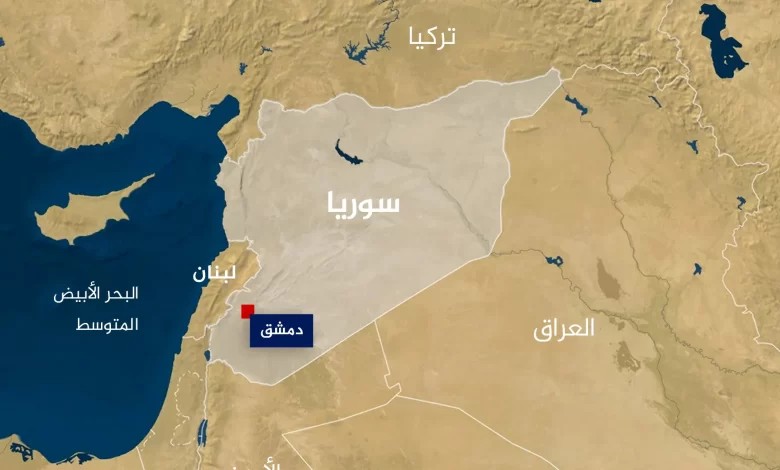
Syria is not a marginal state in the region’s geopolitics; rather, it is a pivotal point connecting the Gulf, Iraq, Turkey, the Eastern Mediterranean, Lebanon, and Jordan. This makes any project for regional stability or restructuring unviable without a stable Syria capable of playing an active and balanced role.
Perhaps what gives Syria this increasing importance is not only its geographical location, but also the very nature of the coming phase itself.
The Middle East is gradually moving from a phase of open conflict to one of managing balances, and from a logic of protracted wars to one of sustainable stability. This transformation requires states capable of:
- Controlling borders.
- Protecting vital waterways.
- Preventing the formation of chaotic environments.
- Absorbing complex regional and international balances.
- Creating an environment that prevents the resurgence of extremist organizations or transnational networks of influence.
All of these issues are directly linked to Syria.
Lebanon’s stability is tied to Syria. The security of the Eastern Mediterranean is tied to Syria. Controlling smuggling routes, arms trafficking, and illegal immigration is tied to Syria.
Even the future of relations between the Arab world and Turkey will largely depend on Syria.
Furthermore, one of the most significant transformations the world is witnessing today is the redrawing of global trade routes and supply chains, especially after successive international crises, disruptions to shipping lines, and escalating international competition for ports, energy, and maritime routes.
Here, Syria re-emerges as a strategically vital location.
Syria possesses a direct coastline on the Mediterranean Sea and is situated at a natural crossroads between the Arabian Gulf and Iraq on one side, and Turkey, Europe, and the Eastern Mediterranean on the other. This gives it significant potential to become a pivotal logistics and trade hub within any future regional transportation, energy, and supply chain project.
In a world moving towards reducing reliance on long and fragile routes, countries capable of securing stable land and sea corridors are of exceptional strategic value.
This explains the growing international interest in the concepts of:
- Economic corridors.
- Regional land connectivity.
- Energy and gas pipelines.
- Medium-sized ports.
- Alternative supply chains.
Given its location, Syria can become, in the future,:
- A trade corridor between the Gulf and the Mediterranean.
- A hub for energy and transportation lines.
- A regional logistics center.
- A link between Arab, Turkish, and European markets.
Indeed, part of the coming international conflict will not only be about armies and military bases, but also about “who controls the flow of trade, energy, and supply chains.”
Therefore, Syria’s stability is not only linked to security, but also to the new global economy, which is now seeking more stable, less costly, and safer paths.
This explains the increasing American signals of “practical cooperation” with the Syrian state in the post-war phase, not merely as a security issue, but as a key element in preventing the collapse of the new regional balance.
A deep strategic reading of what was said in the Senate session reveals that Washington, along with many international powers, no longer views Syria solely through the lens of internal war or humanitarian crisis, but has begun to see it as:
- A linchpin of regional balance.
- A cornerstone of sustainable stability.
- A pivotal state in preventing the return of chaos to the Levant.
- A potential partner in future transportation, energy, and trade networks.
However, this role cannot be achieved automatically; it requires a new Syrian national project that rebuilds the concept of the state, its institutions, and its regional function.
The future Syria should not simply be a country emerging from war, but a country possessing:
- Strong institutions.
- A resilient economy.
- Modern infrastructure.
- Developed ports, roads, and transportation networks.
- Balanced relations with its neighbors.
- A rational, sovereign vision.
- The capacity to transform from a conflict zone into a center of stability and regional economic integration.
The world today is not merely seeking to “stop wars,” but to establish stable systems that prevent their recurrence in the first place, while simultaneously ensuring the flow of trade, energy, and global supply chains.
It is precisely in this context that Syria becomes one of the most important countries poised to play the role of a “geopolitical linchpin” in the new Middle East, not merely as a… Not as a mere follower of an axis, but as a state capable of contributing to a more rational and sustainable regional balance, and one more connected to the new global economy.
The opportunity before Syrians today may be one of the most significant historical opportunities in decades: the chance to rebuild Syria not only as a state that survived war, but as a state capable of participating in shaping the future of the entire region.
This requires a true state-minded approach, one that understands that the next phase will not be built on slogans, but on stability, institutions, development, smart partnerships, and the ability to transform Syria’s geographical location from a burden of conflict into a source of strength and lasting stability.
Based on this, the Syrian Future Movement recommends a set of national and strategic paths that it deems essential for transforming Syria into an active element of stability in the new Middle East:
Working to rebuild the Syrian state on modern institutional foundations that strengthen the rule of law, administrative efficiency, and political stability, moving away from the logic of chaos, power-sharing, and division.
Developing national infrastructure, particularly in the areas of:
- Ports.
- Land and rail transport.
- Logistics zones.
- Energy.
- Regional trade integration, positioning Syria as a regional economic and logistical hub within future trade networks and supply chains.
- Launching a comprehensive national vision to transform the Syrian coast into an economic and investment platform linked to the Eastern Mediterranean, while fully preserving national sovereignty and Syria’s supreme interests.
- Supporting regional connectivity projects with neighboring Arab countries and Turkey, contributing to transforming Syria from an arena of tension into a bridge for economic and trade integration.
- Strengthening the concept of “developmental security” by linking security, economic stability, and job opportunities, recognizing that sustainable development is one of the most important tools for protecting national security and preventing the return of chaos and extremism.
- Building a balanced Syrian foreign policy based on strategic partnerships and measured openness, and avoiding turning Syria into a permanent battleground for regional and international powers.
- Investing in Syrian human and scientific expertise, both within the country and abroad, and considering the reconstruction of the Syrian people an essential part of the state-building project.
- Supporting regional stability initiatives and joint cooperation in protecting trade routes, energy infrastructure, and supply chains, thereby solidifying Syria’s role as a responsible and active regional partner.
- The push towards a modern legal and investment environment that attracts Arab and international capital and restores long-term confidence in the Syrian economy.
The Syrian Future Movement believes that Syria’s success in transforming into a stable, open state capable of positive integration into the regional and global economy will not only be a national gain for Syrians but will also be one of the most important keys to sustainable stability in the Middle East in the coming decades.