
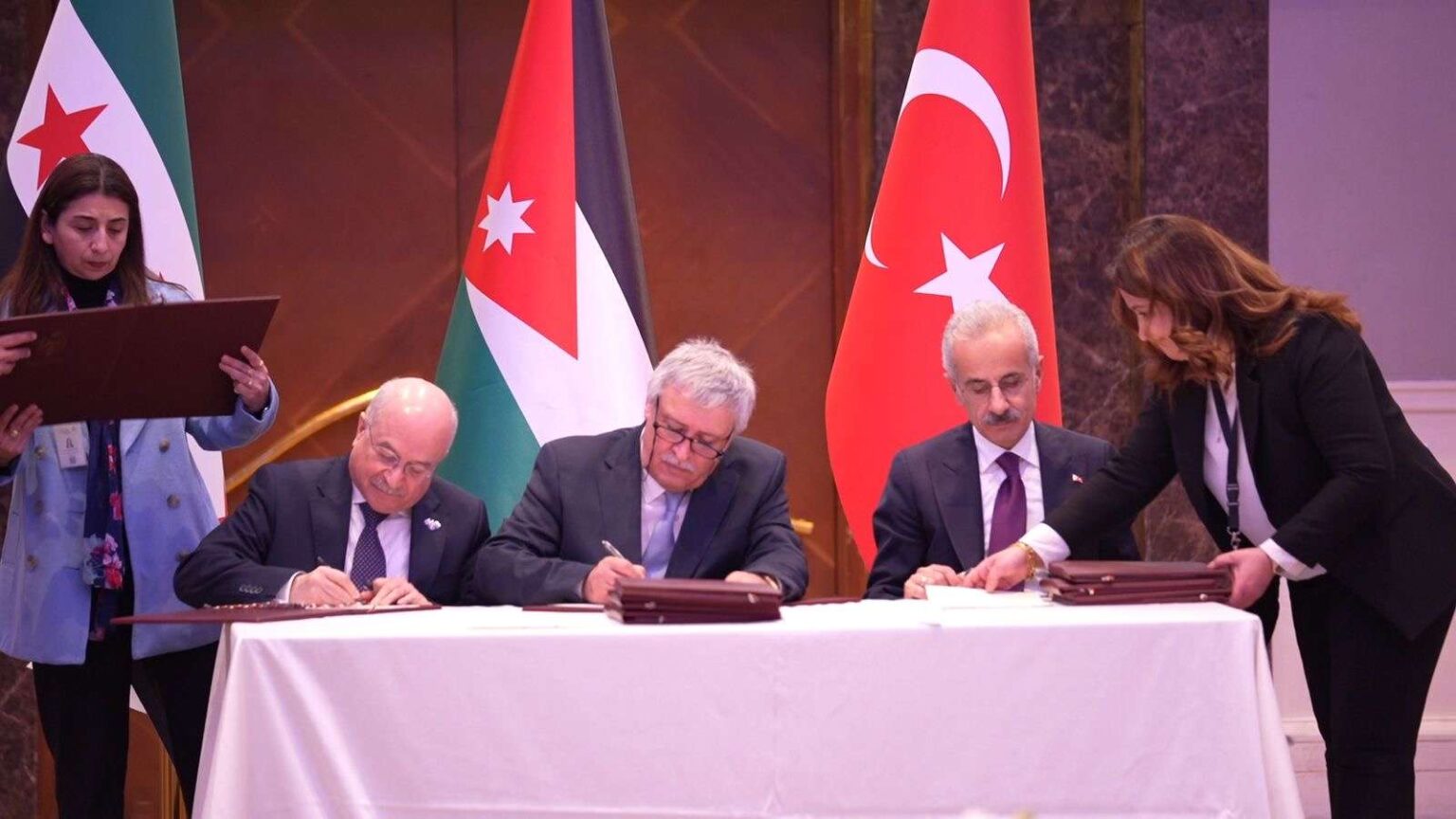
The Syrian Future Movement warmly and deeply welcomes the signing of the tripartite Memorandum of Understanding between the Syrian Arab Republic, the Hashemite Kingdom of Jordan, and the Republic of Turkey, for the development of an integrated regional transportation system. This memorandum was signed on April 7, 2026, in Amman, under the auspices of the Ministers of Transport of the three countries.
The Syrian Future Movement views this memorandum as more than just a sectoral agreement. We see it as a strategic declaration of intent to rebuild Syria’s role as a vital link between North and South, and to transform borders from obstacles into bridges for development and integration.
This path aligns directly with our vision, which has long advocated for liberating the Syrian economy from its isolation and reconnecting it with its natural regional environment.
The Syrian Future Movement emphasizes that what distinguishes this memorandum is that it does not come in a vacuum, but rather embodies a set of principles and policies that the Syrian Future Movement has previously advocated and documented in its official statements, most notably:
- “The Plan for Developing the Freight Transport Sector in Syria” (dated August 13, 2025):
In this statement, we affirmed that developing the freight transport sector is a true test of the state’s ability to build effective and transparent institutions, and we called for the introduction of digital technologies and the activation of partnerships with the private sector.
Today, we see these principles reflected in the memorandum of understanding, which focuses on digitalization, streamlining regulations, and engaging the private sector in dialogue. - “The Implications of Decision No. 31 Issued by the General Authority for Ports and Customs” (dated February 22, 2026):
In that statement, we warned that any successful national economic policy requires a delicate balance between strategic objectives and operational stability. While we advocated at the time for a gradual approach to protect supply chains and local prices, today we see in the trilateral memorandum a complementary and ambitious vision for enhancing regional trade integration without harming current economic stability—a vision we have been calling for. - “The Syrian Future Movement Welcomes the Meeting Between the Turkish Foreign Minister and the Syrian Administration” (December 22, 2024):
We affirmed then that the success of the transitional phase in Syria is a shared interest of both Syria and Turkey, and the importance of balanced cooperation between the two countries.
We see this memorandum of understanding as a practical translation of that cooperation, and a confirmation that the Syrian-Turkish relationship is capable of transcending the past towards a strategic economic partnership that serves both peoples.
The Syrian Future Movement sees three major strategic opportunities in this memorandum of understanding:
- The first opportunity (strengthening the geopolitical position): Activating the Middle East Corridor through the three countries, which is expected to be fully operational within three years, will bring about a qualitative transformation in the regional economic landscape and restore Syria’s historical role as a land bridge between Europe, Asia, and the Arabian Gulf.
- The second opportunity (infrastructure development): Reviving and modernizing the railway network, particularly the Hejaz Railway project, and rehabilitating missing links to ensure smooth traffic flow from Anatolia to the port of Aqaba and the Arabian Gulf, is an investment in the future of sustainable transport.
- The third opportunity (increasing trade): The projected 185% growth in trade between Jordan and Syria by 2025 and the resumption of Jordanian truck crossings into Turkey are positive indicators that promise a significant economic return from this agreement.
However, given that the Syrian Future Movement adopts a critical and objective perspective, we see the need to highlight three key challenges:
- The challenge of rapid implementation versus the scale of the projects: Establishing a practical roadmap is an achievement, but translating it into tangible, on-the-ground projects, given limited resources and bureaucratic inefficiencies, will be the greatest challenge.
Strict and transparent monitoring mechanisms are required. - The challenge of sustainability versus funding: The proposed projects (railways, ports, logistics centers) require massive investments. We believe that efforts should begin immediately to mobilize funding from international institutions and regional development funds, while ensuring that the already strained Syrian economy is not burdened with additional costs.
- The challenge of equitable distribution of benefits: The benefits of this corridor should not be limited to border regions or major cities, but should extend to the interior provinces via supporting road networks, to guarantee comprehensive development and prevent the creation of new regional disparities.
Based on the above, the Syrian Future Movement calls for:
- The swift formation of joint technical committees and the establishment of binding timelines for implementing the memorandum’s provisions, with the participation of independent economic and logistical experts.
- Ensuring full transparency in the procedures, publishing periodic progress reports, and making them available for public and institutional oversight.
- The immediate commencement of the necessary studies for repairing and rehabilitating Syria’s damaged infrastructure, in cooperation with the private sector and international investors, to ensure Syria’s readiness to play its pivotal role in this corridor.
- This memorandum should serve as a model for multilateral regional cooperation, and its scope should be expanded later to include other countries such as Iraq and Saudi Arabia, to strengthen the concept of “grand economic integration.”
The Syrian Future Movement believes that building a new Syria requires its reintegration into its regional environment as an active and influential partner.
We believe that this memorandum of understanding is a step in the right direction, but it requires sustained political will, diligent follow-up, and public oversight to ensure that its promises are translated into tangible realities that improve the lives of Syrians and revitalize the national economy.