Executive Summary:
The dialectical relationship between politics and economics is a central focus of international political economy (IPE) theories.
This study aims to analyze how economic diplomacy can be employed to support reconstruction and stability.
The study uses President Ahmad al-Sharaa’s visit to Berlin (March 30, 2026) and London (March 31, 2026) as a case study.
The findings reveal that this visit represents a promising model for balanced economic diplomacy, while emphasizing the need for comprehensive internal reforms to ensure its sustainability.
Introduction:
Following the fall of Bashar al-Assad’s regime in December 2024 and the assumption of the presidency of the interim government by President Ahmad al-Sharaa, Syria entered a complex transitional phase requiring comprehensive political and economic reconstruction.
In this context, the dialectical relationship between politics and economics emerges as a fundamental axis determining a state’s capacity for recovery and international integration.
This study employs a theoretical framework that integrates realism, liberalism, and a critical perspective in international political economy, with a focus on the concept of economic diplomacy.
The visit of President al-Sharaa to Berlin and London at the end of March 2026 is a significant case study, revealing the possibilities and challenges of this diplomacy in light of declining Iranian influence and regional geopolitical shifts.
Theoretical Framework – The Interplay Between Politics and Economics:
Realist theory (Morgenthau, 1948; Mearsheimer, 2001) asserts that states strive to maximize their power in an anarchic international system, and that economic resources are a crucial tool for enhancing political and security influence.
Liberal theory (Keohane & Nye, 1977; Nye, 2004), on the other hand, views economic interdependence as an opportunity for “commercial peace,” with the potential to be used as a tool for political pressure.
Conversely, the critical perspective (derived from Marxist political economy) sees the economy as the basic structure that determines the political superstructure, with international conflicts reflecting contradictions over control of markets and resources (Strange, 1988). This dilemma is clearly evident in the Syrian context. Political stability (building inclusive institutions, guaranteeing minority rights, combating terrorism, and promoting inclusivity) is a prerequisite for attracting investment, while economic recovery is essential for strengthening political legitimacy and reducing internal tensions.
The Syrian Economic Reality – Reconstruction Challenges:
According to the World Bank report issued on October 21, 2025, on assessing physical damage and reconstruction (2011-2024), reconstruction costs range between US$140 billion and US$345 billion, with a conservative best estimate of US$216 billion.
This estimate is broken down as follows: US$75 billion for residential buildings, US$59 billion for non-residential buildings, and US$82 billion for infrastructure.
This figure is equivalent to approximately ten times the projected GDP for 2024, with the economy having contracted by more than 50% since the beginning of the conflict.
These figures highlight the urgent need for proactive economic diplomacy capable of attracting investment and breaking the international isolation imposed by previous sanctions.
Economic Diplomacy – Concept and Importance in Transitional Phases:
Economic diplomacy is defined as the use of economic tools (trade, foreign direct investment, development aid, sanctions) to achieve foreign policy objectives, or the use of political diplomacy to advance economic interests (van Bergeijk, 2011; Okano-Heijmans, 2013).
Its areas include negotiating trade agreements, attracting foreign investment, and exercising economic statecraft.
In countries emerging from conflict, this diplomacy becomes a vital tool for reintegration into the global economy.
In the Syrian case, the European Union’s lifting of most economic sanctions on May 28, 2025 (following a political decision on May 20, 2025, while maintaining security exemptions) was a significant positive step that opened new avenues for cooperation.
President Ahmad al-Sharaa’s Visit to Berlin and London:
President Ahmad al-Sharaa’s visit to Berlin on March 30, 2026, followed by his visit to London on March 31, 2026, represents a practical model of Syrian economic diplomacy.
The visit came after the lifting of most European sanctions and focused on three main axes: reconstruction, the return of refugees, and economic partnerships in the energy and infrastructure sectors.
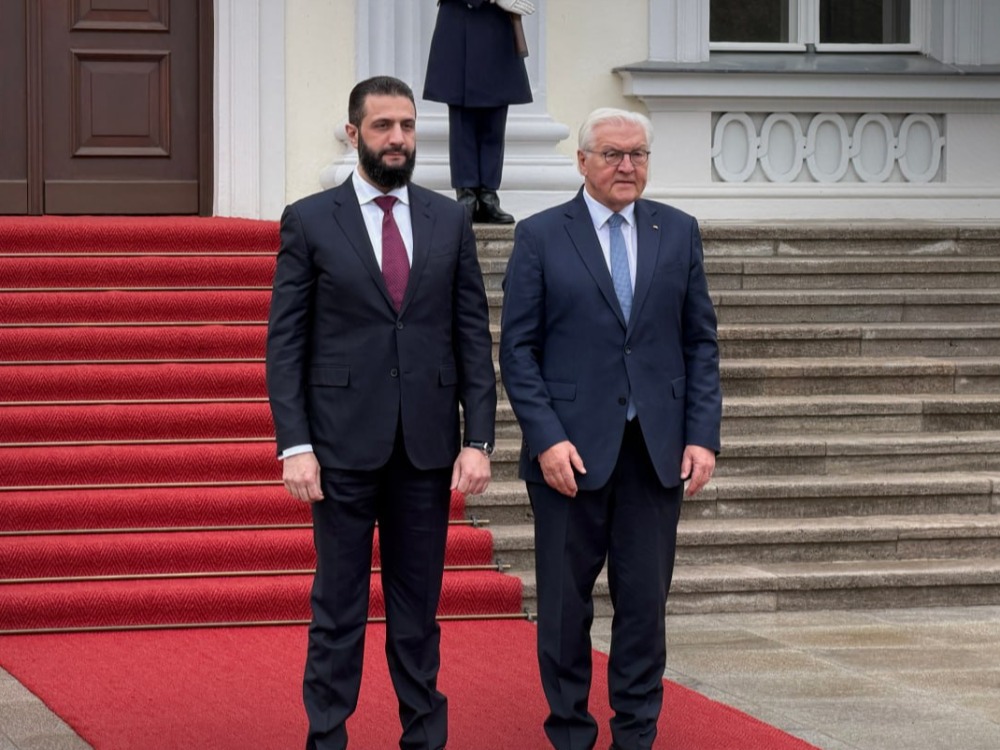
In Berlin, President al-Sharaa met with President Frank-Walter Steinmeier and Chancellor Friedrich Merz, and participated in a Syrian-German economic roundtable with Foreign Minister Johann Wadephul.
Chancellor Merz confirmed that approximately 80% of Syrians residing in Germany (around 700,000-900,000 people) are expected to return within the next three years, with priority given to those without legal residency or those who have committed crimes.
The visit also included discussions on potential energy agreements with German companies such as Siemens Energy.
In London, the visit came in the context of previous British support packages, including a £94.5 million package announced in July 2025 to support humanitarian relief and long-term recovery (education and livelihoods).
The metaphorical question arises here: “How to eat the European shoulder?” This reflects the constructive competition between Berlin (focusing on stability and the return of refugees to alleviate internal burdens) and London (focusing on trade and development partnerships).
Therefore, Europe will benefit from Syria’s strategic location as an alternative energy corridor, especially given the decline of Iranian influence, while Syria will benefit from diversifying its international partners.
Syrian diplomacy also emphasizes a balanced approach that maintains relations with Russia and Arab states (especially the Gulf states) while opening avenues for cooperation with the West.
This balance will enhance economic independence and capitalize on regional geopolitical shifts.
Challenges and Recommendations:
Despite promising opportunities, the transitional phase faces structural challenges, including ensuring inclusivity and
Transparency in governance, addressing human rights concerns (especially those raised by Kurdish groups during the visit to Berlin), and translating diplomatic promises into tangible investments are essential.
Furthermore, linking foreign aid to fundamental internal reforms is crucial to avoid the risks of dependency or the re-emergence of previous centralized systems.
Therefore, the Economic Bureau of the Syrian Future Movement recommends the following:
- Strengthening institutional and legal reforms to create a transparent and attractive business environment.
- Developing a national reconstruction strategy focused on “building back better” with broad participation from local communities and minorities.
- Maintaining external balance while strengthening partnerships with Arab and Asian countries to reduce reliance on a single axis.
- Developing transparent monitoring mechanisms for the use of international aid.
Conclusion:
President Ahmed al-Sharaa’s visit to Berlin and London demonstrates that economic diplomacy can transform the tension between politics and economics into a strategic opportunity during Syria’s transitional phase.
By continuing comprehensive internal reforms and maintaining external balance, Syria can transition from conflict to sustainable development, leveraging its geostrategic location and the decline of Iranian influence.
This model also represents a significant step toward Syria’s reintegration into the international system based on shared interests and mutual respect.
References:
- Council of the European Union. (2025, May 28). Syria: EU adopts legal acts to lift economic sanctions on Syria. https://www.consilium.europa.eu/en/press/press-releases/2025/05/28/syria-eu-adopts-legal-acts-to-lift-economic-sanctions-on-syria-enacting-recent-political-agreement/
- Keohane, R. O., & Nye, J. S. (1977). Power and interdependence: World politics in transition. Little, Brown.
- Mearsheimer, J. J. (2001). The tragedy of great power politics. W.W. Norton & Company.
- Morgenthau, H. J. (1948). Politics among nations: The struggle for power and peace. Alfred A. Knopf.
- Okano-Heijmans, M. (2013). Economic diplomacy: Japan and the balance of national interests. Martinus Nijhoff Publishers.
- Strange, S. (1988). States and markets. Pinter Publishers.
- van Bergeijk, P. A. G. (2011). Economic diplomacy: The art and science of economic persuasion. In P. A. G. van Bergeijk, M. Okano-Heijmans, & J. Melissen (Eds.), Economic diplomacy: Economic and political perspectives (pp. 1-12). Martinus Nijhoff Publishers.
- World Bank. (2025, October 21). Syria’s post-conflict reconstruction costs estimated at $216 billion. https://www.worldbank.org/en/news/press-release/2025/10/21/syria-s-post-conflict-reconstruction-costs-estimated-at-216-billion
- UK Government. (2025, July 5). UK re-establishes diplomatic relations with Syria. https://www.gov.uk/government/news/uk-re-establishes-diplomatic-relations-with-syria-in-first-ministerial-visit-for-14-years