
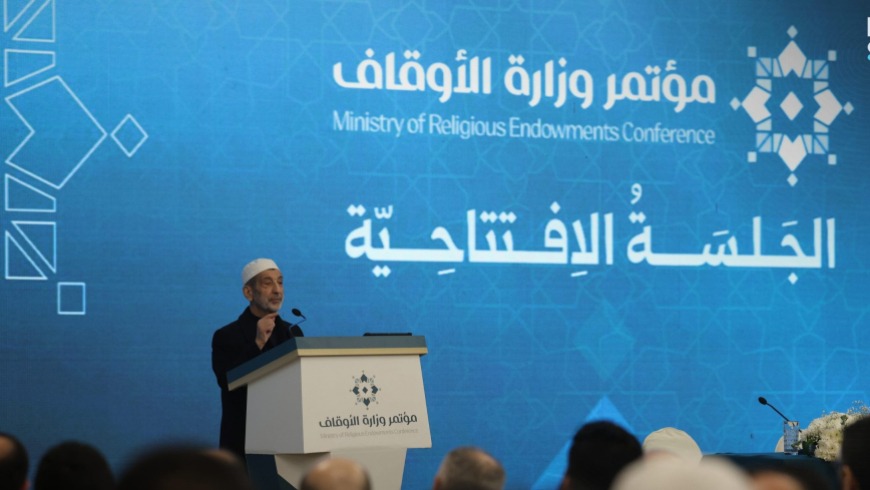
The Religious Affairs Office of the Syrian Future Movement followed with great interest the launch, on Sunday, February 15, 2026, of the Syrian Ministry of Religious Endowments’ first conference since the liberation, entitled “Unity of Islamic Discourse,” under the slogan “A Bond Among Its People.” The conference was held under the auspices of the Presidency of the Republic and the Supreme Fatwa Council, and in the presence of the Minister of Religious Endowments, Dr. Muhammad Abu al-Khair Shukri, the Minister of Justice, the President’s Advisor for Religious Affairs, Sheikh Abdul Rahim Atoun, the Head of the Fatwa Council, and more than 150 religious figures from various governorates, at the Damascus Conference Palace.
The Syrian Future Movement notes that, according to official statements, the conference aims to formulate a comprehensive charter/reference document that promotes moderation and centrism, reduces differences between schools of Islamic jurisprudence and preaching, and restores the religious institution’s role in strengthening coexistence and civil peace. This will be achieved through two phases:
Preliminary workshops in the governorates (14 workshops) for analysis and consultation.
Then, central workshops to approve the final charter at a general forum expected to draw more than 1,500 participants.
The Syrian Future Movement appreciates the positive intentions declared in this initiative, as unifying religious discourse on the basis of moderation and centrism is a national necessity during this sensitive transitional phase. It helps overcome the effects of past polarization, strengthens coexistence among the various components of the Syrian people, and contributes to confronting the discourse of extremism and hatred that has harmed society.
The Syrian Future Movement appreciates the organizational effort in engaging religious figures from different regions and emphasizing that unity does not negate diversity but rather manages it wisely.
The Syrian Future Movement believes that the initiative faces fundamental challenges and potential drawbacks that must be addressed responsibly. These include:
- The initiative’s issuance and organization by a governmental executive body (the Ministry of Religious Endowments) raises legitimate questions about the independence of religious scholars and institutions. It may be interpreted as an attempt to impose centralized control over religious discourse, reminiscent of past historical experiences that led to restrictions on scholarly and preaching freedom.
- The lack of clarity so far regarding the implementation mechanisms raises questions about whether the charter will be binding and whether it will be imposed on independent preachers and religious leaders. How can we ensure that oversight doesn’t devolve into censorship or the exclusion of dissenting opinions?
- The limited inclusiveness evident in the initial phase, where official and institutional presence predominates, may lead some independent scholars and preachers, or those outside the government framework, to feel marginalized.
The Syrian Future Movement, through its Religious Office, calls for addressing these challenges through the following steps:
- Transforming the charter into a consensus document emerging from a broad, participatory dialogue that includes independent scholars and preachers, and representatives from various schools of Islamic jurisprudence and advocacy, free from direct executive oversight.
- Guaranteeing the complete academic independence of scholars, emphasizing the charter’s advisory and recommendation-based nature, without linking it to administrative or punitive measures.
- Opening public participation in the central workshops and the concluding forum to include diverse voices, with transparent mechanisms for receiving suggestions and objections.
- Linking efforts to broader national objectives: strengthening civil peace, protecting religious freedoms, and supporting coexistence among all communities without bias.
The Syrian Future Movement affirms its commitment to supporting any sincere effort that promotes moderation and national unity, and keeps the door open for constructive dialogue with the concerned parties, believing that religion in the future Syria should be a factor of unification and stability, and never a tool of control or exclusion.