
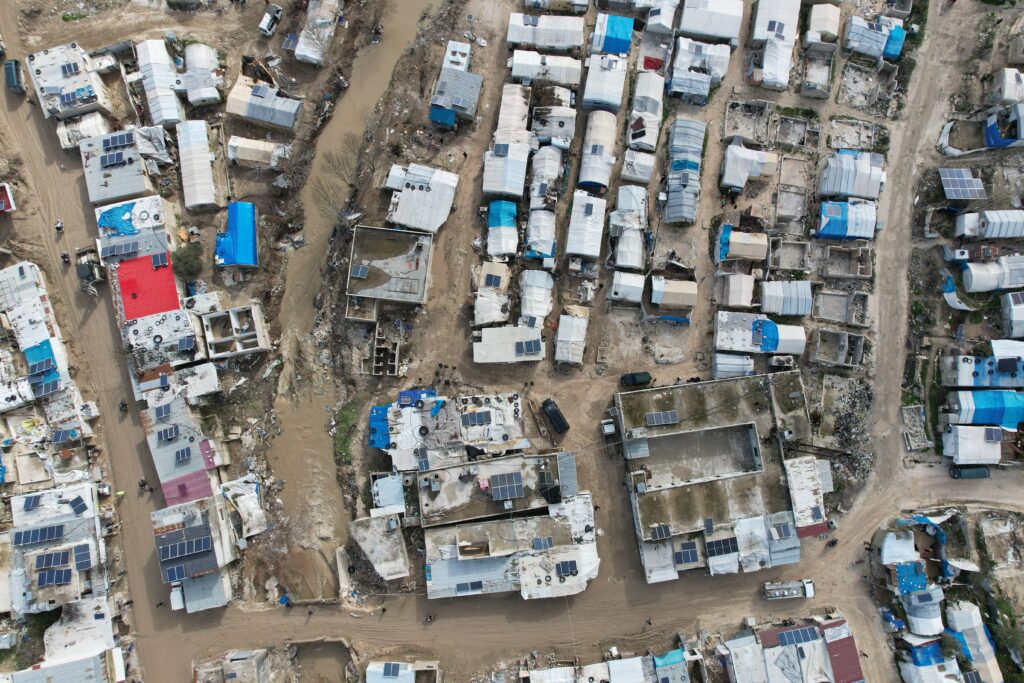
The Syrian Future Movement welcomes the official announcement by the Director of Social Affairs in Idlib to close all camps by the end of 2026 and return services to the central administration, as well as the discussions in Aleppo Governorate regarding mechanisms for the return of families and the “Zero Tent” initiative. The Syrian Future Movement views these two steps as part of a comprehensive national campaign to end the chronic displacement crisis and restore administrative sovereignty in northern Syria.
The Syrian Future Movement reiterates its previous statement, “The Syrian Network for Human Rights’ Appeal to Support Camps Affected by Floods,” issued on February 9, 2026, in which it reaffirmed its commitment to supporting the rights of displaced persons and called for comprehensive political solutions that guarantee a safe and sustainable return, with a focus on basic services and compensation following natural disasters.
The Syrian Future Movement appreciates these developments as the culmination of the transitional government’s efforts to unify administration across the northern governorates. Idlib encompasses approximately 1,150 camps housing one million displaced persons, while Aleppo is hosting thousands of families in the “A Homeland Without Tent” campaign. This will eliminate the parallel economy within the camps and enhance social stability during the reconstruction phase.
The Syrian Future Movement calls for the launch of a unified national program, “Syria Without Tents,” to encompass hundreds of thousands of displaced people in Idlib and Aleppo. This program should focus on the reconstruction of damaged villages, subsidized housing, and centralized health and education services, with accurate databases and priority given to families affected by floods and storms.
The Syrian Future Movement emphasizes the formation of joint transitional committees comprising representatives from the central government, local administrations, and civil society. These committees would oversee the lockdown, ensure transparent aid distribution, address grievances, and compensate for losses, while involving residents in the planning process, as demonstrated in successful debris removal campaigns.
The Syrian Future Movement advocates for long-term development plans that link the lockdown to small-scale agricultural and industrial projects in rural Idlib and Aleppo. These plans aim to provide sustainable employment opportunities and prevent setbacks, while mobilizing targeted international support from the Saudi Development Fund and other partners, such as the United Nations, for funding and monitoring.
The Syrian Future Movement urges the Syrian transitional government to adopt this vision as a political framework, to transform the closure of the camps into a national project that reshapes the future of Syria, stressing its full commitment to supporting every effort that consolidates the unity of the land and the people to build a stable and prosperous Syria with strong institutions.