

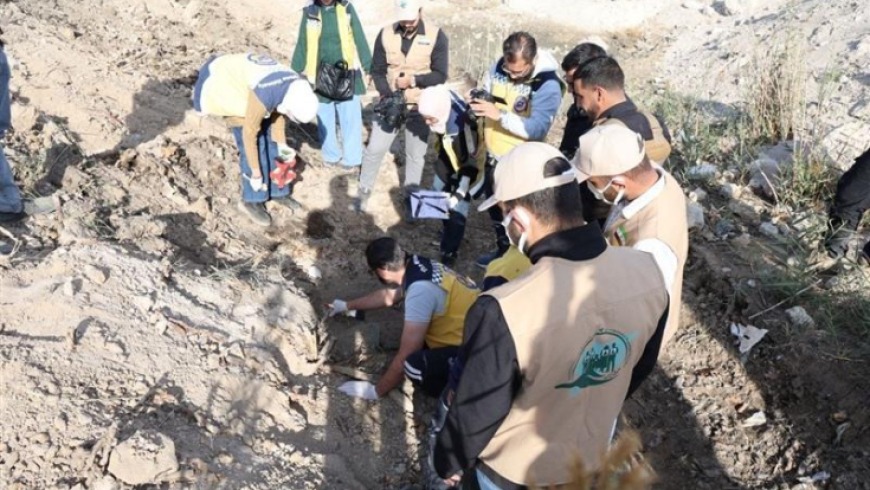
The Syrian Future Movement strongly supports the warning issued by the National Commission for Missing Persons on Tuesday, January 20, 2026, urging residents of Raqqa, Hasakah, and Deir ez-Zor governorates to refrain from approaching or tampering with sites suspected of containing unidentified remains or mass graves. We believe this warning aligns with national efforts to preserve forensic evidence and the dignity of victims, and protects the process of uncovering the fate of thousands of missing and forcibly disappeared persons resulting from the years-long Syrian war. We also consider this step a crucial move towards achieving transitional justice and national reconciliation, in accordance with international laws such as the Geneva Conventions and their protocols related to the protection of victims in armed conflicts.
The Syrian Future Movement affirms that the issue of missing persons represents a deep wound in the fabric of Syrian society, as thousands of families suffer from the uncertainty surrounding the fate of their loved ones. We support the Commission’s emphasis on the immediate reporting of any suspicious sites through its official channels, and we warn against any unauthorized interference, which exposes perpetrators to legal accountability and constitutes a violation of the dignity of victims. We believe this approach strengthens trust in national institutions and contributes to rebuilding the state on the foundations of transparency and accountability.
The Syrian Future Movement emphasizes that this warning is consistent with international obligations under international humanitarian law, including the 1949 Geneva Conventions and their Additional Protocols, which mandate the protection of bodies and graves during times of conflict. It also reflects recent agreements signed by the movement with international organizations such as the International Committee of the Red Cross and the International Commission on Missing Persons, aimed at unifying efforts and enhancing effectiveness in determining the fate of missing persons. We further stress that, in light of the political transition in Syria following the fall of the former regime, these efforts must be part of a comprehensive transitional justice process that ensures accountability for perpetrators and reparations for victims.
The Syrian Future Movement sees this crisis as an opportunity to build a system that protects human rights and prevents the recurrence of violations. Inspired by the experiences of other countries that have successfully dealt with the legacy of conflict, we recommend the following:
- Strengthening protection and detection, drawing on the Bosnian experience in Srebrenica, where mass graves were protected through international cooperation with the International Criminal Tribunal for the former Yugoslavia (ICTY), leading to the identification and dignified reburial of thousands of remains.
- We recommend forming specialized joint teams with international organizations to map suspected sites in northeastern Syria and ensuring their protection through strict national laws that prevent unauthorized interference, as outlined in the Bournemouth Protocol on the Protection and Investigation of Mass Graves.
- Investigating and identifying remains, as in the Rwandan experience, where the International Criminal Tribunal for Rwanda (ICTR) assisted in investigating mass graves, focusing on forensic evidence, which contributed to national reconciliation.
- We also recommend adopting modern technologies such as DNA analysis and digital data, in collaboration with international experts, to quickly and accurately identify victims, as Argentina did with its forensic anthropology team that identified thousands of missing persons from the dictatorship era.
The return of remains and remembrance, as happened in Iraq, where an agreement was signed with Iran to exchange remains after the 1980-1988 war, leading to the return of thousands of bodies to their families. Therefore, we see the necessity of establishing mechanisms for the return of remains to families while respecting religious and cultural traditions, and establishing memorial sites, as in Rwanda, to promote transparency and reconciliation, along with providing psychological support to families.
Justice and reconciliation, as in the experiences of countries like Argentina and Bosnia, where investigations into mass graves led to holding perpetrators accountable and strengthening peace.
We recommend integrating these efforts with transitional justice processes in Syria, including fair trials and reparations, to prevent impunity and ensure that violations are not repeated.
The Syrian Future Movement calls on the Syrian government and the international community to implement these recommendations while strengthening cooperation with the National Commission for Missing Persons.
We also call on all Syrians to heed this warning, as preserving the dignity of victims is a fundamental step towards the future of Syria.