Introduction:
Over the past two decades, Syria has witnessed profound transformations in its position within regional and international drug trafficking networks. It has gradually shifted from being a traditional transit route for certain types of smuggling to one of the most prominent centers for the production and export of stimulants, primarily Captagon, within a highly fragile political, security, and economic environment.
During Bashar al-Assad’s rule, a quasi-institutional structure for the illicit drug economy emerged, transforming this trade from a marginal activity into an alternative economic driver, particularly in light of international sanctions and the collapse of traditional productive sectors.
With the fall of the regime in December 2014, this system entered a phase of disintegration and restructuring. The centralized monopoly structure collapsed, new patterns of horizontal network expansion emerged, and the weight of exports declined in favor of the domestic market. This shifted the drug threat from a regional one to a domestic social threat.
This paper aims to provide a comparative analytical reading of the reality of drug trafficking and use in the pre- and post-Saddam periods, relying on reliable open sources, international reports, primary government data, and partial field indicators, using a descriptive-analytical-comparative approach.
Methodology and Research Limitations:
The study employs a descriptive and comparative analytical approach, through:
- Analysis of international reports issued by research institutions and specialized UN bodies.
- Review of official data issued by security and health authorities in Syria during 2025.
Reliance on previous studies on the drug economy in conflict zones. - Comparison of indicators between the two periods to illustrate structural and behavioral transformations.
Research Limitations:
- The difficulty in obtaining complete official statistics during the period of conflict and political transition.
- The varying ability to verify figures in an environment suffering from institutional weakness.
- Partial reliance on approximate estimates for some indicators, which are presented in an analytical format limited by the temporal and geographical scope of the study.
Literature Review:
The literature on war economics and fragile states indicates that protracted conflicts reshape the formal economy into an alternative economy based on illicit activities, from smuggling valuable goods to drugs and weapons. In the case of drugs, several countries have employed the “narco-state” model during their conflicts, as in Afghanistan (opium) and Colombia (cocaine).
In Syria, New Lines Institute reports have documented the country’s transformation into a major hub for the production and export of Captagon during the war, with military units such as the Fourth Division establishing an organized drug manufacturing infrastructure to provide alternative resources in light of sanctions and the collapse of the formal economy. (New Lines Institute, 2024–2025) The literature suggests that the collapse of the central state reshapes the illicit economy into small, decentralized networks that are difficult to trace or hold accountable, a pattern that aligns with the post-2024 transformations in Syria.
The Pre-Fall Phase (2011–2024):
In this phase, the illicit economy, operating under a state virtually integrated with smuggling networks, transformed drugs into one of the most significant resources of the illicit economy. These drugs became linked to certain centers of power within the state and security apparatus, bringing the regime closer to being described as a “state sponsor of the illicit economy.”
- Production Patterns:
The production of Captagon and other amphetamines was concentrated in the Qalamoun region and the western Damascus countryside, the Latakia and Tartus countryside, and border areas adjacent to Lebanon. New Lines Institute estimates that the value of annual Captagon exports ranged between $5 billion and $10 billion during 2018–2023. - Distribution and Smuggling Channels:
Seaports, land crossings into Jordan and Iraq, and commercial maritime routes were utilized. Large seizures were recorded, such as the one at the Italian port of Salerno (2020), with an estimated value of approximately €1 billion. - Domestic Use:
Although export was the primary objective, partial data indicates a gradual increase in drug use among young people, with estimated rates ranging from 18% to 25% for the 18-35 age group in the most vulnerable areas.20
Post-Fall Phase (2025):
This phase is characterized by fragmentation, decentralization, and a shift of the threat inward. The collapse of central authority led to the disintegration of the previous monopoly system and the emergence of small networks operating with limited resources but with wider horizontal reach.
- Decline in Centralized Production:
Captagon production decreased by 60% to 70% compared to its peak, due to the destruction of major factories, the absence of organized protection, and increased security crackdowns. - Market Shift:
The domestic market became the main source of profit, with lower prices, increased availability of drugs, and rising rates of use among young people (estimated at 30% to 35% in the most vulnerable areas). - Escalating Drug-Related Violence:
Competition among small networks has led to an increase in localized conflicts and the emergence of small-time dealers, with drug-related crimes rising by approximately 40% compared to 2023. - The State’s Response:
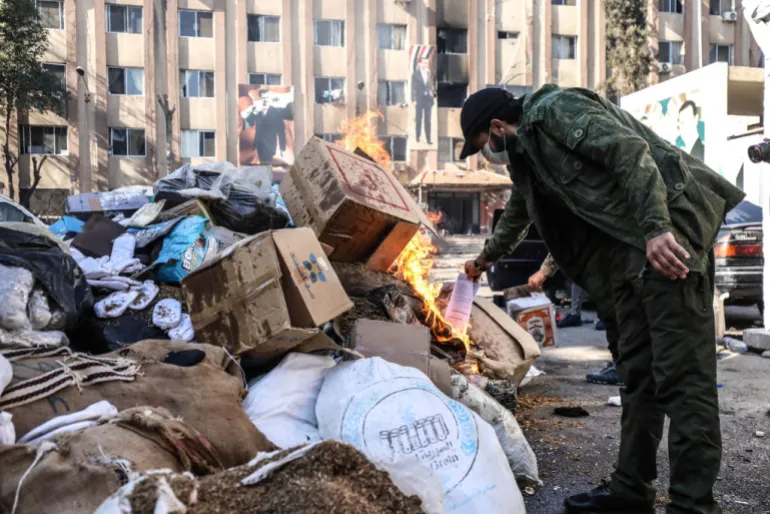
Authorities conducted raids and seized millions of narcotic pills and renewed cooperation with Jordan and Iraq. However, limited resources and the vast geographical area affected hampered the effectiveness of complete deterrence.
Analytical Comparison
Pre-2024: Organizational structure was centralized and semi-monopolistic, with exports, high prices, and both formal and informal structures controlling the market. Violence was selective and limited, and the social impact was relatively small.
Post-2024: Organizational structure is decentralized and fragmented, the market is characterized by increasing domestic consumption, local competing networks control the market, prices are relatively low, violence is more widespread, and the social impact is broad and socially destructive.
Conclusion:
The fall of the Assad regime did not end the drug economy; rather, it reshaped it into less organized local networks, posing a greater threat to youth and civil society.
The current challenge represents a more profound social and health risk than previous threats and necessitates a comprehensive strategy. We at the Syrian Future Movement recommend that this strategy include:
- Strengthening security and enforcement capabilities.
- Treatment and rehabilitation programs, along with providing psychosocial support.
- Addressing poverty and unemployment and engaging youth in positive alternatives.
- Involving civil society in monitoring and oversight.
The success of the new Syrian state will be measured not only by its ability to control territory but also by its capacity to protect future generations from the effects of chaos and the illicit economy.
References:
- New Lines Institute. Captagon in 2024: Implications After the Fall of the Syrian Regime. 2025. Link
- New Lines Institute. Shedding Light on Drug Use Patterns in Syria. 2024.
- European Monitoring Centre for Drugs and Drug Addiction (EMCDDA). Annual Report 2021.
- United Nations Office on Drugs and Crime (UNODC). Regional Drug Report 2023.
- International Crisis Group (ICG). Middle East Update, Nov 2025.
- Ledgerwood, E., & Robinson, P. Illicit Economies in Post-Conflict Zones. 2020.
- Collier, P., & Hoeffler, A. Greed and Grievance in Civil Wars. Oxford University Press, 2007.
- Elliott, J. Narco-States and International Security. Routledge, 2013.